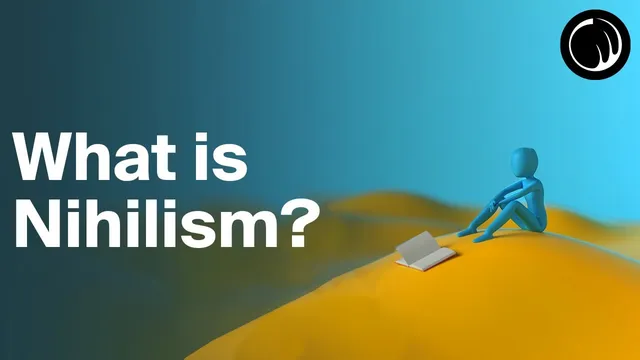
Don’t Believe in Anything - The Philosophy of Nihilism
Based on Pursuit of Wonder's video on YouTube. If you like this content, support the original creators by watching, liking and subscribing to their content.
Existential nihilism is framed as the claim that life has no intrinsic meaning or value and that the universe is indifferent to humanity.
Briefing
Existence may be indifferent and human life may lack intrinsic meaning—but several 19th and 20th century thinkers argue that people can still respond without surrendering to despair. The central tension running through the discussion is straightforward: if the universe offers no built-in “why,” then meaning must either be manufactured, embraced as absurd, or replaced through a leap of faith. That matters because nihilism isn’t just a bleak idea; it’s presented as a modern pressure point created by the erosion of traditional religious and rational foundations.
The argument begins with a sweeping origin story for nihilism. The term is traced to 19th-century philosopher Friedrich Heinrich Jacobi, who used it to criticize Enlightenment rationalism and transcendental idealism—especially the way rational explanation could hollow out religion and devalue the self. Cultural visibility arrives later through Ivan Turgenev’s 1862 novel Fathers and Sons, where the label is tied to a generation’s cynicism toward authority and tradition. From there, nihilism becomes associated with Russian revolutionary currents, though that earlier version is described as more about destroying and re-evaluating inherited ideals than denying ethics or meaning outright.
Modern existential nihilism is then defined in sharper terms: human life has no intrinsic meaning or value; values and purposes are baseless; and the universe is chaotic, indifferent, and fundamentally unconcerned with humanity. Friedrich Nietzsche is framed as a key diagnostician of the “death of God,” predicting that the collapse of external sources of meaning would leave people without an ultimate basis for purpose. As knowledge about the universe expands, the discussion claims, humans feel increasingly distant from any cosmic relevance—so nihilism “wedges” into everyday being.
Several responses are offered as partial remedies rather than final solutions. Søren Kierkegaard is presented as insisting that meaning remains possible, but only through a leap beyond rational comprehension—most directly into Christian faith, though the leap can be generalized to any passionate belief that goes past logic. Nietzsche’s own split between passive and active nihilism is offered as a more secular strategy: passive nihilism treats meaning as impossible and becomes self-terminating, while active nihilism uses the “negative space” left by collapsing ideals to create new, authentic purposes.
Existentialism and absurdism shift the emphasis from discovering meaning to making it livable. Jean-Paul Sartre and Albert Camus accept the premise that life lacks intrinsic meaning, but Sartre places responsibility on individual freedom and self-awareness: people create value through choices and actions. Camus, meanwhile, argues for embracing the absurd—the clash between human longing for meaning and the world’s silence—then responding with revolt: living intensely without consolation. The discussion also raises a critique: if there’s no clay, can people truly sculpt a world of meaning, or does “imagining” become insufficient for those who want something objective and durable?
The closing position lands on uncertainty. Despite major human achievements in medicine, technology, and understanding nature, the discussion claims humanity still lacks a robust answer to why we are here. The proposed interim stance is “agnostic nihilism”: neither denying indifference nor claiming certainty about a grand purpose, while leaving open the possibility that a new philosophy—or even a new synthesis of meaning—could emerge without blind faith or self-deception.
Cornell Notes
The discussion frames nihilism as a modern outcome of weakened religious and rational foundations, culminating in existential nihilism: life has no intrinsic meaning, and the universe is indifferent. It traces the term’s roots from Friedrich Heinrich Jacobi’s critique of Enlightenment rationalism to later cultural adoption through Ivan Turgenev, then distinguishes earlier Russian nihilism from today’s broader philosophical version. Responses are grouped around Kierkegaard’s leap of faith, Nietzsche’s split between passive (self-destructive) and active (creative) nihilism, and existentialism/absurdism’s insistence that meaning must be created or lived through revolt. The unresolved question is whether subjective creation can satisfy the desire for an objective “why,” leading to an “agnostic nihilism” stance for now.
How does the discussion define existential nihilism, and why is it treated as a uniquely modern problem?
What role does Friedrich Heinrich Jacobi play in the term’s history, and how does that differ from later usage?
How does Kierkegaard’s “leap of faith” function as a response to nihilism?
What distinguishes Nietzsche’s passive nihilism from active nihilism?
How do Sartre and Camus each respond to the claim that life lacks intrinsic meaning?
Why does the discussion end with “agnostic nihilism,” and what problem does it highlight for purely subjective meaning?
Review Questions
- Which historical uses of “nihilism” are distinguished from modern existential nihilism, and what’s the key difference in what they deny or preserve?
- Compare Kierkegaard’s leap of faith with Nietzsche’s active nihilism: what each requires people to do when rational foundations collapse.
- What critique is raised against existentialist/absurdist meaning-making, and how does “agnostic nihilism” attempt to address it?
Key Points
- 1
Existential nihilism is framed as the claim that life has no intrinsic meaning or value and that the universe is indifferent to humanity.
- 2
The term “nihilism” is traced from Friedrich Heinrich Jacobi’s 19th-century critique of Enlightenment rationalism to later cultural adoption through Ivan Turgenev’s Fathers and Sons.
- 3
Nietzsche’s passive nihilism is portrayed as self-terminating despair, while active nihilism is portrayed as a creative method for rebuilding values after old ideals collapse.
- 4
Kierkegaard’s response relies on a leap beyond rational comprehension, while existentialism and absurdism rely on freedom, choice, and revolt in the face of meaninglessness.
- 5
A central unresolved tension is whether subjective meaning-making can satisfy the desire for an objective, robust “why.”
- 6
The closing stance—“agnostic nihilism”—keeps both indifference and possible objective significance on the table because certainty remains out of reach.