Don't Suffer More Than Needed | Buddhist Philosophy on Pain and Suffering
Based on Einzelgänger's video on YouTube. If you like this content, support the original creators by watching, liking and subscribing to their content.
Buddhist teaching distinguishes unavoidable pain from optional suffering, arguing that freedom comes from reducing the mind’s reactive layer rather than eliminating pain.
Briefing
Buddhist philosophy draws a sharp line between unavoidable pain and the extra layer of suffering that people often add on top—arguing that freedom comes not from eliminating pain, but from ending the “second arrow” of resistance. Pain is treated as an inherent feature of life: illness, injury, separation, loss of status, and the constant instability of circumstances. Suffering, by contrast, is portrayed as optional—shaped by how the mind reacts to what happens. That distinction matters because it reframes mental health and resilience: even when events can’t be controlled, the degree of inner torment can be reduced.
The core diagnosis is that people become trapped in a cycle driven by attachment and aversion. Life’s unpredictability is captured through the “Eight Worldly Winds”: pleasure and pain, gain and loss, praise and blame, fame and disrepute. Most people chase the first half of each pair and try to outrun the second. But this strategy makes inner tranquility dependent on external conditions, so the mind becomes vulnerable to every reversal. When gain arrives, it’s treated as proof of safety; when loss follows, it triggers rebellion. When praise turns to blame, the same attachment flips into resentment. The result is a persistent sense of insecurity—fear of losing what’s held dear and dread of what’s avoided.
Buddhist teaching also challenges the idea that avoiding discomfort solves the problem. Social anxiety becomes an example: fear of social interaction can lead to avoidance, yet avoidance doesn’t erase the underlying fear and may intensify it. The mind stays on alert, anticipating the next encounter, until life feels like waiting in a locked cell. The philosophy’s practical alternative is to stop treating every unpleasant event as the whole story.
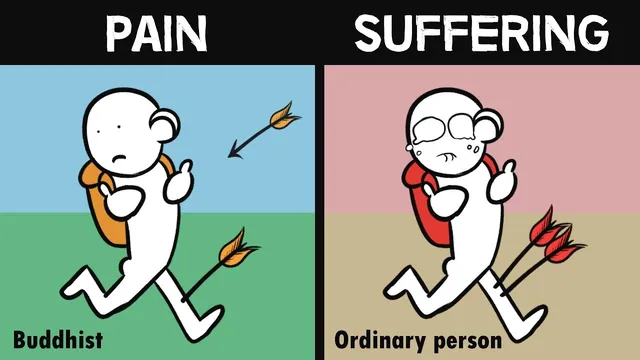
A parable illustrates the mechanism: an arrow strikes first—painful, often unavoidable circumstances like being cut off in traffic, insulted, or betrayed. Then a second arrow arrives—suffering created by reaction, such as outrage, rumination, self-blame, and despair. The first arrow is the event; the second arrow is the mental and emotional aftermath that lands “in the same spot,” multiplying harm. Even anxiety follows this pattern: the sensation may come and go, but resistance to it can escalate the experience into a loop—worry about worrying.
Relief begins with awareness. Buddhism places “space” between the first and second arrow, insisting that the second arrow is optional. Meditation and mindfulness are presented as tools for noticing anger, resentment, and excessive worry as consequences rather than the event itself—then choosing to release them. The teaching also leans on impermanence: clinging to pleasure or demanding stability is compared to grasping water. Enjoyment is not condemned; it’s reframed as possible only when its transient nature is accepted.
The overall aim is transformation—from helplessly drifting with life’s reversals to “sailing” them skillfully. By learning to move with impermanence rather than fight it, people can reduce suffering even while pain remains part of living.
Cornell Notes
Buddhist philosophy distinguishes unavoidable pain from optional suffering, arguing that freedom comes from ending the mental reaction that amplifies hardship. Life’s instability is summarized by the “Eight Worldly Winds” (pleasure/pain, gain/loss, praise/blame, fame/disrepute), and attachment to the pleasant side makes people vulnerable to every reversal. A parable of “two arrows” frames the key mechanism: the first arrow is the event, while the second arrow is the added suffering created by resistance, rumination, and emotional rebellion. Awareness—supported by meditation and mindfulness—creates a gap where the second arrow can be avoided. Acceptance of impermanence helps people enjoy life without demanding it stay fixed, reducing the cycle of fear and despair.
Why does Buddhism treat pain and suffering as fundamentally different?
What are the “Eight Worldly Winds,” and how do they drive suffering?
How does the “two arrows” parable explain why reactions can worsen harm?
Why doesn’t avoidance solve problems like social anxiety in this framework?
What role does awareness play between the first and second arrow?
How does impermanence reduce attachment without eliminating enjoyment?
Review Questions
- How does the “second arrow” differ from the original painful event, and what kinds of mental reactions count as it?
- In what ways do the “Eight Worldly Winds” explain why attachment can increase fear and despair?
- What specific practices (as described) create the “space” needed to choose not to add the second arrow?
Key Points
- 1
Buddhist teaching distinguishes unavoidable pain from optional suffering, arguing that freedom comes from reducing the mind’s reactive layer rather than eliminating pain.
- 2
The “Eight Worldly Winds” describe how life swings between pleasure/pain, gain/loss, praise/blame, and fame/disrepute—reversals that trigger attachment-based rebellion.
- 3
Attachment to desirable outcomes and resistance to undesirable ones makes inner tranquility dependent on unstable external conditions.
- 4
The “two arrows” model explains suffering as an added reaction: the first arrow is the event, while the second arrow is rumination, outrage, and resistance that prolong distress.
- 5
Avoidance can worsen fear-based problems (e.g., social anxiety) by keeping the mind locked in anticipation rather than resolving the underlying reaction.
- 6
Mindfulness and meditation are presented as practical tools for noticing the second arrow early and letting it go.
- 7
Acceptance of impermanence reframes enjoyment as compatible with change, reducing disappointment and grief when circumstances shift.