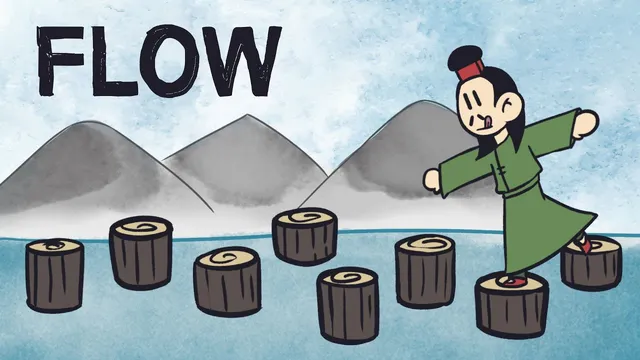
Don't Try | The Philosophy of Flow
Based on Einzelgänger's video on YouTube. If you like this content, support the original creators by watching, liking and subscribing to their content.
Flow is described as an optimal state that emerges when intention and action align, not as something that can be forced through effort.
Briefing
Flow—the “zone” of effortless, highly focused performance—can’t be forced by willpower, but it also isn’t pure luck. A Taoist-style apprenticeship story about a charioteer-in-training frames the core idea: mastery emerges when intention and action align so completely that the body moves as an extension of the self. The same pattern shows up in everyday experience and in psychological research: when attention stops fragmenting into analysis, worry, and self-monitoring, performance becomes smooth, precise, and strangely easy.
The transcript grounds that claim in a personal driving narrative. After years of overthinking, the narrator learns to drive and notices a consistent failure mode: when the mind stays in “planning mode,” anxiety rises and the car feels harder to control. The turning point comes during a trip through the Ardennes, where hills, unfamiliar terrain, bad weather, and chaotic traffic remove the ability to micromanage outcomes. In the storm, the narrator stops trying to drive “well” and instead drives without the constant mental commentary. The result is a paradox—desire to perform disappears, yet control improves. Anxiety becomes distant, attention narrows to the road, and traffic starts to feel coordinated, almost like a single organism.
That lived experience becomes a bridge to academic psychology through Mihaly Csikszentmihalyi’s work on flow. Flow is defined as an intrinsically rewarding activity that is challenging to one’s skill level. In that state, people report intense focus on the present, reduced reflective self-consciousness, a merging of action and awareness, and sometimes a distorted sense of time. Importantly, flow isn’t limited to comfortable settings; prisoners and people in extreme conditions have described optimal experiences. The key is not comfort but a meaningful stretch of body or mind.
The transcript then explains why flow is elusive: “psychic entropy,” a mental condition of inner disorder where attention scatters across distractions, past rumination, and future worry. Information overload—multitasking, constant notifications, interpersonal conflict, or chronic worrying—threatens goals and breaks effective attention. The narrator’s own attempt to force smooth driving through analysis becomes a textbook example: trying to control performance adds frustration, which adds more mental noise, which blocks the very state being chased.
Flow also has conditions, not randomness. Csikszentmihalyi describes “flow activities” such as sports, rituals, art, and games—activities with clear goals, rules, and immediate feedback. A central requirement is a transformation of the self through increased complexity: skill growth, experience, and knowledge. Flow tends to sit between two traps—anxiety when challenge exceeds skill, and boredom when the task is too easy. The practical takeaway is that matching challenge to ability (often slightly above) sustains the optimal tension.
Finally, the transcript offers ways to create those conditions without trying to “catch” flow directly: choose activities one enjoys, set clear goals, get immediate feedback, focus on the task rather than planning or rumination, and go all-in. Mindfulness, meditation, warm-ups, and rituals can reduce discursive thinking. It also argues that modern life’s complexity breeds psychic entropy; solitude and reduced media input can help restore a more primordial, harmonious attention state. The overall message is less about chasing a mystical feeling and more about engineering the mental and environmental ingredients that make effortless performance possible.
Cornell Notes
Flow (“being in the zone”) is an optimal performance state marked by intense focus, reduced self-consciousness, and a merging of action and awareness. It can’t be willed into existence; forcing it often increases anxiety and mental noise. Csikszentmihalyi links flow to a balance between challenge and skill, plus clear goals, rules, and immediate feedback in activities that promote self-transformation through increased complexity. When attention fragments into “psychic entropy”—from distractions, multitasking, conflict, or worry—flow becomes unlikely. The practical path is to create conditions that reduce inner disorder and sustain the right level of challenge, rather than trying to seize flow directly.
Why does trying harder often make flow less likely?
What exactly is flow, according to Csikszentmihalyi?
What is “psychic entropy,” and how does it block flow?
How do flow activities create the right conditions?
How should someone choose a challenge level to avoid anxiety or boredom?
What practical steps can increase the odds of flow without “chasing” it?
Review Questions
- How does the transcript connect “psychic entropy” to the failure of trying to force flow?
- What conditions (challenge-skill balance, goals, feedback, self-transformation) are presented as necessary for flow to emerge?
- In the driving story, what specific mental shift occurs when the narrator stops trying—and how does that relate to the psychological model?
Key Points
- 1
Flow is described as an optimal state that emerges when intention and action align, not as something that can be forced through effort.
- 2
Trying to control performance through analysis can increase anxiety and create “psychic entropy,” which fragments attention and blocks flow.
- 3
Csikszentmihalyi defines flow as an intrinsically rewarding activity that is challenging to one’s skill level, producing intense present-moment focus and reduced self-consciousness.
- 4
Flow activities tend to share rules, clear goals, immediate feedback, and a pathway for self-transformation through increased complexity (skill and knowledge).
- 5
Flow is most likely when challenge and skill are balanced—too much mismatch produces anxiety (too hard) or boredom (too easy).
- 6
Practical routes to flow focus on engineering conditions: enjoy the activity, set goals, get feedback, narrow attention to the task, and use mindfulness/rituals/warm-ups to reduce discursive thinking.
- 7
Because modern life increases information overload, solitude and reduced media input can help restore attention conditions that make flow more accessible.