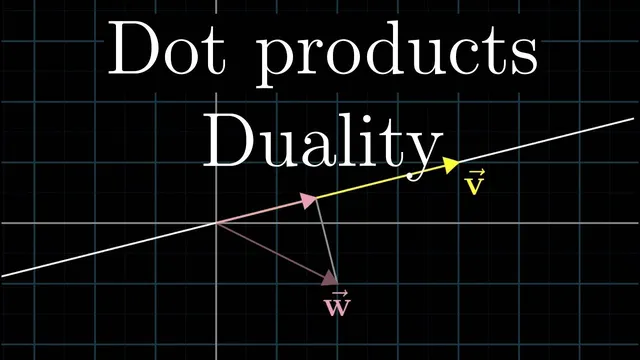
Dot products and duality | Chapter 9, Essence of linear algebra
Based on 3Blue1Brown's video on YouTube. If you like this content, support the original creators by watching, liking and subscribing to their content.
Dot products can be computed numerically by multiplying matching coordinates and summing, but they also have a projection-based geometric meaning with sign determined by direction.
Briefing
Dot products don’t just measure “how much two vectors point together”—they secretly encode a linear transformation. That deeper link, revealed through duality, explains why the coordinate formula matches projection geometry and why dot products naturally appear when linear maps collapse higher-dimensional space down to a number.
The usual entry point into dot products is numerical: for vectors of the same dimension, multiply corresponding coordinates and add the results. For example, (1,2)·(3,4)=1·3+2·4, and (6,2,8,3)·(1,8,5,3)=6·1+2·8+8·5+3·3. Geometrically, the same quantity can be read as follows: project one vector onto the line through the origin in the direction of the other, take the length of that projection, and multiply by the length of the original vector. The sign tracks whether the projection points along the same direction (positive), is perpendicular (zero), or points opposite (negative).
That geometric picture can feel asymmetric—projecting w onto v looks different from projecting v onto w—yet the dot product is symmetric. The symmetry becomes intuitive once scaling is considered. If v is scaled by a constant (say 2v), then under the “project w onto v” viewpoint the projection length stays the same while the vector being projected onto doubles; under the “project v onto w” viewpoint the projection length doubles while the target vector’s length stays fixed. Either way, the dot product doubles, so the order doesn’t change the outcome.
The real puzzle is why the coordinate recipe has anything to do with projection at all. The answer comes by stepping into linear transformations from 2D to 1D (the number line). A linear map that takes a 2D vector to a single number is fully determined by where it sends the basis vectors i-hat and j-hat; those images become the columns of a 1×2 matrix. Matrix multiplication in this setting looks strikingly like a dot product: multiplying a 1×2 matrix by a 2D vector is equivalent to dotting the vector with the “tilted” version of that matrix.
To make the connection concrete, the number line is embedded diagonally in the plane. Projecting a 2D vector onto this diagonal line defines a linear function that outputs a number. The key geometric object is the unit vector u-hat pointing toward the embedded point labeled 1. When i-hat and j-hat are projected onto the diagonal number line, the resulting numbers are exactly the x- and y-coordinates of u-hat. Those coordinates form the 1×2 matrix for the transformation, so applying the transformation to any vector becomes identical to taking the dot product with u-hat. Scaling u-hat by 3 scales the transformation by 3 as well, yielding the general rule: dotting with a non-unit vector corresponds to projecting onto its direction and then scaling by the vector’s length.
This is the essence of duality in linear algebra: a vector can be viewed as encoding a linear transformation to the number line, and a linear transformation to the number line corresponds back to a specific vector. In that light, the dot product is more than a geometric test for direction—it’s a translation mechanism between vectors and transformations, letting arrows in space stand in for linear maps.
Cornell Notes
Dot products can be understood as the numerical face of a linear transformation. When a 2D vector is projected onto a diagonally embedded copy of the number line, the resulting “output number” is a linear function of the input. That function must correspond to a 1×2 matrix, and multiplying that matrix by a 2D vector is equivalent to taking a dot product with a particular vector u-hat. The entries of the matrix turn out to be the x- and y-coordinates of u-hat, so the projection-based definition becomes a dot-product computation. Scaling u-hat scales the transformation, explaining why dotting with non-unit vectors corresponds to projecting onto the vector’s direction and then scaling by its length.
Why does the dot product’s geometric definition (projection times length) end up matching the coordinate “multiply-and-add” formula?
How can the dot product be symmetric even though the projection story seems asymmetric?
What does it mean, concretely, that a linear transformation from 2D to the number line corresponds to a vector?
In the diagonal-number-line construction, why do the matrix entries equal the coordinates of u-hat?
How does the dot product interpretation change when u-hat is scaled to 3u-hat?
Review Questions
- How does the diagonal-number-line projection define a linear transformation from 2D vectors to numbers, and why must such a transformation correspond to a 1×2 matrix?
- Explain, using the u-hat construction, why the dot product with u-hat equals the projection-based output number for any input vector.
- What role does linearity play in extending the “projection onto a unit direction” interpretation to non-unit vectors?
Key Points
- 1
Dot products can be computed numerically by multiplying matching coordinates and summing, but they also have a projection-based geometric meaning with sign determined by direction.
- 2
Projecting one vector onto the direction of another yields a linear-to-number function, which can be represented by a 1×2 matrix in 2D.
- 3
Multiplying a 1×2 matrix by a 2D vector is algebraically equivalent to taking a dot product with the corresponding 2D vector.
- 4
In the diagonal-number-line setup, the 1×2 matrix entries are the x- and y-coordinates of the unit direction vector u-hat.
- 5
Scaling the direction vector scales the entire transformation, explaining why dotting with non-unit vectors corresponds to projecting onto the direction and then scaling by the vector’s length.
- 6
Duality links vectors and linear transformations: a vector can encode a transformation to the number line, and a transformation to the number line corresponds back to a specific vector.