Double Your Productivity Instantly using this ADHD System
Based on Ali Alqaraghuli, PhD's video on YouTube. If you like this content, support the original creators by watching, liking and subscribing to their content.
Start by subtracting distractions and draining inputs to free mental bandwidth before adding any productivity tools.
Briefing
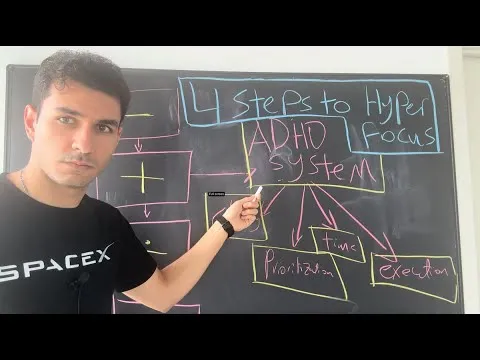
A four-step “hyperfocus” system aimed at ADHD brains—built around subtracting distractions, then adding a simple productivity structure—promises a fast jump in output by fixing the root causes of executive dysfunction: cluttered mental bandwidth, unclear goals, weak prioritization, and time blindness.
The framework starts with “subtract,” arguing that productivity fails when people add new tools on top of an already overloaded mind. ADHD is described as a worst-case setup for planning and execution because the frontal lobe’s executive functions struggle with prioritizing, starting, and finishing. The system treats focus as a bandwidth problem: before installing apps, plugins, or routines, people must remove what steals attention. Practical examples include minimizing phone usage, curating the physical environment (like removing a TV that sits in the line of sight while working), and setting boundaries with draining relationships by reducing access rather than cutting everyone off.
Once distractions are reduced, the next step is “add,” which means installing a productivity system tailored to how people actually take action. The “add” portion is broken into four internal components: maintaining clarity, prioritizing, managing time, and executing. Clarity comes first. The method emphasizes that many people mistake execution or time management for the real issue when the underlying problem is not knowing what they truly want. A suggested way to surface that is to ask what path would be least regrettable—such as imagining a decision on a deathbed—and to look for one or two goals that emerge as genuinely meaningful. The video also notes that internal conflict can happen when limiting beliefs block desire, though that’s framed as a separate topic.
With clarity in hand, the system moves to prioritization: turning a goal (like growing a company from $10k to $50k to $100k per month) into a sequence of tasks that create the highest odds of progress. The guidance warns against goals that are too long-term and abstract (which kills motivation and dopamine) or too short-term (which can lack inspiration and time to build something meaningful). Prioritization is treated as the “step zero” that many productivity creators skip.
Time management is positioned as simpler than most advice online, but also more fragile for ADHD due to time blindness—difficulty estimating and contextualizing time. Without a clear intention (“now or scheduled at a specific time”), tasks can never get anchored to a moment, so time passes and nothing happens. The method recommends an “opt-out” approach: decide to do the task now, and if it can’t happen immediately, schedule it immediately—because waiting for meetings or drifting into “waiting mode” can paralyze action.
Finally comes execution, framed as closing a “gap” between where someone is and where they want to be. Instead of chunking an entire project into many steps, the system says to focus only on the first step to shorten the distance to action. A personal example describes lowering stakes, making the first move ridiculously easy (checking lighting and mood, setting up the phone and tripod), and then chaining small actions until recording and posting happen. The system concludes by reiterating the sequence—subtract, add, clarify, prioritize, manage time, execute—and teases deeper dives into “divide” and “multiply,” plus a program called Next Level Peak Performance for ADHD brains.
Cornell Notes
The hyperfocus system for ADHD productivity centers on a simple sequence: subtract distractions, then add a structured workflow that runs through clarity → prioritization → time management → execution. It argues that most productivity advice fails because it adds tools without first freeing mental bandwidth—especially important for ADHD, where executive dysfunction makes planning, starting, and finishing harder. Clarity is treated as the real bottleneck: people often think they need better time management, but they actually don’t know what they want. Prioritization turns a goal into the next actionable step, while time management depends on explicit “now or scheduled” intentions to counter time blindness. Execution succeeds by shrinking the gap to action—focusing on the first step rather than breaking the whole task into overwhelming chunks.
Why does the system insist on “subtract” before “add,” and what counts as subtracting?
How does “clarity” function as the foundation of productivity in this framework?
What does prioritization mean here, and what are the risks of choosing the wrong time horizon?
Why is time management described as both simpler and more sensitive for ADHD?
How does the execution approach differ from typical “chunk the task” advice?
What kinds of environmental or situational triggers does the system mention for improving follow-through?
Review Questions
- In this framework, what is the difference between a clarity problem and an execution problem, and how would you test which one you’re facing?
- Why does “time blindness” make explicit “now or scheduled” intentions necessary, and what happens when that intention is missing?
- What does focusing only on the first step do to the “gap” to execution, and how is that different from breaking a task into many chunks?
Key Points
- 1
Start by subtracting distractions and draining inputs to free mental bandwidth before adding any productivity tools.
- 2
Treat clarity as the prerequisite for everything else; if the goal isn’t clear, prioritization and scheduling won’t stick.
- 3
Use prioritization to define the next actionable step that ladders up to the goal, not just a vague long-term outcome.
- 4
Counter ADHD time blindness by deciding “now or scheduled” for tasks; avoid letting tasks float without a time anchor.
- 5
Manage time with an opt-out mindset: attempt immediately, and if it can’t happen, schedule it right away to prevent drift.
- 6
Improve execution by shrinking the distance to action—focus on the first step rather than chunking the entire project into overwhelming sequences.
- 7
Support the system with environmental triggers (like reducing noise) that make starting easier in the moment.