Double Your Productivity using this ADHD System (Invented by a Space Systems Engineer)
Based on Ali Alqaraghuli, PhD's video on YouTube. If you like this content, support the original creators by watching, liking and subscribing to their content.
Start by subtracting the biggest attention obstacles (e.g., phone/computer distractions and toxic relationships) before adding any productivity tools.
Briefing
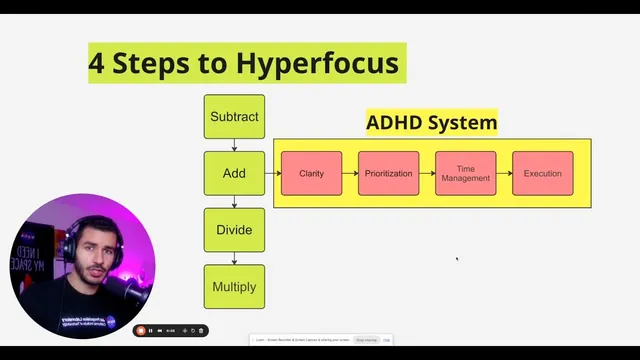
A productivity system built around “subtracting” distractions—then adding a simple framework for clarity, prioritization, time management, and execution—is presented as the fastest path to sustained hyperfocus, especially for people with ADHD. The core claim is blunt: real productivity is mostly removal, not accumulation. Before any tools, templates, or scheduling tricks, the first job is to identify what’s draining attention and time—phones, computers, toxic relationships, and other obstacles—and remove it so mental bandwidth opens up.
The system is framed as “four steps to hyperfocus,” with the first step explicitly labeled subtract. A physical analogy drives the point: if an obstacle blocks the hand from reaching a mug, no technique will help until the obstacle is moved. In practical terms, that means making a list of the biggest attention-siphons and eliminating them first. Only after that decluttering step does the video recommend adding a productivity system—because adding organization without removing interference still leaves the mind stuck.
The remaining three pillars are designed to be simple enough to use daily but structured enough to handle the common failure modes of ADHD: too many ideas, confusion, difficulty starting, distraction, unfinished tasks, and fast boredom. The second pillar, clarity, requires a clear goal and target—otherwise effort turns into aimless motion. The third pillar, prioritization, focuses on choosing the action that removes the obstacle between the current week and the larger goal. The method described is obstacle-based: if the goal is to support parents financially, the “first step” is the bottleneck action that makes progress possible.
Time management is treated as an “opt out” strategy rather than an “opt in” one. Instead of asking when to schedule a task, the approach asks why it can’t be done right now or within a short window (one to two hours, today, tonight). Only when a strong reason exists does scheduling happen—otherwise the task stays unscheduled and the brain keeps getting pulled into other demands. If it can’t happen today, the plan escalates to tomorrow morning with an implementation intention (“I’m going to do it 6:00 tomorrow at my desk and here’s how I’ll start”).
Execution is positioned as the final bottleneck, but not in the simplistic sense of timers or “just start.” Execution is described as psychological self-talk: fear of failure, perfectionism, and avoidance strategies that protect self-esteem by preventing attempts. The proposed fix is logic-driven reframing—estimating how long it takes to try and fail once, then again, and showing that repeated attempts are still faster than procrastination. A parallel is drawn to SpaceX culture, where engineers intentionally fail, diagnose why, and iterate quickly.
After subtracting and building the four-pillar system, the routine becomes “divide and multiply”: run the same protocols daily, diagnose which pillar is failing when procrastination hits, and adjust based on personal chronotype and behavior patterns. Consistency is presented as easier once structure exists, with the payoff described as higher self-esteem from reliably getting things done. A deeper program is offered with a 30-day money-back guarantee, and the closing message reiterates the priority order: subtract before adding any productivity machinery.
Cornell Notes
The system centers on a subtract-first philosophy: productivity comes largely from removing attention-draining obstacles before adding tools or routines. After subtraction, a four-pillar framework supports hyperfocus—clarity (a specific goal and target), prioritization (the next action that removes the bottleneck obstacle), time management via an “opt out” approach (try to do the task now or soon, schedule only if you truly can’t), and execution through self-talk (address fear of failure and perfectionism rather than relying only on timers). The method is tailored to ADHD-style challenges like distraction and difficulty finishing tasks. The payoff is a repeatable daily protocol that makes procrastination diagnosable by pillar, so adjustments become systematic rather than emotional.
Why does the system insist that productivity is “subtractive” rather than “additive”?
What does “clarity” require, and what goes wrong without it?
How does the system define prioritization?
What is the difference between “opt out” and “opt in” time management?
Why does the system treat execution as psychological rather than purely tactical?
How does the system help someone self-diagnose procrastination?
Review Questions
- If a task keeps getting postponed, how would you determine whether the root cause is clarity, prioritization, time management, or execution self-talk?
- What would an “opt out” plan look like for a high-priority task you can’t start right now—what steps come before scheduling?
- How does intentionally failing (as described via the SpaceX example) counter perfectionism-driven procrastination?
Key Points
- 1
Start by subtracting the biggest attention obstacles (e.g., phone/computer distractions and toxic relationships) before adding any productivity tools.
- 2
Build a four-pillar system for hyperfocus: clarity (goal/target), prioritization (bottleneck action), time management via “opt out,” and execution through self-talk.
- 3
Use obstacle-based prioritization: pick the action that removes what’s blocking the goal’s progress this week.
- 4
Adopt “opt out” time management: try to do the task now or within a short window first; schedule only when there’s a strong reason you truly can’t.
- 5
Create implementation intentions for tasks that can’t happen today (specific time, location, and first step).
- 6
Treat execution as a psychological problem—address fear of failure and perfectionism with logic-driven reframing and planned “try-and-fail” iterations.
- 7
Run the system daily with consistent protocols, then diagnose procrastination by which pillar is failing and adjust that pillar.