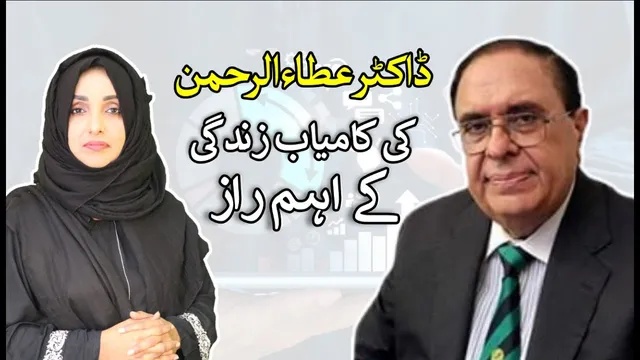
Dr Atta Ur Rahman | The Nations MOST Decorated Scientist Life's INSIGHTS
Based on Dr Rizwana Mustafa's video on YouTube. If you like this content, support the original creators by watching, liking and subscribing to their content.
Dr. Atta Ur Rahman ties scientific success to rigorous investigation—going deeper when results don’t satisfy him, even if the work is associated with Nobel-level names.
Briefing
Dr. Atta Ur Rahman’s career arc links world-class research credibility to institution-building and national technology policy—arguing that scientific progress only sticks when discoveries are pushed into equipment, training, funding, and real-world adoption.
He describes an unusually fast academic rise: after moving to Karachi at age 10, he accelerated through school with double promotions, topped Pakistan’s Cambridge O-Levels, then earned BSc (Honours) and an MSc with first-class distinction from the University of Karachi. A Commonwealth Scholarship took him to Cambridge, where he completed a PhD by age 26 and stayed as a Kings College fellow, teaching and running research in a high-competition environment. That setting mattered because it exposed him to top minds and rigorous standards—he credits repeated encounters with Nobel-level researchers and the habit of quietly attending lectures, taking notes, and strengthening fundamentals.
A defining moment came during his early faculty years at Cambridge when he challenged a Nobel laureate’s chemistry work. He says he investigated Robert Robinson’s proposed “chemistry of harmine/harmaline” pathway (with collaborators including Sir William Perkin) and found the reaction sequence to be wrong. He then published his counter-results in major chemistry journals, framing the episode as a lesson in not ignoring doubts—especially when famous names are involved. For him, good research requires going “deeper and deeper,” refusing to cover up uncertainty, and accepting that time and resources are part of the process.
After returning to Pakistan, he focused on building research capacity rather than relying on imported talent or equipment. He helped establish the International Center for Chemical and Biological Sciences (a major chemistry/biology research hub) and describes a step-by-step procurement strategy: securing analytical instruments like gas chromatography and micro-analyzers, then later obtaining advanced tools such as nuclear magnetic resonance and mass spectrometry. He highlights international grants and donations—ranging from German material support to large-scale funding from the U.S. Office of Naval Research, the British system, and Japan—crediting these inflows with enabling a lab that could operate at international standards and train technicians.
His policy work as Pakistan’s Minister of Science and Technology adds another layer: he pushed for emerging technology missions—biotechnology and nanotechnology—while treating information technology as easier to scale through training. He points to initiatives like expanding internet access, launching virtual university programs, and accelerating mobile adoption through pricing and infrastructure reforms. He also argues that scientific research must be transformed into technology and then adopted, because basic research alone does not deliver national growth.
Finally, he turns to career guidance for aspiring scientists: build competence, use global open learning platforms (including MIT- and Stanford-style course libraries and other free lecture repositories), and choose high-demand fields such as AI, cybersecurity, IoT, nanotechnology, regenerative medicine, genomics, and bioinformatics. He warns that Pakistan’s higher-education pipeline remains constrained—especially the low ratio of PhD graduates—and calls for sustained funding and hiring reforms to keep research output competitive. The throughline is consistent: curiosity and rigor must be paired with institutions, funding, and skills pathways that let talent scale from lab results to national impact.
Cornell Notes
Dr. Atta Ur Rahman connects three layers of scientific success: rigorous research, institution-building, and technology adoption. After rapid academic progress culminating in a Cambridge PhD, he challenged a Nobel-linked chemistry pathway by re-investigating reaction sequences and publishing counter-findings. Returning to Pakistan, he helped develop major research infrastructure—acquiring advanced analytical equipment and leveraging international grants—to create an environment where technicians and labs could meet global standards. In government, he pushed emerging technology missions (biotech, nanotech) and scaled information technology through training, internet access, and virtual education. For young researchers, he emphasizes competence-building, using free global online courses, and targeting high-demand fields to unlock both local and international career opportunities.
What does Dr. Atta Ur Rahman say is essential for doing strong research, even when big names are involved?
How did he describe his path from Cambridge research to building a Pakistan-based research powerhouse?
What role did technology adoption play in his view of national scientific progress?
What career strategy does he recommend for aspiring scientists who want international-level opportunities?
What does he identify as a structural bottleneck in Pakistan’s higher-education research pipeline?
How did he connect his research credibility to his later policy and institutional reforms?
Review Questions
- Which research principle does Dr. Atta Ur Rahman use to justify challenging established Nobel-linked work, and what outcome did that lead to?
- How did his approach to building a research institute differ from simply hiring people or buying equipment?
- What combination of open learning and field selection does he recommend for maximizing career opportunities in science and research?
Key Points
- 1
Dr. Atta Ur Rahman ties scientific success to rigorous investigation—going deeper when results don’t satisfy him, even if the work is associated with Nobel-level names.
- 2
His Cambridge experience included both high-standard research training and deliberate learning habits: attending lectures, taking notes, and strengthening fundamentals.
- 3
He describes institute-building as a staged process: acquiring foundational analytical tools first, then advanced instrumentation, while training technicians to operate and maintain them.
- 4
In government, he prioritized technology missions (biotechnology and nanotechnology) and treated information technology as scalable through training, internet access, and virtual education systems.
- 5
He argues that basic research must be transformed into technology and then adopted; otherwise, national growth benefits remain limited.
- 6
For young researchers, he recommends competence-building plus global free online learning platforms, then targeting high-demand emerging fields for better job prospects.
- 7
He identifies Pakistan’s higher-education bottleneck as low PhD output relative to enrollment, worsened by hiring constraints and delayed/frozen funding.