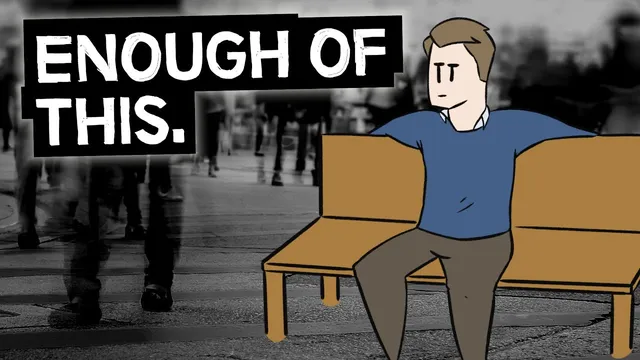
Drifting Away from People: The Dark Side of Solitude
Based on Einzelgänger's video on YouTube. If you like this content, support the original creators by watching, liking and subscribing to their content.
Estrangement often begins with small, practical changes—less communication, emptier conversations, and shifting interests—before it becomes a full withdrawal.
Briefing
Estrangement from people can start as a slow, personal retreat—or snap into place quickly—and it carries a double edge: solitude can feel liberating, but it can also intensify loneliness, distort thinking, and even fuel radicalization. The core warning is that withdrawing from social contact doesn’t automatically make someone safer or wiser; what happens inside the resulting isolation—especially the quality of one’s thoughts and the information one consumes—often determines whether solitude becomes healing or corrosive.
The drift away typically begins with reduced contact: conversations grow empty, interests shift, and schedules make meetings feel impossible. Other times the separation is personality-driven, with social “conventions” feeling alien—like the pressure to perform normalcy, small talk, and expected life milestones. The transcript uses Meursault from Albert Camus’s The Stranger as a lens: his emotional detachment and lack of conventional reactions lead others to misread him as heartless, even dangerous. The deeper point is that being “different” can look like moral failure to outsiders, even when the motive isn’t cruelty.
Why solitude feels so powerful is also tied to how people perceive themselves. Jean-Paul Sartre’s line “Hell is other people” is invoked to describe the way others’ presence changes behavior—often through subtle “masking” and self-monitoring. Schopenhauer is brought in with the idea that people can be most truly themselves when alone, suggesting that solitude offers freedom from judgment and influence.
Yet the transcript stresses that withdrawal can be driven by disappointment and fear. Disillusionment with family, friends, or repeated bad relationships can harden into a belief that people are toxic. On a broader scale, modern life’s constant negative news can produce Weltschmerz—a pervasive sense of doom—pushing some toward retreat as a defense. In extreme cases, isolation becomes a breeding ground for hostility toward groups or even humanity itself.
That risk sharpens when solitude turns into an echo chamber. Research is cited on “moral echo chambers,” including a study analyzing over 900,000 posts in a Reddit community known as “incels” (involuntary celibates). Lead author Dr. Mohammad Atari is quoted saying that morally homogeneous environments make people more likely to resort to radical means to defend their values. The transcript argues that when nobody disagrees—when screens replace real-world feedback—beliefs can become more extreme while “reality” becomes less reliable.
The alternative offered is not forced socializing, but contact with the broader world—“touching grass,” meeting the majority, and using real-life observation as a corrective to online distortions. The transcript concludes that solitude is not inherently wrong; it becomes dangerous when it breeds resentment, depression, anxiety, or destructive ideology. The practical takeaway is to notice the direction of drift: if isolation is making someone more miserable, more hostile, and more trapped in one-sided narratives, it may be time to change course and re-engage with reality through other people.
Cornell Notes
People drift away from others for many reasons—busy schedules, shifting interests, personality mismatch, disappointment, or fear. Solitude can feel liberating because it removes other people’s judgment and influence, echoing ideas associated with Sartre and Schopenhauer. But estrangement can also worsen loneliness and mental health, and it can distort thinking when isolation turns into a “moral echo chamber.” Research cited from a large Reddit study (over 900,000 posts) links morally homogeneous online environments to higher likelihood of radicalization, with Dr. Mohammad Atari warning that lack of disagreement can radicalize people. The transcript’s bottom line: solitude is not inherently harmful; what matters is whether it leads to healthier reflection or to resentment, warped beliefs, and destructive pathways.
What are the main ways estrangement from people begins, and how can it look “normal” at first?
Why does solitude feel freeing, according to the transcript’s philosophical references?
How can disappointment turn into a broader withdrawal from humanity?
What makes isolation especially dangerous when it becomes an echo chamber?
What corrective does the transcript suggest for people drifting away?
Review Questions
- What factors can make someone’s solitude feel liberating at first but harmful later?
- How do “masking” and self-monitoring relate to why other people’s presence changes behavior?
- Why does the transcript connect moral echo chambers to radicalization, and what role does disagreement play?
Key Points
- 1
Estrangement often begins with small, practical changes—less communication, emptier conversations, and shifting interests—before it becomes a full withdrawal.
- 2
Personality mismatch can lead others to misread emotional detachment as coldness or even danger, as illustrated by Meursault.
- 3
Solitude can feel freeing because it reduces other people’s judgment and the need to perform socially expected behavior.
- 4
Disappointment and fear can turn into broader hostility, including doom-focused worldviews (Weltschmerz) and resentment toward groups.
- 5
Isolation becomes especially risky when it turns into a moral echo chamber where nobody disagrees and online narratives replace real-world feedback.
- 6
Research cited from a large Reddit dataset links morally homogeneous environments to higher chances of radicalization, with Dr. Mohammad Atari warning that lack of disagreement can radicalize people.
- 7
Solitude is not inherently harmful; it becomes destructive when it fuels resentment, mental health decline, and increasingly extreme beliefs.