Drinking in ZERO-G! (and other challenges of a trip to Mars)
Based on Veritasium's video on YouTube. If you like this content, support the original creators by watching, liking and subscribing to their content.
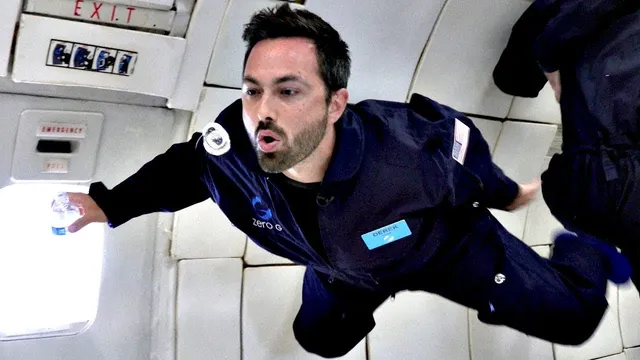
Parabolic flights create brief microgravity by putting the aircraft and contents into near freefall, offering a preview of months-long transit conditions to Mars.
Briefing
A trip to Mars would feel less like a single “big moment” and more like a long chain of bodily problems—microgravity, low gravity, radiation, and even everyday liquid behavior—that must be engineered around rather than wished away. A short taste of weightlessness on a parabolic-flight “vomit comet” makes the point: muscles weaken without load, bones lose density quickly, and ordinary tasks become unexpectedly difficult when liquids and bodily fluids behave differently.
On the flight, microgravity is created by repeated parabolic arcs that put the aircraft and everything inside into near freefall, letting the body experience roughly 30 seconds of weightlessness per arc. The contrast with Mars is stark. Mars’ surface gravity is about 37% of Earth’s, meaning jumps would last longer and go higher—roughly double the airtime for an average Earth jumper—and even simple athletic moves like dunking a regulation basketball hoop would be far easier. The Moon’s gravity is about 1/6 of Earth’s, enabling even more dramatic movement. But the same low-gravity environment that boosts mobility also undermines the body’s conditioning: in microgravity, muscles atrophy and bone density drops.
Muscle loss is a major concern for long-duration travel. Studies cited in the transcript report muscle mass can decrease by up to 20% on space flights lasting 5 to 11 days. Because weightlifting becomes ineffective in weightlessness, astronauts rely on elastic resistance—such as being tethered to an elastically constrained treadmill—often exercising around two and a half hours every day. Bones face an even faster problem: astronauts can lose about 1–2% of bone mass per month, especially in the lower extremities, which is described as more than ten times faster than typical age-related bone loss associated with osteoporosis.
Everyday life also changes in ways that sound trivial until they happen. In microgravity, surface tension dominates, making liquids cling and move unpredictably. That complicates showering, brushing teeth, and even bathroom routines. The transcript highlights how easily water can “hold together” in zero-g, turning basic hygiene into a technical challenge.
Low gravity also alters motion and stability. A rotating disc demonstrates that in microgravity it flips back and forth as the hole shifts sides—an example tied to the intermediate axis theorem, where rotation about an intermediate moment of inertia is unstable and small disturbances can trigger rotation about another axis.
Radiation adds a separate, persistent hazard. On orbit, astronauts sometimes report brief flashes of light when their eyes are closed but they’re not fully asleep. The transcript attributes these to heavy particles or bursts of energy interacting with the eye or optic nerve—an effect that early astronauts likely noticed and normalized after others reported similar experiences.
Taken together, these hurdles aren’t portrayed as deal breakers, but as design constraints for long-term survival. The path forward is framed as becoming a multiplanetary species: spacesuits that are currently around 310 pounds could help maintain muscle and bone mass by providing load, and radiation shielding can be improved using ship insulation and water. Still, the body’s evolution is tuned to Earth’s 9.8 m/s² gravity, so adapting to Mars’ gravity—and enduring months of transit—would likely require both medical and engineering solutions, not just arrival on a new world.
Cornell Notes
Mars travel would test human bodies in multiple physics regimes: near-weightlessness during transit, reduced gravity on arrival, radiation exposure, and fluid behavior that breaks everyday routines. Microgravity leads to rapid muscle atrophy (up to ~20% over 5–11 days) and significant bone loss (about 1–2% per month), forcing exercise to shift toward elastic resistance rather than conventional weights. Low gravity also changes motion stability and makes liquids harder to manage because surface tension dominates. Radiation can produce “phosphenes”—flashes of light perceived when particles interact with the eye or optic nerve. Long-term survival depends on engineering countermeasures like load-providing spacesuits, radiation shielding (including water), and gradual adaptation to gravity differences.
How does a parabolic-flight “vomit comet” simulate microgravity, and why does that matter for Mars travel?
Why is exercise so different in microgravity, and what countermeasures are used?
What are the reported rates of muscle and bone loss in space, and where does bone loss concentrate?
How does low gravity change everyday tasks involving liquids?
What causes the flashes of light astronauts sometimes report while on orbit?
How could spacesuits and shielding help address Mars’ gravity and radiation risks?
Review Questions
- What specific physiological changes in microgravity make conventional weightlifting insufficient, and what exercise method replaces it?
- How do Mars’ gravity and the Moon’s gravity differ from Earth in terms of movement outcomes like jumping?
- Why do flashes of light occur during orbit, and what anatomical pathway is implicated in the transcript?
Key Points
- 1
Parabolic flights create brief microgravity by putting the aircraft and contents into near freefall, offering a preview of months-long transit conditions to Mars.
- 2
Mars surface gravity is about 37% of Earth’s, enabling much higher jumps and longer airtime, while the Moon’s gravity is about 1/6 of Earth’s.
- 3
Microgravity causes rapid muscle atrophy (up to ~20% over 5–11 days) and significant bone loss (about 1–2% per month), especially in the legs.
- 4
Because weights don’t provide meaningful load in space, astronauts rely on elastic resistance—such as tethered treadmill exercise—for roughly 2.5 hours daily.
- 5
Surface tension dominates in microgravity, making everyday hygiene and bathroom tasks harder because liquids don’t flow and drain normally.
- 6
Astronauts sometimes see flashes of light from radiation interactions with the eye or optic nerve, even when eyes are closed but sleep hasn’t started.
- 7
Long-term survival on Mars likely requires countermeasures like load-providing spacesuits, radiation shielding (including water), and adaptation to gravity changes that the body isn’t evolved for.