e^(iπ) in 3.14 minutes, using dynamics | DE5
Based on 3Blue1Brown's video on YouTube. If you like this content, support the original creators by watching, liking and subscribing to their content.
e^t is uniquely determined by x′(t)=x(t) plus the initial condition x(0)=1.
Briefing
The core insight is that the exponential function is uniquely characterized by the rule “rate of change equals the current value,” and swapping the constant in that rule changes the motion from runaway growth to decay—and, when the constant is imaginary, to circular motion in the complex plane. Starting from the defining property, e^t is the only function whose derivative equals itself and that satisfies the initial condition e^0 = 1. Interpreting e^t as position on a number line turns calculus into mechanics: if position x(t) equals e^t, then velocity x′(t) equals x(t). The farther the position is from 0, the faster it moves, so the system accelerates in a way that feels like it quickly gets out of hand.
Adding a constant in the exponent changes the dynamics in a predictable way. For x(t) = e^{2t}, the chain rule gives x′(t) = 2e^{2t} = 2x(t). In the same physical picture, velocity is always twice the current position: the “velocity vector” scales the position by 2 at every point, making the growth even more aggressive. If the constant is negative, such as x(t) = e^{-0.5t}, then x′(t) = -0.5x(t). The negative sign flips the direction (a 180-degree reversal) while the factor 0.5 shrinks the magnitude, producing exponential decay toward 0 rather than divergence.
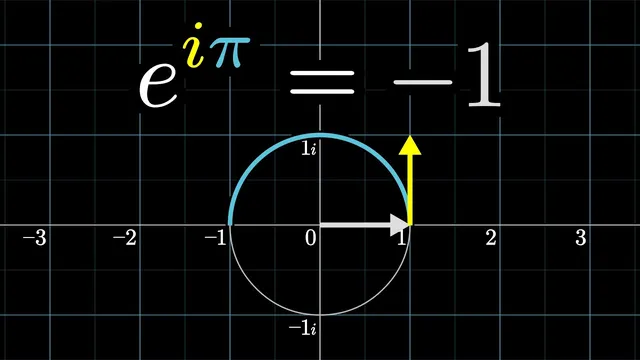
The most striking case comes when the constant is i, where i^2 = -1. For x(t) = e^{it}, differentiation yields x′(t) = i e^{it} = i x(t). Multiplying by i doesn’t scale a real number; it rotates it by 90 degrees. That forces the interpretation to move off the number line and into the complex plane, where positions are complex vectors. The resulting rule says: at every moment, the velocity is the current position rotated a quarter-turn. Such a velocity field naturally generates circular motion.
With the initial condition e^{i·0} = 1, there is a single trajectory consistent with the rule that velocity always matches the 90-degree-rotated position. The motion is uniform around the unit circle: radius 1, speed 1 unit per second. After π seconds, the point has advanced π radians, landing at -1, so e^{iπ} = -1. After τ seconds (where τ = 2π), the point completes a full revolution and returns to 1, giving e^{iτ} = 1. More generally, e^{it} corresponds to the point t radians around the unit circle in the complex plane.
The discussion ends by acknowledging a lingering discomfort: putting an imaginary number in the exponent feels “immoral” to many people. The transcript hints that the notation e^t can mislead by overemphasizing repeated multiplication of e, and it promises a deeper justification later. Still, the dynamical argument already pins down the meaning: e^{it} is the complex-valued function whose derivative rotates its value, producing circular motion and the celebrated identity e^{iπ} = -1.
Cornell Notes
e^t is singled out by two conditions: its derivative equals itself and it starts at 1 when t = 0. Treating e^t as position turns calculus into motion: velocity equals position, so distance from 0 implies faster movement and accelerating growth. Changing the exponent constant changes the dynamics: e^{2t} doubles the velocity rule, while e^{-0.5t} flips direction and shrinks speed, creating decay toward 0. When the constant is i, differentiation gives x′(t) = i x(t), and multiplying by i rotates by 90 degrees. That rotation rule forces a complex-plane interpretation and yields uniform circular motion on the unit circle, making e^{iπ} = -1 and e^{it} the point t radians around that circle.
Why does the condition “derivative equals the function” uniquely characterize e^t (with e^0 = 1)?
How does the physical picture translate x(t) = e^t into motion on a number line?
What changes when the exponent is multiplied by a real constant, like 2 or -0.5?
Why does choosing the constant i force a complex-plane interpretation?
How does the rotation rule lead to e^{iπ} = -1?
What does e^{it} mean geometrically for general t?
Review Questions
- How does the chain rule change the differential equation satisfied by e^{kt}, and what does that imply for the motion?
- In the complex-plane model, why does multiplying by i correspond to a 90-degree rotation, and how does that determine the trajectory?
- What specific initial condition is used to pin down the unique trajectory for e^{it}, and how does it connect to the unit circle?
Key Points
- 1
e^t is uniquely determined by x′(t)=x(t) plus the initial condition x(0)=1.
- 2
Interpreting x(t) as position turns x′(t)=x(t) into a motion rule where velocity always equals position.
- 3
Replacing the exponent with 2t scales the velocity rule to x′(t)=2x(t), intensifying growth.
- 4
Using a negative constant like -0.5t flips the velocity direction and shrinks its magnitude, producing exponential decay toward 0.
- 5
Choosing i in the exponent yields x′(t)=i x(t), meaning velocity is a 90-degree rotation of position.
- 6
The rotation rule generates uniform circular motion on the unit circle, giving e^{iπ}=-1 and e^{it} as the point t radians around that circle.