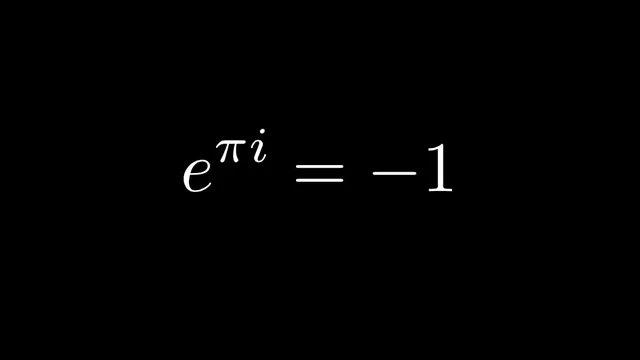
e to the pi i, a nontraditional take (old version)
Based on 3Blue1Brown's video on YouTube. If you like this content, support the original creators by watching, liking and subscribing to their content.
Exponentials are defined by how they convert addition-like “sliding” actions into multiplication-like “stretching/rotating” actions.
Briefing
The equation e^(πi) = −1 stops looking like black magic once exponentials are redefined as a bridge between two kinds of actions on numbers: sliding (addition) and stretching/rotating (multiplication). Instead of treating e^x as “repeated multiplication,” the explanation builds exponentials from a single functional rule: applying exponentials turns adders into multipliers in a way that forces the familiar identity e^(x+y) = e^x · e^y. That rule isn’t a consequence of counting; it’s the defining behavior of the exponential function, with the special role of e emerging from how naturally the function fits this action-based framework.
The core reframing starts by treating any number as three simultaneous roles on a line: a point, an adder (which slides the line), and a multiplier (which stretches the line). Addition is defined purely by how adders compose: sliding by one amount after another is equivalent to sliding by a single combined amount. Multiplication is defined similarly, but with a different constraint—zero stays fixed while the point for one is moved to where the multiplier’s point would land, preserving spacing. With these action rules in place, exponentials become the mechanism that converts “sliding” behavior into “stretching” behavior.
That conversion property—e^(x+y) = e^x · e^y—acts like a blueprint. Multiple functions can satisfy the same rule, but the most natural one is singled out by an explicit infinite-sum construction. The constant e is then described as the value of that function at 1, and the notation e^x is portrayed as a historical leftover from the earlier idea of repeated multiplication.
The leap to e^(πi) = −1 comes from extending the same action logic into the complex plane. Real numbers already correspond to sliding and stretching on a line; complex numbers add new actions because they can also rotate. The imaginary unit i is introduced as the point that, as an adder, slides upward, and as a multiplier, rotates the plane by a quarter-turn. Applying that rotation twice matches multiplication by −1, making i the “square root of −1” in this action language.
From there, exponentials are expected to translate the new “vertical” adder direction (movement involving i) into the new “rotational” multiplier direction. Geometrically, the exponential e^x maps points on a vertical line of adder-amounts into points on the unit circle of multipliers (radius one). The natural wrap-around is crucial: going around a circle once corresponds to an angle of 2π because circumference is 2π times the radius. Therefore, moving by π corresponds to half a revolution—landing at the point opposite 1 on the unit circle, which is −1. The result follows: e^(πi) lands exactly where the multiplier action represents a half-turn, giving −1.
Cornell Notes
The explanation treats numbers as actions, not just quantities. Addition becomes “sliding” a line, multiplication becomes “stretching” while keeping zero fixed, and exponentials are defined as the transformation that turns adders into multipliers. This leads to the key rule e^(x+y) = e^x · e^y, with e identified as the function’s value at 1. Extending the same action idea to the complex plane, i acts like a quarter-turn rotation when used as a multiplier. Since exponentials convert vertical adder motion into rotation on the unit circle, πi corresponds to a half-turn, placing e^(πi) at −1.
Why does the explanation avoid defining e^x as repeated multiplication?
How are addition and multiplication defined using “actions” on a line?
What role does the identity e^(x+y) = e^x · e^y play?
How does i connect to rotations and why does i^2 = −1 matter here?
Why does πi correspond to −1 on the unit circle?
Review Questions
- In the action-based framework, what specific rule defines how adders combine, and how does that differ from how multipliers combine?
- How does the identity e^(x+y) = e^x · e^y function as a definition of exponentials in this explanation?
- What geometric reasoning links πi to a half-turn on the unit circle, and how does that determine the value of e^(πi)?
Key Points
- 1
Exponentials are defined by how they convert addition-like “sliding” actions into multiplication-like “stretching/rotating” actions.
- 2
The functional rule e^(x+y) = e^x · e^y is treated as the defining behavior of e^x, not as a consequence of repeated multiplication.
- 3
The constant e is identified as the value of the natural exponential function at x = 1.
- 4
Complex numbers extend the action picture by adding rotational behavior to multiplication.
- 5
Multiplying by i corresponds to a quarter-turn rotation, so i^2 matches the multiplier action for −1.
- 6
Exponentials map vertical adder motion (multiples of i) onto the unit circle, making e^(πi) correspond to a half-turn.
- 7
Because a full rotation is 2π radians, π radians lands at −1 on the unit circle, yielding e^(πi) = −1.