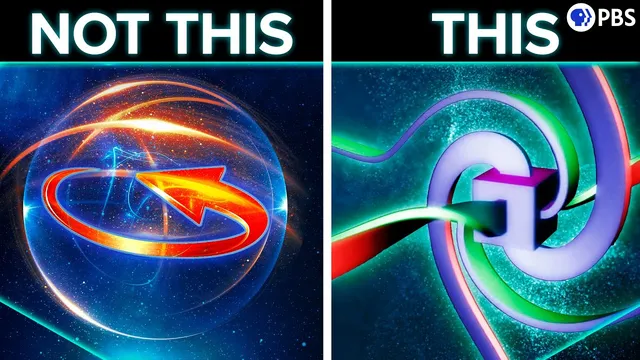
Electrons DO NOT Spin
Based on PBS Space Time's video on YouTube. If you like this content, support the original creators by watching, liking and subscribing to their content.
Electron spin is intrinsic quantum angular momentum that is not classical rotation, even though it behaves like angular momentum in conservation arguments.
Briefing
Electron “spin” is real quantum angular momentum that produces magnetic moments and quantized measurement outcomes—yet it is not literal spinning like a bicycle wheel. That mismatch between what spin behaves like and what it physically is drove a century of experiments and theory, from the Einstein–de Haas effect to the Stern–Gerlach experiment, and ultimately reshaped how physicists describe matter.
A classic conservation-of-angular-momentum puzzle appears in the Einstein–de Haas effect: a suspended iron cylinder begins rotating when a vertical magnetic field is switched on, even though nothing mechanical was initially spinning. The magnetic field magnetizes the iron, aligning electrons in the outer shells. Those aligned electron spins carry angular momentum, and the cylinder’s rotation compensates so total angular momentum stays conserved. The story sounds intuitive only if electrons were tiny spinning objects—but that picture fails. Classical rotation would require electrons to spin so fast that the surface speed would exceed the speed of light, and it clashes with the fact that electrons are treated as point-like. Wolfgang Pauli therefore rejected the “spinning charge” model and instead framed electron spin as a “classically non-describable two-valuedness”: an intrinsic quantum property that behaves like angular momentum without being classical rotation.
Evidence for that two-valuedness comes sharply from the Stern–Gerlach experiment. Silver atoms pass through a magnetic field gradient, and atoms with a magnetic moment experience a force depending on the orientation of that moment relative to the field. If the magnetic moments were classical dipoles with random orientations, the detector would show a continuous smear. Instead, the atoms land in only two spots, corresponding to two discrete outcomes. Recombining the beam and sending it through a second Stern–Gerlach apparatus oriented at 90 degrees again yields only two deflection spots—showing that the “spin direction” is quantized and depends on the measurement axis. In other words, spin isn’t just quantized; the direction you measure determines which quantized component becomes manifest.
Pauli’s solution to how to put this into quantum mechanics was to modify the Schrödinger equation so the wavefunction has two components, forming a spinor. Paul Dirac later derived a relativistic framework in which spinors appear naturally. Spinors carry an especially non-classical rotational behavior: a 360-degree rotation does not return the system to its original state; a 720-degree rotation does. This deep mathematical structure connects spin to conserved quantities without requiring a classical picture of rotation.
Spin also organizes the fundamental architecture of matter. Particles with half-integer spin (like electrons, protons, and neutrons) are fermions and are described by spinors; their intrinsic angular momentum can only be measured as plus or minus half of the reduced Planck constant along a chosen axis. Integer-spin particles (bosons, such as photons and gluons) behave differently under rotations and follow different quantum statistics. That difference underlies the Pauli Exclusion Principle, which prevents fermions from sharing the same quantum state and is what builds atomic structure—and, by extension, the solidity of everyday matter.
Finally, spin’s significance reaches beyond magnetism and spectroscopy: it’s a clue to how quantum structure governs reality. The transcript then pivots to a related theme—how entropy depends on context and on entanglement—arguing that low early-universe entropy may reflect the dominance of gravitational degrees of freedom and the universe’s extreme smoothness, while entanglement can be relative to which subsystem is considered.
Cornell Notes
Electron spin is intrinsic quantum angular momentum that produces magnetic moments and yields only two discrete outcomes when measured along any chosen axis. Experiments such as the Einstein–de Haas effect and the Stern–Gerlach setup show angular-momentum conservation and quantized deflections, even though electrons are not classical spinning objects. Pauli’s “two-valuedness” led to modifying the Schrödinger equation so the wavefunction becomes a two-component spinor; Dirac’s relativistic theory makes spinors unavoidable. Spinors also exhibit non-classical rotation behavior: returning to the original state requires a 720-degree rotation. This quantum spin structure underpins fermion/boson statistics, including the Pauli Exclusion Principle, which helps explain atomic structure and why matter doesn’t collapse.
Why does the iron cylinder rotate in the Einstein–de Haas effect even though nothing mechanical starts spinning?
What breaks the “electron as a spinning charged ball” picture?
How does the Stern–Gerlach experiment demonstrate that spin measurement outcomes are quantized?
What mathematical change did Pauli make to incorporate spin into quantum mechanics?
What is distinctive about how spinors behave under rotation?
How does spin connect to the Pauli Exclusion Principle and the structure of matter?
Review Questions
- What experimental results distinguish quantized two-outcome spin measurements from a classical “randomly oriented dipoles” expectation?
- Why does the classical spinning-charge model imply unphysical speeds for electrons, and how did Pauli reinterpret the phenomenon?
- How do fermion and boson spin values (half-integer vs integer) connect to quantum statistics and the Pauli Exclusion Principle?
Key Points
- 1
Electron spin is intrinsic quantum angular momentum that is not classical rotation, even though it behaves like angular momentum in conservation arguments.
- 2
The Einstein–de Haas effect shows angular-momentum transfer: aligning electron spins in a magnetic field makes a suspended iron cylinder rotate so total angular momentum is conserved.
- 3
Pauli rejected a classical “spinning electron” model because it would require surface speeds exceeding the speed of light and conflicts with electrons being point-like.
- 4
The Stern–Gerlach experiment demonstrates two discrete spin outcomes along a chosen axis, not a continuous spread as classical dipoles would produce.
- 5
Spin is encoded mathematically by two-component spinors: Pauli modified the Schrödinger equation, and Dirac’s relativistic theory makes spinors necessary.
- 6
Spinors require a 720-degree rotation to return to the original state, reflecting a phase change under 360-degree rotation.
- 7
Fermions (half-integer spin) obey exclusion behavior that underpins atomic structure and the stability of ordinary matter.