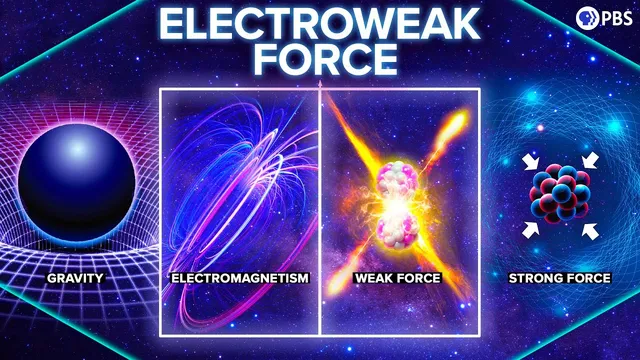
Electroweak Theory and the Origin of the Fundamental Forces
Based on PBS Space Time's video on YouTube. If you like this content, support the original creators by watching, liking and subscribing to their content.
Beta decay (neutron → proton + electron + neutrino) provided the experimental entry point for understanding the weak interaction, but early contact-interaction models didn’t capture its symmetry behavior.
Briefing
Electroweak unification ties two seemingly separate forces—electromagnetism and the weak interaction—together through a single symmetry that was broken as the universe cooled. That symmetry-breaking mechanism is what gives the weak force its short range and mass for the W and Z bosons, while leaving the photon massless. The payoff is not just a tidy story: experiments have confirmed electroweak behavior with high precision, and the framework points directly to the Higgs field as the missing ingredient.
The weak interaction enters the picture through beta decay, where a neutron turns into a proton while emitting an electron and a neutrino. Early quantum attempts, including Enrico Fermi’s “four fermion” interaction, treated the process as an extremely short-range contact interaction that worked at low energies but didn’t naturally explain key symmetry issues—especially charge-parity (CP) violation. Meanwhile, electromagnetism advanced through quantum electrodynamics (QED), a gauge theory in which forces are mediated by particles rather than by direct contact. In gauge theories, the existence and behavior of force-carrying fields follow from symmetries of the equations of motion.
That gauge-theory logic helped motivate a weak-force version: in 1957, Julian Schwinger proposed gauge bosons for the weak interaction. Because the weak force can convert neutral particles into charged pairs, the mediating bosons would have to carry charge, hinting at a relationship with electromagnetism. Experiments also suggested these hypothetical W bosons were massive—consistent with the weak force’s short range, often linked to the energy-time uncertainty idea. But massive gauge bosons create a theoretical headache: gauge symmetries typically demand massless carriers. Adding mass naively breaks the local phase symmetry that underpins the gauge description.
The resolution comes from a subtle but powerful distinction: equations of motion can respect a symmetry even if the system’s lowest-energy state does not. This is spontaneous symmetry breaking, illustrated by magnetic materials that have rotationally symmetric laws but pick a preferred alignment direction once cooled below the Curie temperature. Applying the same concept to the electroweak sector means starting with a combined SU(2)×U(1) symmetry—yielding four massless bosons in the symmetric phase—then letting the electroweak symmetry break at temperatures below roughly 10^15 Kelvin (the “electroweak era,” less than a trillionth of a second after the Big Bang). After breaking, the photon emerges as an independent massless U(1) gauge field, while the remaining SU(2) components become massive, producing the observed weak-force carriers.
Electroweak unification therefore reframes the origin of fundamental forces: the forces arise from symmetry principles, and their differences come from which symmetries survive at a given energy scale. That success also fuels the broader Standard Model program, where further symmetry extensions aim to incorporate the strong nuclear force into a larger structure U(1)×SU(2)×SU(3). The episode closes by pivoting to a different theme—how singularities in black holes and the Big Bang are tied to spacetime geometry—highlighting that the same drive for deeper principles keeps pushing physics forward.
Cornell Notes
Electroweak unification explains electromagnetism and the weak interaction as consequences of a single SU(2)×U(1) symmetry that existed when the universe was extremely hot. In that high-temperature phase, the theory predicts massless gauge bosons, but as the universe cooled below about 10^15 Kelvin, the symmetry was spontaneously broken. After symmetry breaking, the photon remains massless as the surviving U(1) gauge field, while the weak-force carriers become massive, giving the weak interaction its short range. This mechanism relies on the Higgs field to trigger the symmetry breaking and is supported by precision electroweak measurements. The framework also motivates broader attempts to unify the Standard Model forces via larger symmetry structures.
Why did early models of beta decay struggle to match the deeper symmetry structure of the weak interaction?
What makes gauge theories powerful for deriving forces from symmetries?
Why is giving mass to gauge bosons a theoretical problem?
How does spontaneous symmetry breaking resolve the mass problem for the weak force?
What does the electroweak symmetry breaking predict about the photon and W bosons?
Review Questions
- How do gauge symmetries determine the types of fields and particles that appear in a theory?
- What is the difference between symmetry in the equations of motion and symmetry in the physical ground state, and why does that matter for the weak force?
- Why does spontaneous symmetry breaking allow massive weak bosons without abandoning the gauge-theory framework?
Key Points
- 1
Beta decay (neutron → proton + electron + neutrino) provided the experimental entry point for understanding the weak interaction, but early contact-interaction models didn’t capture its symmetry behavior.
- 2
Quantum electrodynamics succeeded by treating forces as mediated by gauge bosons (photons) arising from symmetries of the equations of motion.
- 3
Schwinger’s gauge-boson approach to the weak interaction implied charged mediators (W bosons) and aligned with the idea that electromagnetism and the weak force are related.
- 4
Gauge theories typically require massless carriers; the observed short range of the weak force therefore created a major theoretical tension.
- 5
Spontaneous symmetry breaking resolves the tension by allowing symmetric equations of motion to produce a non-symmetric ground state that generates masses for the weak bosons.
- 6
Electroweak unification uses SU(2)×U(1) symmetry, which breaks below roughly 10^15 Kelvin, leaving a massless photon and massive weak-force carriers.
- 7
The electroweak framework points to the Higgs field as the mechanism responsible for symmetry breaking and mass generation.