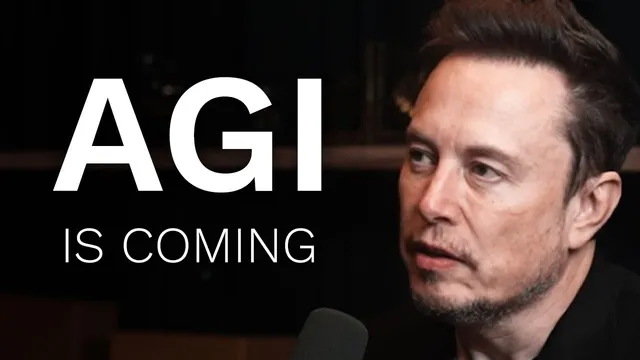
ELON MUSK - OpenAI will not build AGI. Tesla will.
Based on David Ondrej's video on YouTube. If you like this content, support the original creators by watching, liking and subscribing to their content.
Grok is presented as a curiosity-driven assistant that prioritizes truthfulness by grounding responses in physics first principles, mathematical logic, and reality checks.
Briefing
Elon Musk’s central message is that today’s AI progress hinges on grounding answers in physics and reliability—and that the path to transformative intelligence may come more from Tesla’s real-world, energy-efficient systems than from OpenAI-style AGI efforts. He frames XAI’s Grok as an assistant built around curiosity and truth-seeking, but with an explicit focus on reducing the most dangerous failure mode of large language models: confident hallucinations. Grok’s “fun mode” is treated as more than entertainment; it’s described as a way to keep interactions vivid while still aiming for grounded, testable outputs that can be traced back to “physics first principles,” mathematical logic, and ultimately reality as the final judge.
Musk contrasts LLMs’ current unreliability—especially when questions get difficult or high-stakes—with an approach that tries to make reasoning coherent across long outputs. He argues that token-by-token generation can drift, so the system must maintain “gestalt” coherence rather than letting small errors compound into nonsense. He likens improved reasoning to revising a draft: start messy, iterate, and converge toward a consistent whole. In that framing, AI becomes useful not just for generating text, but for enabling invention—because engineering depends on correct foundational rules. If the underlying physics is wrong, new technologies become “wishful thinking.”
On the bigger scientific horizon, Musk ties XAI’s mission to understanding the universe and suggests that AI could help push toward major theoretical breakthroughs—such as unifying general relativity and quantum mechanics—if it can discover new physics. He also shifts the discussion from “intelligence” to “consciousness,” arguing that even if thought and emotion aren’t more than atoms interacting, the “why” of subjective experience remains unresolved. He floats a provocative possibility: either everything is conscious or nothing is, and AI might help illuminate why consciousness feels compelling even if it’s an illusion.
The conversation then turns to dystopia versus utopia. Musk uses the Brave New World “soma” idea as a lens for the tension between artificial happiness and authentic human experience. He connects it to a real-world drug with similar trade-offs—relieving pain while impairing mental acuity—arguing that what looks like a happiness solution can become a control mechanism or a loss of depth. That same theme appears in his view of emotion and suffering: he questions whether eliminating all negative feelings would make society sterile and ultimately unstable.
Finally, Musk grounds AI’s future constraints in hardware and energy. He predicts shortages moving from silicon chips to voltage step-down transformers and then to electricity demand, arguing that electrification of transport and heating will triple electricity needs. For AI specifically, he emphasizes “useful productivity per watt” and says progress will be limited by compute and power availability—so efficiency, not brute force, becomes the decisive battleground. He also calls for regulatory oversight and a third-party referee model to reduce the risk of an unsafe competitive race, while defending open sourcing with a possible time delay. Throughout, Tesla’s approach is portrayed as more computer-efficient and more tightly coupled to the real world, with the potential to reach AGI-like capability by learning from perception and control under strict energy budgets.
Cornell Notes
Musk frames XAI’s Grok as a curiosity-driven assistant that aims to be more reliable than typical large language models by grounding answers in physics first principles, mathematical logic, and reality. He argues that token-by-token generation can drift into confident nonsense, so the system must preserve coherence across an entire response—like revising a draft until it “adds up.” He links AI’s long-term value to discovering new physics and, separately, to understanding intelligence and consciousness—questions that remain unresolved even if thought is ultimately physical. He also warns that AI’s future is constrained by energy and hardware bottlenecks, making efficiency (“useful productivity per watt”) as important as raw capability. Finally, he uses the Brave New World “soma” idea to argue that artificial happiness may trade away authentic human experience and depth.
Why does Musk emphasize “grounded” answers rather than more fluent text generation?
What problem does Musk say arises from predicting text one token at a time?
How does Musk connect AI to major scientific discovery, like a Theory of Everything?
What does Musk mean by “intelligence” and “consciousness” being fundamental open questions?
Why does the “soma” discussion matter for AI and society?
What constraints does Musk say will shape AI’s progress over the next few years?
Review Questions
- How does Musk’s critique of token-by-token generation translate into his requirements for coherence and reliability in AI outputs?
- What trade-offs does Musk draw between pain relief and mental acuity when comparing real drugs to Brave New World’s soma?
- Why does Musk treat energy and hardware bottlenecks as a primary limiter of AI capability, and how does that affect the “useful productivity per watt” framing?
Key Points
- 1
Grok is presented as a curiosity-driven assistant that prioritizes truthfulness by grounding responses in physics first principles, mathematical logic, and reality checks.
- 2
Musk argues that large language models can drift into confident errors over long outputs, so coherence must be evaluated at the response level, not just token-by-token.
- 3
Engineering breakthroughs depend on correct foundational rules; if underlying physics reasoning is unreliable, inventions become wishful thinking.
- 4
Musk links AI’s long-term scientific promise to discovering new physics and to unresolved questions about intelligence and consciousness.
- 5
He uses Brave New World’s soma to argue that artificial happiness can become dystopian, especially when real-world analogs trade pain relief for reduced mental acuity.
- 6
AI progress is constrained by energy and infrastructure—silicon, transformer capacity, and electricity supply—making efficiency (“useful productivity per watt”) a decisive target.
- 7
He calls for regulatory oversight to reduce the risk of unsafe competitive races and supports open sourcing with a possible time delay.