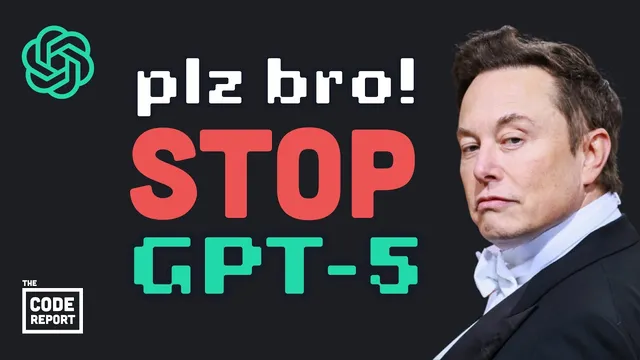
Elon wants GPT-5 stopped NOW… 5 reasons AI kinda sucks
Based on Fireship's video on YouTube. If you like this content, support the original creators by watching, liking and subscribing to their content.
AI’s biggest near-term impact may be changing how people learn and work, not replacing foundational skills like problem-solving and critical thinking.
Briefing
AI hype is colliding with everyday reality: large language models are powerful enough to change how people learn and work, but the near-term payoff is uneven, the incentives behind the rollout are murky, and the long-term “AGI takeover” narrative looks overstated. The central claim is that AI will likely plateau rather than trigger a runaway “singularity,” leaving society to deal with messy side effects—education disruption, unreliable engineering, and an internet increasingly hard to trust.
The first knock is educational. If chatbots can already write and debug code, generate app ideas from napkin sketches, and solve many assignments instantly, students may question the value of a computer science degree. The transcript argues that this doesn’t invalidate the discipline so much as it changes what matters: foundational problem-solving and critical thinking still matter, while students should learn to leverage AI tools rather than treat them as a replacement for learning. It also claims that many degrees beyond CS will be affected, since AI can assist across domains, but real-world experience remains the differentiator.
Second, the transcript draws a line between impressive demos and building complex systems. Large language models are portrayed as strong at repackaging known information, but weaker when requirements are novel or when multiple moving parts must work together—illustrated by a failed attempt to build a moderately complex .NET application. It also raises a specific risk: AI can be used to execute code via plugins, potentially generating and testing tens of thousands of candidate solutions when requirements are well defined. That capability could make hand-written source code less necessary, likened to how garbage collectors reduced manual memory management.
Third, the critique turns to incentives and messaging. The transcript points to OpenAI leadership and public materials as evidence of “optics” and marketing: claims that GPT-4 is both not as good as it seems and yet framed as showing “sparks of AGI,” alongside calls for urgent regulation. It argues that rapid mainstream adoption—fuelled by partnerships such as Microsoft and broad daily usage—functions like a hype engine rather than a transparent technical roadmap.
Fourth, AI is said to be degrading the internet’s authenticity. If images, posts, and accounts are increasingly indistinguishable from human output, trust erodes. The transcript references the “dead internet theory,” suggesting fake engagement could inflate metrics and keep creators locked in a feedback loop.
Finally, the most consequential prediction is that AI won’t grow exponentially into an unstoppable intelligence explosion. Instead, progress is expected to follow a sigmoid curve: transformer ideas date back to 2017, and while building useful models requires massive compute, the leap to human-level general intelligence is framed as unlikely. The transcript ends on a mix of skepticism and mysticism—arguing that human consciousness and “secret sauce” may be beyond current models—while warning that any sudden “AGI has arrived” narrative could be used to push extreme social changes. Overall, the message is not that AI is useless, but that the timeline, the marketing, and the societal fallout are being oversold.
Cornell Notes
The transcript argues that today’s AI is impressive but overhyped: it can accelerate certain tasks, yet it struggles with novel, complex engineering and can blur trust online. It also claims AI’s educational impact will be real—students may question traditional learning—but critical thinking and real-world experience still matter, and learners should focus on using AI effectively. A major concern is that AI-generated content and engagement can make the internet feel synthetic, undermining authenticity. The biggest forecast is that AI progress will plateau rather than trigger a rapid “singularity,” because scaling and capability gains have practical limits and human-level general intelligence remains uncertain. The takeaway: treat AI as a tool with uneven reliability and shifting incentives, not as an imminent takeover.
Why does the transcript say AI changes the value of a computer science degree, and what alternative does it recommend?
What distinction does the transcript make between AI’s “miracle” performance and its ability to build real systems?
How does the transcript frame the risk and potential of AI executing code?
What evidence does the transcript use to argue that AI hype is driven by marketing and incentives?
Why does the transcript say the internet is becoming less trustworthy?
What is the transcript’s main forecast about AI’s long-term trajectory?
Review Questions
- What parts of education does the transcript claim AI undermines, and which skills does it say remain valuable?
- How does the transcript explain why AI can struggle with building complex systems even when it performs well on simpler tasks?
- What reasons does the transcript give for expecting AI capability growth to plateau rather than accelerate into AGI quickly?
Key Points
- 1
AI’s biggest near-term impact may be changing how people learn and work, not replacing foundational skills like problem-solving and critical thinking.
- 2
Instant help with assignments and coding can reduce the perceived value of formal training, but real-world experience still determines competence.
- 3
Large language models can falter when building complex software systems with many interdependent components, especially when requirements are novel.
- 4
AI code execution tools could scale solution generation and testing, potentially reducing the need for hand-written code while increasing the importance of correctness and safety.
- 5
Mainstream AI growth is portrayed as tightly linked to messaging and incentives, including mixed signals about capability and urgent calls for regulation.
- 6
AI-generated content threatens internet authenticity by making it harder to distinguish human-made posts and images from synthetic ones.
- 7
The transcript predicts AI capability will plateau rather than trigger an exponential “singularity,” citing practical scaling limits and uncertainty about human-level intelligence.