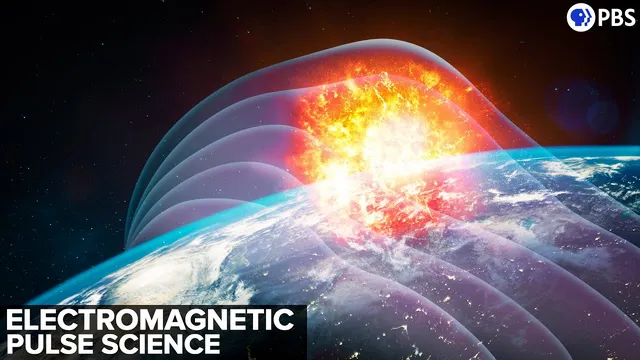
EMP Attack: The Real Science of Electromagnetic Pulse
Based on PBS Space Time's video on YouTube. If you like this content, support the original creators by watching, liking and subscribing to their content.
Starfish Prime demonstrated that a space thermonuclear detonation can generate an EMP capable of disrupting electronics hundreds to thousands of kilometers away.
Briefing
A single thermonuclear detonation in space can generate an electromagnetic pulse (EMP) strong enough to knock out electronics across a continent-scale region—and it can also create a long-lived artificial radiation belt that damages satellites for years. The 1962 Starfish Prime test over the Pacific demonstrated both effects: it produced “artificial auroras” by ionizing the upper atmosphere, disrupted power and communications far from the blast, and destroyed roughly a third of low Earth orbit satellites through repeated exposure to the new radiation environment.
Starfish Prime released an enormous burst of gamma rays. While Earth’s atmosphere blocks most gamma photons from reaching the surface, the energy still matters: gamma rays scatter off electrons in the upper atmosphere, knocking them free. Those fast electrons then spiral along Earth’s geomagnetic field lines. As they move, they emit a narrow, intense EMP that travels at the speed of light—keeping pace with the fading gamma-ray “shell” as it passes through the atmosphere. The result is a sharply timed pulse that can drive excessive current in wires and circuitry. In practical terms, that can mean anything from immediate shutdown to melted components: excess current produces heat, and heat can damage or destroy transformers and other grid hardware.
The reach of the EMP depends on the explosion’s size and altitude. Because an orbital detonation can illuminate a large portion of the planet, the likely impact region can span a continent, limited by Earth’s curvature. Starfish Prime’s 400 km altitude was high enough that effects reached Hawaii, where hundreds of streetlights reportedly went dark about 900 km away. A modern event over a large populated landmass could induce massive currents in today’s sprawling power networks, potentially burning out transformers and triggering blackouts that might take years to repair.
Beyond the EMP, the same spiraling electrons don’t vanish immediately. Near the poles, the geometry of the magnetic field changes the electrons’ motion so they bounce back and forth rather than striking the ground. Over time, they form a toroidal radiation belt around Earth—an artificial analogue to the natural Van Allen belts. Natural belts exist because charged particles trapped by geomagnetic field lines bounce between hemispheres; satellites avoid them because radiation degrades electronics. Starfish Prime created a belt several orders of magnitude stronger than Earth’s natural belts and it persisted for about five years, repeatedly exposing low Earth orbit satellites and contributing to widespread failures.
The strategic implication is blunt: a space nuke can be “precise” in where it hits the ground with EMP, but it is indiscriminate for satellites. Low Earth orbit—now crowded with thousands of spacecraft—would likely see a surge in charged-particle density comparable to the peak of the Van Allen belts, risking the loss of a substantial fraction of satellites. Hardening can reduce damage, but it is costly. The United States is also leaning toward redundancy, including plans for proliferated constellations of many small satellites, which are harder to wipe out in bulk and easier to replace.
Starfish Prime’s legacy helped drive major arms-control steps, including the Partial Nuclear Test Ban Treaty and the Outer Space Treaty, both aimed at limiting nuclear weapons in space. Yet the transcript stresses that deterrence and treaties only hold if compliance continues—raising the question of whether the world will reaffirm peaceful “space time” or drift toward militarized orbit.
Cornell Notes
Starfish Prime showed that a thermonuclear detonation in orbit can create two major hazards: a fast, damaging EMP on the ground and a long-lived artificial radiation belt in space. Gamma rays from the explosion knock electrons free in the upper atmosphere; those electrons spiral along Earth’s magnetic field lines and generate an EMP that travels at light speed, arriving as a sharp pulse. The electrons then become trapped, bouncing between hemispheres and forming a toroidal belt that can persist for years and degrade or destroy low Earth orbit satellites. Because modern satellite networks are far larger than in 1962, a similar event today could cause widespread outages and satellite losses, making hardening and redundancy central concerns for space security.
How does a space nuclear explosion produce an EMP that can disrupt electronics far from the blast?
Why did Starfish Prime’s EMP reach Hawaii, and what does that imply for a modern event?
What creates the long-lived artificial radiation belt after a space nuke?
How do the natural Van Allen belts relate to satellite vulnerability?
Why is satellite damage from a space EMP/radiation event hard to “target,” and what mitigation strategies exist?
What arms-control logic connects Starfish Prime to later treaties?
Review Questions
- What physical chain links gamma rays to a sharp EMP pulse that can damage power grids?
- How do geomagnetic field geometry and electron pitch angle lead to the formation of an artificial radiation belt?
- Why does a space nuclear event pose a different kind of risk to satellites than to ground-based infrastructure?
Key Points
- 1
Starfish Prime demonstrated that a space thermonuclear detonation can generate an EMP capable of disrupting electronics hundreds to thousands of kilometers away.
- 2
Gamma rays don’t need to reach the ground to matter; their energy ionizes the upper atmosphere and drives electron motion that produces the EMP.
- 3
The EMP forms as a narrow, intense pulse because the emitted electromagnetic disturbance stays synchronized with the gamma-ray shell moving through the atmosphere.
- 4
The same electrons can become trapped by Earth’s magnetic field, bouncing between hemispheres and creating a toroidal artificial radiation belt that can persist for years.
- 5
Satellite vulnerability depends strongly on orbit: low Earth orbit is especially at risk if it overlaps the artificial belt, while geosynchronous orbits can sit in a safer gap.
- 6
Hardening satellites against particle flux can reduce damage but is costly; redundancy with many small satellites is a practical alternative.
- 7
Arms-control progress after Starfish Prime—especially the Partial Nuclear Test Ban Treaty and the Outer Space Treaty—reflects the real-world consequences of nuclear activity in space.