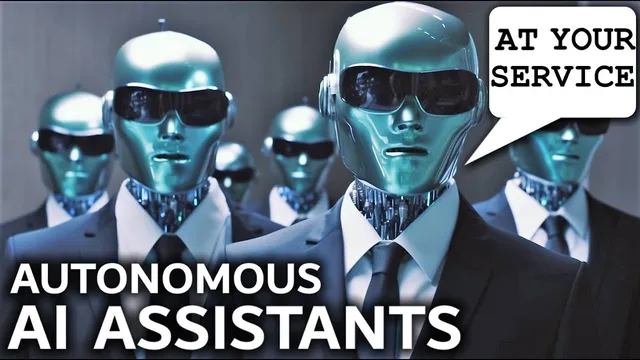
Enable AGI | How to Create Autonomous AI Agents with GPT-4 & Auto-GPT
Based on MattVidPro's video on YouTube. If you like this content, support the original creators by watching, liking and subscribing to their content.
Auto-GPT can chain web search, browsing, summarization, and file-writing to pursue a goal with limited user intervention.
Briefing
Autonomous AI agents built with GPT-4 can already perform multi-step, goal-driven work—searching the web, reading long pages, storing information for later, generating plans, and writing outputs to files—without constant user micromanagement. The practical takeaway is less “AGI is here” and more “agentic workflows are real,” but they’re still brittle: they loop when they can’t get the right input, fail to parse outputs, and struggle with tasks that require reliable, real-time access or stable tool behavior.
The walkthrough centers on Auto-GPT, an open-source application that turns a language model into an agent that can run tasks automatically. Using an OpenAI API key, the setup involves cloning the Auto-GPT GitHub repo, installing Python requirements, and optionally enabling Pinecone for vector-based “memory,” which lets the system store and retrieve information across steps. Auto-GPT can also run in a continuous mode that warns users it may act without authorization and could run indefinitely—an explicit safety concern that the experimenter avoids.
In the first major test, the agent is given a business-and-net-worth mission: increase net worth, develop and manage multiple businesses, and autonomously research and implement ideas. It immediately begins planning and then repeatedly requests authorization, getting stuck in loops when the user doesn’t provide the expected responses. After restarting with simpler default goals, it pivots into a drop-shipping/e-commerce direction, using Google searches and browsing to compare platforms. The agent reads large blocks of text from sites like ecommerce.com and evaluates options such as Shopify and BigCommerce, summarizing and ingesting content to refine its plan. It also demonstrates self-criticism—checking whether its strategy balances factors like costs, quality, and operational constraints.
A second test pushes into personal-data territory by setting up a “private investigator” style mission: gather information about “MattVidPro AI,” plan a meeting, and generate a bio. The agent attempts to research via Google, then browse social and personal pages, including Twitter and a personal website and YouTube channel. It creates additional sub-agents to analyze videos and playlists, but the system hits errors and even returns a limitation message about browsing—highlighting how easily tool access and agent orchestration can break down.
To show what “works” when the task is narrower, the experiment shifts to a gardening YouTuber scenario. The agent researches successful gardening channels, extracts common video formats and keywords, and then produces a concrete channel plan plus a set of video ideas. It writes these outputs into files in the Auto-GPT filesystem, including a “garden channel plan” and “video ideas” covering topics like raised beds, pest and disease control, pruning, drought survival, and product reviews. Even with occasional parsing failures and limitations around real-time data (e.g., Google Trends), the agent still achieves a usable deliverable.
Overall, the demonstration frames agentic AI as a powerful early capability: it can chain tools, read and summarize web content, and generate structured outputs. But it also underscores the current ceiling—unreliable autonomy, safety risks in continuous mode, and difficulty with complex, high-stakes, or real-time information tasks. The result is a clear prompt for caution and planning as these systems improve.
Cornell Notes
Auto-GPT turns GPT-4 into an autonomous agent that can pursue goals by chaining tools: searching the web, browsing pages, summarizing long text, and writing plans and outputs to files. With Pinecone enabled, it can store information using vector-based memory, letting it reference earlier findings during later steps. In business and personal-investigation tests, the agent often loops, requests authorization, or fails when sub-agents can’t reliably access tools or parse results. When the task is simplified—building a gardening YouTube channel—the agent successfully produces a channel strategy and a list of video ideas by researching competitors and extracting recurring topics, formats, and keywords. The key lesson: agentic workflows work today, but they remain fragile and require guardrails.
What makes Auto-GPT feel “autonomous,” and what components enable that behavior?
Why does “continuous mode” matter, and what risk does it introduce?
How did the agent behave in the net-worth/drop-shipping business test?
What went wrong in the “private investigator” style personal research attempt?
Why did the gardening YouTuber task succeed more than the personal-investigation task?
What does the demonstration suggest about current limits of agentic GPT-4 systems?
Review Questions
- In what ways do Pinecone-based vector memory and local file storage change what an agent can do across multiple steps?
- Compare the failure modes seen in the personal-investigation test versus the gardening-channel test. What task characteristics likely made one more reliable?
- What safety trade-offs does continuous mode introduce, and how did the walkthrough mitigate them?
Key Points
- 1
Auto-GPT can chain web search, browsing, summarization, and file-writing to pursue a goal with limited user intervention.
- 2
Pinecone can add vector-based memory so the agent can store and retrieve information across steps more effectively.
- 3
Continuous mode increases risk by running without authorization and potentially looping indefinitely.
- 4
Agent runs can stall when outputs aren’t parsed correctly or when the agent expects user confirmation in the middle of an action plan.
- 5
Personal-data style autonomy is especially fragile because tool access and sub-agent orchestration can fail, producing errors or incomplete results.
- 6
Narrow, structured tasks (like generating a YouTube channel plan from competitor research) are more likely to produce usable artifacts today.
- 7
Even when autonomy works, it still depends on reliable tool access and well-formed outputs; brittle parsing and real-time data limitations remain key constraints.