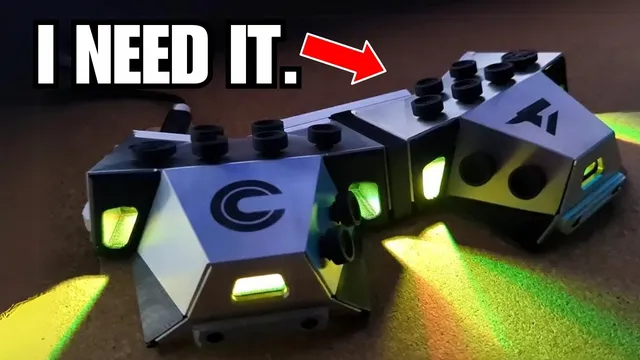
END GAME KEYBOARD
Based on The PrimeTime's video on YouTube. If you like this content, support the original creators by watching, liking and subscribing to their content.
The Master Forge is pitched as a keyboard replacement that uses 3D switches to enable quicker reaction and faster typing without breaking finger contact.
Briefing
A new “Master Forge” keyboard pitch is betting that typing can jump from conventional key presses to a faster, more ergonomic input method—using 3D switches, extensive key combinations, and a tightly integrated software stack. The core promise is “hyper fluency”: faster reaction and typing without breaking finger contact, framed as a path to reaching around 400 words per minute after a steep learning period. The pitch also leans heavily on hardware build quality—an aerospace-grade aluminum exoskeleton—and on an ecosystem that invites users to customize and even build their own add-ons.
The keyboard’s differentiator is its 3D switching approach, positioned as a way to replace traditional one-dimensional key actuation with multi-axis input. That design is sold as enabling quicker responses and reducing repetitive strain, with the claim that users can type faster while using less effort. The discussion then pivots to feasibility and timelines. Some participants compare the idea to stenography—arguing that stenographer-style input can be dramatically faster—but also question whether “speed of thought” claims are realistic for everyday users. Neuralink comes up as a contrast: brain-computer interfaces are viewed as potentially inevitable in the long run, but far too distant to matter for most people now.
Beyond the switches, the Master Forge is presented as more than a keyboard replacement. It’s described as shipping with a “Platinum” car Corder engine Corp (as named in the transcript) and a plug-and-play, driverless operating system, plus features like anti-ghosting routing and a USB hub. Security concerns surface immediately: if the device runs embedded software and drivers, users worry about hacking—especially the idea of a “Char recorder” being compromised. The customization pitch is also extreme: every combination of keys is described as customizable, with the conversation trying to quantify the number of possible states and noting that human fingers limit practical use.
A major selling point in the later segment is openness. The company behind Forge is said to post weekly updates in community spaces and to release much of its tooling as open source, including an open serial API specification and an Open Access CAD repo. That openness is framed as enabling users to build custom bolt-ons and even create their own fully featured devices using a “car engine chip module.”
Still, the biggest obstacle is adoption. Multiple participants focus on the learning curve: switching typing layouts (like from QWERTY to Dvorak) can take months, and stenography-style input is treated as a commitment rather than a quick upgrade. Even fans of the concept say the hardest sell is the time required to become useful again on familiar layouts. The transcript ends with broader keyboard culture comparisons—mentioning other specialized controllers and ergonomic approaches—and a recurring theme: the hardware may look impressive and the openness may be radical, but the real test is whether the Master Forge can deliver on its speed and usability promises once real users put in the training time.
Cornell Notes
The Master Forge keyboard pitch centers on a hardware-and-software leap aimed at making typing faster and more ergonomic. Its key claim is “hyper fluency” enabled by 3D switches that allow quicker reaction and typing without breaking finger contact, with an advertised path to around 400 words per minute after learning. The ecosystem adds anti-ghosting routing, USB hub support, and a plug-and-play “driverless” operating system, while also emphasizing open-source tools, an open serial API, and an Open Access CAD repo for customization. Skepticism focuses on feasibility—especially “speed of thought” comparisons—and on the practical barrier of relearning input methods, which can take months. Openness and customization are treated as major differentiators, but adoption hinges on whether users can stick with the training.
What makes the Master Forge different from a conventional keyboard, according to the transcript?
Why does the transcript repeatedly bring up stenography and “Char recorder” style input?
What role does software and connectivity play in the Master Forge pitch, and what concern follows from it?
How does openness/customization factor into the product’s appeal?
What is the biggest practical barrier to adoption mentioned in the discussion?
How do participants evaluate the “speed of thought” or extreme speed claims?
Review Questions
- What specific hardware feature (as described) is supposed to enable faster reaction and typing on the Master Forge?
- Why does switching to a new input layout (like QWERTY to Dvorak) create a temporary productivity problem, and how does that relate to adopting the Master Forge?
- Which transcript-mentioned features suggest the Master Forge is more than a basic keyboard, and what security concern arises from that added complexity?
Key Points
- 1
The Master Forge is pitched as a keyboard replacement that uses 3D switches to enable quicker reaction and faster typing without breaking finger contact.
- 2
The speed claims (including reaching around 400 words per minute) depend on a significant learning period, which multiple participants treat as the main adoption hurdle.
- 3
Embedded software features—like a plug-and-play “driverless” operating system, anti-ghosting routing, and USB hub ports—raise immediate hacking/security concerns.
- 4
Customization is positioned as near-unlimited, with every key combination described as customizable, though practical use is constrained by human finger input.
- 5
Forge’s openness is a major differentiator: weekly community updates plus open-source tooling, an open serial API specification, and an Open Access CAD repo for building bolt-ons.
- 6
The transcript contrasts long-term brain-computer interface possibilities (Neuralink) with near-term interface training, expressing skepticism about “speed of thought” for everyday users.
- 7
Community discussion repeatedly ties extreme typing speed to stenography-style systems, while emphasizing that relearning can take months and disrupt existing typing habits.