Engineering with Origami
Based on Veritasium's video on YouTube. If you like this content, support the original creators by watching, liking and subscribing to their content.
Origami’s engineering value comes from turning flat sheets into 3D structures with minimal processing, often increasing rigidity through geometry.
Briefing
Origami has become a practical engineering toolkit because it turns flat sheets into complex, functional 3D structures with minimal processing—often adding rigidity, enabling compact storage, and delivering precise motion. That combination has driven a shift from paper-folding as an art form into designs for medicine, space hardware, protective barriers, and even transportation aerodynamics.
The modern surge traces back to Akira Yoshizawa, whose thousands of new crease patterns and influential books helped spark a worldwide renaissance. From there, engineers began treating folding as a controllable mechanism: a flat sheet can be transformed into shapes that “snap” between stable states, such as bi-stable structures that pop into place when twisted. In one striking example, origami bellows developed for the da Vinci surgical robot keep an internal cavity constant as a flexible catheter advances—supporting the catheter along its path to reduce buckling during insertion.
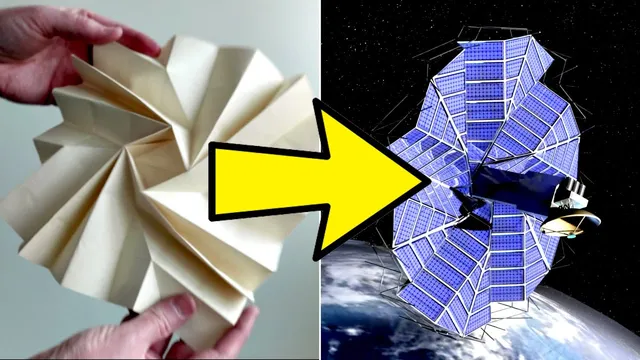
Origami’s mechanical advantages also show up in protection and deployment. A bulletproof, collapsible wall based on the Yoshimura crease pattern can pack tightly for vehicle use and deploy into a multi-layer barrier; tests using 12 layers of Kevlar stop handgun rounds, while an updated design with interchangeable panels is intended to handle rifle fire. The same deployment logic powers space systems: the Miura ori pattern, used on a space mission as early as 1995, opens and closes in a single motion and flattens into a thin, launch-friendly form—an approach now proposed for satellite solar arrays to improve compactness and reliability.
Beyond deployment, folding can create motion and performance that rigid-link mechanisms struggle to achieve. By leveraging compliant behavior, origami-inspired designs can produce continuous rotation—illustrated by a continuously revolving compliant mechanism called the KALITA cycle. Medical instruments also benefit: origami-based forceps can be tiny for small incisions, then morph into grippers inside the body. A related mini gripper used in robotic surgeries replaces older mechanisms, cutting the number of parts by 75% while expanding the range of motion.
Scaling origami down pushes the concept into micro- and nano-manufacturing. A microscopic flapping-bird prototype required self-folding techniques at sizes smaller than a grain of salt, and the underlying idea maps to medical implants. One application is a nano injector for gene therapy—about four micrometers thick—where hundreds can fit on a one-centimeter chip.
Underpinning all these breakthroughs is math. Designing crease patterns can be reduced to geometric construction rules, such as circle-packing methods for “stick-figure” shapes, and more general algorithms for full surfaces. Tomohiro Tachi’s Origamizer takes a triangulated surface description and outputs a folding pattern, enabling sheets to be folded into arbitrary 3D forms. The result is a workflow where centuries of folding intuition become engineering-ready through modeling, computation, and experimentation—turning paper’s constraints into a design language for modern technology.
Cornell Notes
Origami is useful in engineering because folding a flat sheet can reliably produce 3D shapes, compact storage, added rigidity, and controllable motion with relatively little processing. Real-world applications range from origami bellows that support flexible catheters for the da Vinci surgical robot to deployable structures like the Miura ori solar-array pattern used in space missions. Folding can also improve protection, such as a Yoshimura-crease collapsible wall tested with 12 layers of Kevlar, and can generate complex mechanics like continuous rotation via the KALITA cycle. The field’s growth depends on mathematical design methods—especially algorithms like Origamizer—that convert surface descriptions into crease patterns, making origami more than a craft.
Why does origami translate so well into engineering compared with traditional fabrication?
How do origami structures help with flexible medical tools like catheters?
What makes the Yoshimura and Miura ori patterns especially valuable for deployment?
How can origami create motion that’s hard for conventional mechanisms?
What role does math play in moving from “paper toys” to engineered shapes?
How does origami scale down to micro- and nano-scale devices?
Review Questions
- What engineering properties does origami gain or enhance through folding (e.g., rigidity, stability, compactness, motion), and how do those properties show up in specific examples?
- Compare the roles of Yoshimura and Miura ori patterns in deployment and protection—what geometric behavior makes each useful?
- How do circle-packing methods and Origamizer differ in what kinds of shapes they can generate folding patterns for?
Key Points
- 1
Origami’s engineering value comes from turning flat sheets into 3D structures with minimal processing, often increasing rigidity through geometry.
- 2
Bi-stable folding designs can switch between stable configurations, enabling snap-through behavior useful for mechanisms and sensors.
- 3
Origami bellows can keep an internal cavity constant during extension, helping flexible catheters avoid buckling in robotic surgery.
- 4
Deployable crease patterns like Miura ori enable thin, compact storage and reliable single-motion deployment, with space heritage dating to 1995.
- 5
Origami-based protective structures can be tested with layered materials (e.g., 12 layers of Kevlar) and redesigned for different threat levels using interchangeable panels.
- 6
Mathematical design methods—especially Origamizer for triangulated surfaces—convert target shapes into crease patterns, making origami scalable beyond craft knowledge.
- 7
Scaling origami to micro- and nano-scales supports medical device concepts such as self-folding implants and nano injectors for gene therapy.