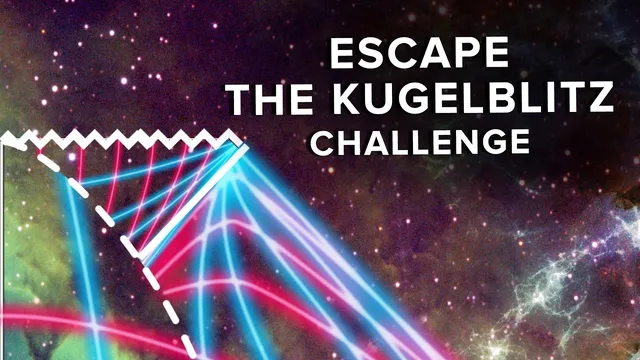
Escape The Kugelblitz Challenge
Based on PBS Space Time's video on YouTube. If you like this content, support the original creators by watching, liking and subscribing to their content.
Penrose diagrams compress the infinite near-horizon stretching of spacetime into a finite picture where light always travels along 45-degree lines.
Briefing
The episode’s core insight is that realistic black-hole formation is messier than the ideal “eternal” black hole often drawn in textbooks: during collapse, an “extended” horizon of doom can appear before the true event horizon finishes forming. That matters because it changes what observers can still influence—especially in a hypothetical scenario where a black hole is created suddenly and spherically around a planet.
It starts by revisiting Penrose diagrams, which compress the infinite stretching of spacetime near a black hole into a finite picture. On these diagrams, light always travels along 45-degree lines, making causal reach easy to judge. The discussion then contrasts an idealized Schwarzschild black hole—non-rotating, uncharged, and eternal—with astrophysical black holes that must form from collapsing matter. A massive star collapses once its core shrinks below its Schwarzschild radius (set by mass). After that point, an event horizon forms and the interior becomes a region where space and time swap roles, driving everything toward a singularity.
The twist comes during collapse: even before the true event horizon completes, there are regions where all future-directed light cones end at the singularity. In Penrose-diagram terms, the “effective event horizon” extends backward in time to include this doomed region. As the star continues shrinking, that invisible horizon grows until it merges with the actual event horizon. Anyone inside this extended horizon loses causal contact with the rest of the universe—meaning no signal, even at light speed, can escape in time.
From there, the episode pivots to a deliberately implausible but physics-driven alien attack: a “kugelblitz,” a black hole made entirely from light. An advanced civilization fires a spherical shell of light inward, with mass-energy equivalent to 100,000 suns. The Schwarzschild radius for that mass is about one light second, so the event horizon forms shortly after the light shell passes the moon. From the outside, the system looks like a black hole. Inside, Earth gets roughly one second of warning before being consumed.
The reason that brief window exists is Newton’s shell theorem: in a perfectly spherical shell, the gravitational influence inside cancels out. So the interior stays effectively flat until the collapsing light shell overtakes it—even after the horizon has already formed from the outside.
Finally, two “competing plans” are posed for humanity to choose one: Plan A builds an infinitely strong Dyson sphere just outside the moon’s orbital radius to absorb the incoming pulse and store its energy; Plan B deploys a reflective spherical force shield halfway between Earth and the moon to bounce light outward using an exotic EM drive that violates momentum conservation so the satellites don’t ricochet back. The challenge is to draw a Penrose diagram and argue which option has the better chance, given the causal structure and the short time window before the extended horizon seals off escape.
Cornell Notes
Penrose diagrams let you track what can influence what by using 45-degree light paths. For an ideal eternal Schwarzschild black hole, the horizon is fixed, but real black holes form from collapsing stars. During collapse, an “extended” horizon of doom can exist before the true event horizon finishes forming, cutting off causal contact for regions whose future light cones hit the singularity. The episode then applies this to a hypothetical kugelblitz: a spherical shell of light with mass-energy equal to 100,000 suns. The event horizon forms after the shell passes the moon, yet Earth may have about one second of “nothing seems wrong” time because Newton’s shell theorem cancels gravitational effects inside a spherical shell until it arrives.
Why do Penrose diagrams make causal limits easy to see?
What changes when moving from an eternal Schwarzschild black hole to a collapsing one?
What is the “extended event horizon” during collapse?
How does a kugelblitz create a short warning window for Earth?
Between the Dyson sphere and the reflective shield, what causal issue should the Penrose diagram test?
Review Questions
- On a Penrose diagram, how would you identify a region that is doomed even before the true event horizon forms?
- Why does Newton’s shell theorem allow an interior region to remain “comfortably flat” until the light shell arrives, even if an event horizon has already formed from the outside?
- What would you look for on the diagram to decide whether Plan A (Dyson sphere) or Plan B (reflective shield) can still affect the causal future before the extended horizon cuts it off?
Key Points
- 1
Penrose diagrams compress the infinite near-horizon stretching of spacetime into a finite picture where light always travels along 45-degree lines.
- 2
Real black holes form when a collapsing star’s core shrinks below its Schwarzschild radius, unlike ideal eternal Schwarzschild models.
- 3
During collapse, an “extended” horizon of doom can appear before the true event horizon completes, trapping regions whose future light cones end at the singularity.
- 4
A kugelblitz modeled as a spherical shell of light with mass-energy equivalent to 100,000 suns forms an event horizon about one light second in scale, shortly after the shell passes the moon.
- 5
Newton’s shell theorem explains why the interior can remain effectively flat until the shell overtakes it, giving Earth roughly one second of apparent normalcy.
- 6
The Dyson sphere plan focuses on absorbing the incoming pulse outside the moon’s orbit, while the reflective shield plan focuses on reflecting light outward from midway between Earth and the moon using an exotic EM drive.