Euler's Formula and Graph Duality
Based on 3Blue1Brown's video on YouTube. If you like this content, support the original creators by watching, liking and subscribing to their content.
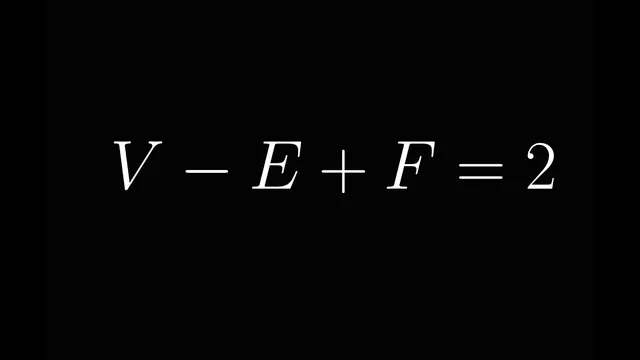
For a connected planar graph, Euler’s formula uses V vertices, E edges, and F faces (including the outer region): V − E + F = 2.
Briefing
Euler’s formula for planar graphs—V − E + F = 2—can be derived from a clean duality argument built on spanning trees. The key move is to translate the planar drawing into two interlocking graphs: one whose vertices are the original graph’s vertices and another whose vertices are the faces carved out by the drawing. Once that dual graph is in place, spanning trees in the original graph force spanning trees in the dual, and a simple counting fact about trees turns into Euler’s constant “2.”
Start with a connected planar graph drawn without edge crossings. Label its vertices V, edges E, and faces F (including the unbounded outer region). The proof then introduces three concepts: cycles, spanning trees, and dual graphs. A cycle is a closed path that starts and ends at the same vertex. A spanning tree is a cycle-free connected subgraph that touches every vertex. The dual graph is formed by placing a vertex inside each face and connecting two dual vertices whenever their corresponding faces share an edge in the original drawing; the “edges” of the dual are literally the same geometric edges, just used to separate faces rather than connect vertices.
The duality payoff comes from a specific setup with two characters: Randolph moves along the original graph’s vertices, while Mortimer moves across the dual graph’s faces. Randolph buys a spanning tree, meaning he has a connected, cycle-free set of edges. Mortimer is forbidden from crossing those same edges, so he can traverse only the remaining edges. The crucial claim is that Mortimer’s available edges automatically form a spanning tree in the dual graph. Two checks make this work: (1) Mortimer can reach all dual vertices (all faces), because isolating a face would require a cycle in Randolph’s spanning tree, which trees cannot have; and (2) Mortimer’s traversable edges contain no cycles, because a dual cycle would split the original vertices into separated regions, preventing Randolph’s spanning tree from spanning everything.
With that correspondence established, counting becomes straightforward. Any tree with n edges has exactly n + 1 vertices: start from a root vertex, and each added edge brings in one new vertex without creating cycles. Randolph’s spanning tree has V vertices and V − 1 edges. The remaining edges form Mortimer’s spanning tree in the dual, whose vertices are the original faces F; therefore Mortimer’s tree has F vertices and F − 1 edges. Add the two edge counts: E = (V − 1) + (F − 1) = V + F − 2. Rearranging yields V − E + F = 2, which is Euler’s formula. The result is less a standalone counting trick than a consequence of how spanning trees and cycles mirror each other across the original graph and its dual.
Cornell Notes
For a connected planar graph with V vertices, E edges, and F faces, Euler’s formula V − E + F = 2 follows from duality plus a tree-counting fact. Build the dual graph by placing a vertex in each face and connecting dual vertices across each original edge. Choose any spanning tree in the original graph; the edges not in that tree form a spanning tree in the dual graph. Because every tree with k edges has k + 1 vertices, the original spanning tree has V − 1 edges, while the dual spanning tree has F − 1 edges. Adding them gives E = (V − 1) + (F − 1), which rearranges to V − E + F = 2.
How is the dual graph constructed from a planar drawing, and why do dual edges correspond to the same original edges?
What does it mean for a subgraph to be a spanning tree, and why does “no cycles” matter?
Why do cycles in the original graph correspond to connected components in the dual (and vice versa)?
Why do the edges available to Mortimer (those not in Randolph’s spanning tree) form a spanning tree in the dual graph?
How does the tree identity “vertices = edges + 1” drive the Euler formula?
Review Questions
- Given a connected planar graph with V vertices and F faces, how many edges must a spanning tree contain, and how does that relate to the dual spanning tree?
- In the duality argument, what specific failure mode would create a cycle in Mortimer’s available edges, and why would that contradict Randolph’s spanning property?
- How does the assumption of planarity (no edge crossings) ensure the dual graph is well-defined in terms of faces and shared edges?
Key Points
- 1
For a connected planar graph, Euler’s formula uses V vertices, E edges, and F faces (including the outer region): V − E + F = 2.
- 2
The dual graph is built by turning each face into a dual vertex and connecting dual vertices across each shared original edge.
- 3
Edges of the dual graph correspond to the same geometric edges as the original graph; they are interpreted as boundaries between faces.
- 4
Choosing any spanning tree in the original graph forces the remaining edges to form a spanning tree in the dual graph.
- 5
Mortimer’s spanning-tree property follows from cycle-freeness: cycles would be required to isolate faces or to prevent the original spanning tree from covering all vertices.
- 6
Every tree with k edges has exactly k + 1 vertices, enabling a direct edge count: E = (V − 1) + (F − 1).
- 7
Rearranging the resulting count yields Euler’s constant term: V − E + F = 2.