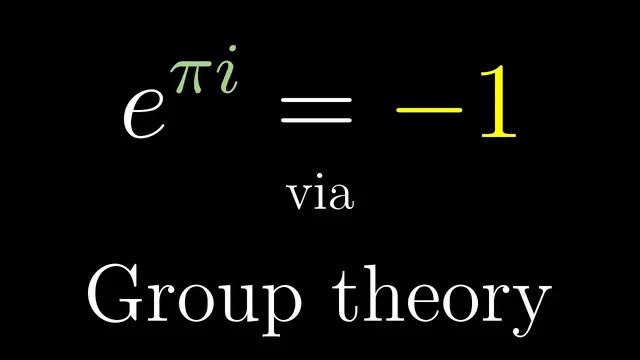
Euler's formula with introductory group theory
Based on 3Blue1Brown's video on YouTube. If you like this content, support the original creators by watching, liking and subscribing to their content.
Group theory models algebra by treating numbers as labels for reversible symmetry actions that can be composed.
Briefing
Euler’s formula, e^(πi) = −1, becomes far more than a numerical coincidence once exponentials are reinterpreted as a bridge between two kinds of symmetry. The core idea is to treat inputs to exponentials as “actions” in an additive group (sliding in the complex plane) and outputs as “actions” in a multiplicative group (stretching and rotating). Under that lens, the equation matters because it pins down exactly how a purely vertical slide—moving by π units in the imaginary direction—turns into a half-turn rotation on the unit circle, which is precisely the transformation associated with −1.
The groundwork starts with group theory as symmetry arithmetic. A group is built from reversible actions that can be composed: doing one symmetry and then another produces a third symmetry that’s still in the same collection. The transcript uses the dihedral group of order 8 as a concrete example: the symmetries of a square (do nothing, rotations, and flips) form eight distinct actions, and combining them follows specific rules (for instance, a rotation followed by a flip can equal a different single flip). The same “actions compose” principle extends to infinite symmetry sets, like rotations of a circle, where each rotation can be labeled by where it sends a chosen point.
Numbers enter as another symmetry system. Real numbers can be modeled as sliding actions on a line: adding corresponds to performing slides one after another. Complex numbers can be modeled similarly as 2D slides: composing slides adds the real and imaginary components, matching complex addition. But multiplication is different: it corresponds to stretching/squishing and rotating actions on the complex plane. In this multiplicative group, i represents a 90-degree rotation, so applying the i-action twice yields a 180-degree rotation, matching i·i = −1. More generally, any multiplicative action can be decomposed into a real scaling (from a positive real factor) followed by a pure rotation.
With that setup, exponentiation is reframed using the “exponential property” 2^(x+y) = 2^x·2^y. That identity is exactly what it means for a function to respect group structure: adding inputs (composing slides) corresponds to multiplying outputs (composing stretching/rotation actions). The key move is to focus on what happens to purely vertical slides—those corresponding to imaginary inputs like i, 2i, and πi. For a general base b, a vertical slide of one unit maps to some rotation amount on the unit circle; different bases rotate by different angles. The number e is singled out because it makes the rotation match the slide length perfectly: e^(i) corresponds to a rotation of exactly 1 radian, so e^(πi) corresponds to a rotation of π radians.
That π-radian rotation is the half-turn, the transformation associated with −1. The transcript closes by offering a geometric intuition: wrap the complex plane into a cylinder so vertical lines become circles, then “smoosh” the cylinder back onto the plane around 0, with concentric circles spaced exponentially—mirroring how exponentials convert vertical motion into angular motion.
Cornell Notes
Group theory treats algebra as symmetry arithmetic: actions can be composed, and the result stays inside the same set. Real and complex numbers can be modeled as additive groups of slides, where composing slides corresponds to addition. Multiplication corresponds to a different group of actions—stretching/squishing plus rotation—where i represents a 90° rotation and i·i gives −1. Exponentiation is then interpreted as a structure-preserving map between these groups: the identity b^(x+y)=b^x·b^y matches “add inputs, multiply outputs.” The base e is special because it sends a vertical slide of length 1 (input i) to a rotation of exactly 1 radian, so a slide of π (input πi) becomes a π-radian half-turn, yielding e^(πi)=−1.
What does it mean for a collection of symmetries to form a group?
How do real numbers become an “additive group of actions”?
How does multiplication become an action-based group on the complex plane?
Why does b^(x+y)=b^x·b^y matter in group-theory terms?
What makes e special for mapping vertical slides to rotations?
How does the transcript connect e^(πi)=−1 to geometry?
Review Questions
- In the transcript’s group-theory framing, what are the “actions” corresponding to addition, and what are the “actions” corresponding to multiplication?
- Explain why the identity b^(x+y)=b^x·b^y is interpreted as a structure-preserving map between groups.
- What rotation does e^(πi) correspond to, and how does that rotation relate to the complex number −1?
Key Points
- 1
Group theory models algebra by treating numbers as labels for reversible symmetry actions that can be composed.
- 2
Real addition can be represented as composing horizontal slides on a line: slide distances add.
- 3
Complex multiplication can be represented as composing stretching/squishing and rotations on the complex plane.
- 4
Exponentiation is interpreted as a homomorphism: adding exponents corresponds to composing multiplicative actions.
- 5
Vertical slides in the complex plane map to rotations on the unit circle under exponentiation.
- 6
The base e is special because it maps a vertical slide of length 1 (input i) to a rotation of exactly 1 radian, forcing e^(πi) to be a π-radian half-turn.
- 7
A π-radian rotation is the transformation associated with −1, yielding Euler’s formula e^(πi)=−1.