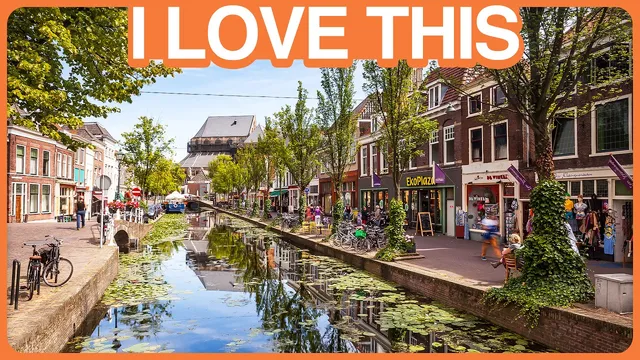
Even Small Towns are Great Here (5 Years in the Netherlands)
Based on Not Just Bikes's video on YouTube. If you like this content, support the original creators by watching, liking and subscribing to their content.
Traffic calming and reduced car speed/volume repeatedly make cycling feel safe, sometimes reducing the need for expensive dedicated bike lanes.
Briefing
Five years in the Netherlands has reshaped one core belief: small towns and even suburban edges can be genuinely pleasant and safe without relying on car dominance. Across places ranging from Haarlem and Leiden to villages of only a few hundred residents, the recurring pattern is simple—streets are designed to restrict car speed and volume, and that makes walking and cycling feel normal rather than risky. The result is a country where “good urbanism” isn’t confined to a few historic city centers.
Haarlem sets the tone early. With a population around 160,000, it still feels lively, largely because the city centre is pedestrianized—an approach that, in the narrator’s comparison, would be hard to imagine in similarly sized Canadian cities. Leiden and Harlingen reinforce the same theme through street-level safety: crossings are narrowed with pedestrian islands, raised to slow vehicles, and treated as standard infrastructure rather than something communities must fight for. Even when the trips are incidental—appointments, friends, everyday errands—the built environment keeps delivering the same message: safety and comfort are engineered into ordinary routes.
That engineering shows up even in places that would typically be considered too small to support frequent transit or high-quality cycling networks. Lent (a suburb of Nijmegen), Ermelo (about 27,000 people), and Veenendaal all combine easy train access with family-friendly cycling. In Lent, separated bicycle paths and even bicycle routing through an old tower illustrate how seriously the Netherlands treats cycling infrastructure. In Ermelo, the surprise isn’t just the volume of bicycles; it’s the density of traffic-calming measures—so many that they outstrip what the narrator has seen in Canadian cities. The takeaway is blunt: protected bike lanes are only one tool, and they’re not necessary when car traffic is already constrained.
The same logic extends to islands, industrial edges, and rural life. On Terschelling, trains connect directly to the ferry, and once there, e-bikes and cycling routes work across the island. Near Ommen (about 18,000 residents) and in villages like Jutrijp (265 people), traffic calming and bicycle access to bus stops show a system designed for multimodal travel rather than car-only mobility. Zwolle’s Bonami Computer Museum—about four kilometers from the station—still feels reachable by bicycle, and Assen’s OV Fiets rentals and top-tier cycling networks appear even in cities under 70,000.
Suburban design also gets a reset. Newer developments such as Kloosterveen in Assen and the neighborhood of Vathorst near Amersfoort include car-free walking and cycling paths, shopping areas within walking distance, and traffic calming even when the areas sit off major highways. Woerden and Sneek add pedestrianized centers, narrow safe streets, and bicycle parking at stations as standard features. Across all these stops, the narrator contrasts this with Canada’s typical pattern: wide, high-speed roads, stroads, sprawling parking lots, and a default expectation that leaving home without a car means discomfort.
After five years, the conclusion is not that every Dutch place is perfect. Some areas still need better public transit. But the overall experience—no sustained sense of being unsafe outside a car—has shifted what “bad” means. The Netherlands, in this account, offers a consistent baseline of safety and accessibility that makes cycling and walking feel viable everywhere, from business parks to small-town centers.
Cornell Notes
Five years in the Netherlands leads to a single recurring finding: small towns and suburban areas can be safe and enjoyable for walking and cycling when car traffic is restricted. Across Haarlem, Leiden, Harlingen, Lent, Ermelo, Veenendaal, and even villages like Jutrijp, the built environment repeatedly uses traffic calming, pedestrianized centers, and bicycle-friendly street design. Train access plus cycling (often via OV Fiets rentals and abundant bicycle parking) makes destinations reachable without driving. The practical implication is that high-quality cycling doesn’t always require expensive dedicated bike lanes; limiting car speed and volume can do much of the work. The narrator contrasts this with Canada’s more car-centric street patterns, where leaving home without a car often feels unsafe.
What design principle shows up again and again across Dutch towns in this account?
How do pedestrianized city centers change the feel of smaller Dutch cities?
Why does train + bicycle access matter in the narrator’s examples?
What surprises the narrator about cycling infrastructure in small towns?
How do newer suburban developments challenge the idea that suburbs must be car-centric?
Review Questions
- Which specific infrastructure choices (traffic calming, pedestrianization, bicycle parking, separated paths) most directly reduce the need for dedicated bike lanes in these examples?
- Pick two towns mentioned here and compare how they support car-free mobility—what differs between their approaches?
- How does the train + bicycle combination change what counts as a “reachable” destination in this account?
Key Points
- 1
Traffic calming and reduced car speed/volume repeatedly make cycling feel safe, sometimes reducing the need for expensive dedicated bike lanes.
- 2
Pedestrianized city centers (e.g., Haarlem, Sneek, and shopping areas in newer developments) help smaller cities feel lively and walkable.
- 3
Train access paired with cycling—often supported by abundant bicycle parking and OV Fiets rentals—enables car-free trips to museums, parks, and business areas.
- 4
Small towns can still offer frequent transit and strong bicycle culture, including examples like Jutrijp’s bus service and Ermelo’s train frequency.
- 5
Suburban design in the Netherlands can include car-free walking and cycling paths, walkable shopping, and traffic calming even near highways.
- 6
The narrator’s Canada comparison centers on wide, high-speed roads and car-centric layouts (stroads, parking lots), which contrasts with the Netherlands’ consistent baseline of safety outside cars.
- 7
The overall experience shifts the definition of “bad” places: instead of widespread unsafe areas, the account describes few situations where being outside a car feels uncomfortable.