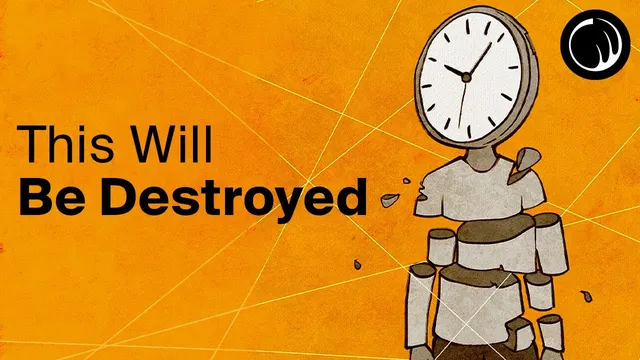
Eventually, Everything Will Be Destroyed
Based on Pursuit of Wonder's video on YouTube. If you like this content, support the original creators by watching, liking and subscribing to their content.
Efforts to improve are portrayed as negating prior states, which then produce unintended harm or renewed dissatisfaction, restarting the cycle of striving.
Briefing
Humanity’s collapse may not be “inevitable” in a simple, deterministic sense—but the forces driving desire, action, and dissatisfaction appear structurally locked to self-destruction, making progress feel like a train that can’t see the wall ahead. The core tension is psychological and existential: creation and improvement are inseparable from negation and unintended consequences, yet conscious beings experience annihilation as undesirable. That mismatch—between what existence seems to do and what consciousness wants—creates a loop of striving, boredom, and renewed striving, even when the world is falling apart.
The reflection begins with a personal turn toward pessimistic philosophy and cosmic horror, then pivots to Emil Cioran’s bleak lines about human exhaustion, diminishing problem-solving capacity, and the delusion of “success” at the apex of blindness. Predictions about the world’s fate, whether grim or hopeful, feel strangely comforting because they reveal how deeply even great minds could only speculate. But the argument shifts from “the end is coming” to “the end is coming through a mechanism”: not that humanity must perish, but that it cannot reliably recognize the track it’s on. The metaphor of a train headed toward a wall frames fate as a path sustained by continued behavior—shoveling coal into the engine—rather than a single moment of doom.
From there, the transcript claims that humans do not fully “own” themselves. Religions call the controlling force God; Arthur Schopenhauer called it the will to live; Friedrich Nietzsche called it the will to power; psychology points to the unconscious or subconscious. The exact nature of the force may be unknowable, but its effects are described as a cycle of “positive annihilation”: self-creation for self-destruction, repeated through individuals, species, and ultimately the universe itself. Entropy and heat death become the cosmic endpoint—an ongoing expansion and decay that returns matter to nothingness. Even the Big Bang is treated as still underway, with the present universe framed as an explosion moving forward toward its own erasure.
In human terms, the mechanism shows up as progress. Desire to act or improve triggers destruction of some prior state, which then produces negative side effects or a new dissatisfaction—followed by another attempt to fix things. The transcript treats this as observable in both personal life and collective history: repeated cycles of creation and devastation, “madness, mayhem,” and the sense that history turns the page while people scream and perish.
Yet the piece insists that destruction and nothingness are not inherently evil in themselves; the problem is the lived experience of conscious selfhood. Non-human animals are contrasted as free of ontological anxiety and long-term striving, living without the same conflict about existence’s meaning. Humans, by contrast, envy that freedom while also being unable to escape consciousness’s “tick” to prefer something else. The result is a paradox: wanting to not want, desiring to not desire, and trying to not try—an endless loop where satisfaction never lasts.
Still, the transcript ends with a stubborn, conditional hope: if there’s any chance to rebuild, it requires a new philosophy that doesn’t offer doctrines or solutions, but instead comforts people outside the whirlpool of consciousness. The aim is not to solve existence, but to reconcile with the likely impossibility of resolution—freeing humanity from delusions so it can use a “second chance” without repeating the same self-destructive pattern.
Cornell Notes
The transcript argues that progress is inseparable from negation: efforts to improve create unintended consequences and new dissatisfaction, restarting the cycle of striving. It links this loop to a deeper “will” behind existence—named differently across religion, philosophy, and psychology—described as self-creation for self-destruction. At the cosmic scale, entropy and heat death frame the universe as moving toward self-annihilation; at the human scale, consciousness makes that process feel personally negative. The piece concludes that any hope for rebuilding would require a new kind of philosophy: one that comforts and clarifies the conflict between self and the will of being without promising final answers.
Why does the transcript treat “progress” as inherently tied to destruction?
What role do pessimists like Emil Cioran, Arthur Schopenhauer, and Friedrich Nietzsche play in the argument?
How does the transcript connect individual experience to cosmic fate?
What is meant by “positive annihilation,” and how does it function?
Why does consciousness make the process feel worse for humans than for animals?
What kind of philosophy does the transcript call for, and what should it avoid?
Review Questions
- How does the transcript define the cycle that turns desire into destruction and then back into renewed desire?
- What evidence or metaphors are used to connect entropy and heat death to human psychological experience?
- Why does the transcript argue that a new philosophy should comfort rather than provide solutions?
Key Points
- 1
Efforts to improve are portrayed as negating prior states, which then produce unintended harm or renewed dissatisfaction, restarting the cycle of striving.
- 2
Fate is framed less as a fixed end-point and more as a path sustained by behavior—humanity keeps “shoveling coal” without recognizing the wall ahead.
- 3
A recurring “will” behind existence is named across religion, philosophy, and psychology, but its essence is treated as unknowable while its effects are considered observable.
- 4
Cosmic fate is described through entropy and heat death, with the universe’s expansion and decay treated as an ongoing self-annihilating process.
- 5
Consciousness is presented as the source of human anguish: annihilation may not be inherently bad, but it is experienced as undesirable by self-aware beings.
- 6
Non-human animals are used as a contrast case—living without ontological anxiety or long-term striving—highlighting the unique conflict of human desire.
- 7
Any hope for rebuilding is tied to a new philosophy that comforts and clarifies the conflict between self and existence without promising doctrines or final answers.