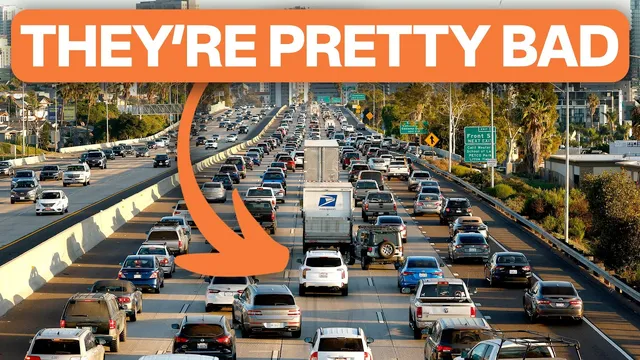
Every Reason to Hate Cars
Based on Not Just Bikes's video on YouTube. If you like this content, support the original creators by watching, liking and subscribing to their content.
Traffic crashes kill about 1.3 million people per year and cause massive injury burdens, with preventable deaths linked to speed and street design.
Briefing
Cars are convenient for individuals, but they impose large, often hidden costs on everyone—through deaths, injuries, pollution, noise, climate impacts, and social harm—so “car freedom” comes with a public bill that cities and governments keep paying. A 2024 UK research review, “Car harm: A global review of automobility’s harm to people and the environment,” frames automobility as a system of externalities: benefits accrue to drivers, while health and financial damage spreads across society.
The most immediate toll is physical harm. Traffic crashes kill about 1.3 million people per year worldwide and are the leading cause of death for ages 4 to 30, according to the review’s use of World Health Organization estimates. Over the lifetime of cars, the authors estimate 60 to 80 million deaths, and in the past 25 years more than 2 billion injuries—some leading to lifelong disability. Even where crash deaths had been falling, the review points to a shift toward larger vehicles—SUVs and pickup trucks—whose height and mass increase fatalities and serious injuries, especially for people outside the vehicle such as pedestrians and cyclists. Regional comparisons underline the point: road deaths fell in the EU by 36% since 2010 but rose in the US by 30%, with pedestrian deaths up 80% in the US over the same period.
The harm extends beyond “accidents.” Many road deaths are described as preventable through safer street design and lower speeds, with cities increasingly adopting a default 30 km/h limit. The review also highlights intentional violence using vehicles—drive-by shootings, car bombs, and deliberate crashes—along with self-harm methods involving exhaust and carbon monoxide. Meanwhile, even avoiding crashes doesn’t end the risk: vehicle pollution (including nitrogen dioxide, sulfur dioxide, ozone, and particulate matter) is linked to heart and lung disease and a range of neurological and mental health outcomes.
Pollution isn’t just tailpipe emissions. Cars generate hundreds of pollutants from brakes, corrosion, lubricants, and road wear. Tyres and road surface abrasion create “road dust,” a major source of microplastics and nanoplastics. Research cited in the transcript reports that tyre wear accounts for 65% of microplastic particles in urban air in Leipzig, and that tyre-related chemicals such as 6PPD—used as a rubber stabilizer—have been found toxic to fish species.
Noise and heat are additional city-level damages. Rolling tyre noise dominates above 30 km/h, and electric vehicles can be louder at higher speeds due to greater weight. Vehicle environments also intensify light and thermal pollution, worsening sleep and amplifying urban heat island effects. Climate change enters through both direct emissions from fuel and the broader carbon footprint of producing vehicles and building infrastructure like asphalt and concrete.
The review’s social argument is that car-centric planning reshapes daily life: it reduces walking and cycling, increases sedentary behavior, and can deepen isolation. It also distributes risk unevenly. Children, older adults, visible minorities, and Indigenous people face higher fatality rates; women are cited as more likely to be seriously injured or die in crashes even after accounting for factors like seat-belt use and crash intensity. Disability access suffers because car-dependent layouts force reliance on others or costly specialized transport.
Finally, the transcript ties car harm to policy and economics. Car use is subsidized through public spending on policing, emergency response, road maintenance, and especially parking requirements that push costs onto non-drivers. Attempts to “solve” congestion by expanding roads are portrayed as financially and empirically flawed, with induced demand and high replacement costs. The alternative is a package of interventions that reduce car use and harm—congestion pricing, removing most on-street parking, replacing minimum with maximum parking limits, building car-light areas, lowering speed limits, and expanding cycling, e-bikes, micromobility, and car-sharing.
The core takeaway is not a call to ban cars everywhere, but a demand to treat cars as a tool—useful when necessary, harmful when dominant—and to redesign cities so most people can live without needing to drive.
Cornell Notes
Automobility creates “externalities”: drivers get convenience while society absorbs the costs through deaths, injuries, pollution, noise, climate impacts, and social harm. A 2024 global review cited in the transcript links traffic crashes to about 1.3 million deaths per year and more than 2 billion injuries over 25 years, with larger SUVs and pickups increasing harm to pedestrians and cyclists. Vehicle pollution includes not only tailpipe emissions but also brake, corrosion, and especially tyre/road-wear particles tied to microplastics and health risks. Car-centric planning also reduces daily activity, increases isolation, and disadvantages children, disabled people, and lower-income communities. The transcript concludes that reducing car use—via speed limits, parking reform, road pricing, and safer street design—offers proven paths to safer, healthier cities.
What does “externalities” mean in the context of cars, and why does it matter for policy?
Why does the transcript argue that vehicle size (SUVs and pickups) worsened road safety even as cars became safer?
How does the harm from cars extend beyond crashes and tailpipe emissions?
What role do speed limits and street design play in reducing fatalities?
Why does car-centric planning disproportionately affect children, disabled people, and low-income communities?
Review Questions
- Which categories of harm are presented as “externalities” of automobility, and how does that change what governments should prioritize?
- What evidence is used to connect vehicle size (SUVs/pickups) to increased harm for pedestrians and cyclists?
- Why does the transcript treat tyre and road-wear particles as central to the pollution story, not a side issue?
Key Points
- 1
Traffic crashes kill about 1.3 million people per year and cause massive injury burdens, with preventable deaths linked to speed and street design.
- 2
Larger vehicles like SUVs and pickups increase fatalities and serious injuries to people outside the vehicle, especially pedestrians and cyclists.
- 3
Vehicle harm includes long-term health effects from air pollution and non-exhaust sources such as brakes, corrosion, and tyre/road-wear particles.
- 4
Tyre wear is highlighted as a major source of microplastics in urban air and waterways, with chemical additives like 6PPD raising additional ecological and health concerns.
- 5
Car-centric planning reduces daily physical activity, increases social isolation, and can worsen access and safety for children, disabled people, and low-income communities.
- 6
Car use is subsidized through public spending (emergency response, policing, infrastructure) and through parking policies that shift costs onto non-drivers.
- 7
Reducing car harm relies on policy packages—speed limits, road pricing, parking reform, car-light zones, and expanded cycling/transit options—rather than road expansion alone.