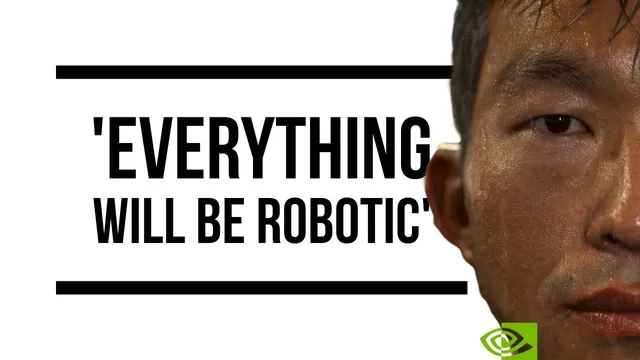
‘Everything is Going to Be Robotic’ Nvidia Promises, as AI Gets More Real
Based on AI Explained's video on YouTube. If you like this content, support the original creators by watching, liking and subscribing to their content.
Nvidia’s CEO frames the next AI leap as “physical AI” that can perceive, plan, and execute actions through robotics, not just generate language.
Briefing
Nvidia’s CEO is pushing a vision of “physical AI” that turns robotics into the next industrial wave—while also betting that AI will increasingly run the company itself, from chip design to software debugging. The central claim is that the next leap won’t just be smarter language models; it will be systems that understand the laws of physics, learn skills through interaction, and coordinate fleets of robots that build products in increasingly automated factories. That “everything is going to be robotic” framing is broad, but the demos and technical details aim to make it concrete: AI that can perceive, plan, and then execute tasks with both gross and fine motor control.
A key thread is the shift from high-level planning to the bottleneck of low-level physical control. Nvidia’s robotics messaging emphasizes learning from human demonstrations, but the transcript highlights a more specific acceleration mechanism: large language models can help program and supervise robotic behavior, such as training a robot dog to stay balanced on a moving rolling yoga ball. The argument is that reasoning and coding-capable models can bootstrap the control stack, while simulation enables rapid iteration—thousands of parallel trials—before transferring what works back into the real world. In this view, the most valuable capability isn’t only planning tasks like “cook food,” but supervising the learning needed to pick up objects correctly, even when the physical details are hard.
Beyond robotics, the same “AI becomes infrastructure” theme appears in Nvidia’s internal workflow. The CEO describes an ambition to turn the organization into “one giant AI,” where AI explores chip design spaces that would be too expensive to search manually, and where AI assists with software by filing bugs and identifying likely responsible developers. The implication is that AI won’t merely power products; it will reshape how complex engineering is done.
The transcript also stacks near-term examples of AI realism and digital twins. It points to multimodal models enabling more lifelike digital humans—using speech recognition and synthesis plus LLM-driven conversation—and to advances in rendering techniques like path-traced subsurface scattering for skin realism. It then moves to hyperlocal forecasting down to tens of meters by combining weather simulation with windfields and building-level effects, and to “Earth 2” as a digital twin that fuses observation data with physics simulations to anticipate extreme weather impacts.
On employment, the transcript juxtaposes bold predictions with caution. A chief of staff at Anthropic’s orbit is quoted forecasting that employment as known could end within 3–5 years, arguing that automation will win not by being perfect, but by being cheaper than the human who would otherwise do the job. Yet the transcript counters with two reality checks: media-driven “jobs apocalypse” narratives can obscure policy-relevant scenario ranges, and AI’s economic effects may skew toward wage inequality—lower wages for many, higher productivity (and profits) for those leveraging AI.
Finally, it challenges the idea that AI is either unstoppable or useless. A report from OpenAI on disinformation spam claims the campaigns didn’t meaningfully increase audience reach, suggesting that bad actors can still fail when outputs aren’t compelling. The transcript closes by stressing that better, harder-to-game benchmarks—like those from Scale AI—matter, because real-world outcomes for jobs and embodied AI remain highly uncertain.
Cornell Notes
Nvidia’s CEO lays out a two-part push: AI should become “physical” through robotics that can learn and act in the real world, and AI should become an internal engineering system that designs chips and improves software at scale. The most emphasized technical bottleneck is low-level physical control; large language models help by supervising and programming robotic behavior, while simulation allows rapid iteration before deployment. The transcript links these advances to practical demos—digital humans, hyperlocal forecasting, digital twins, and AI-generated audio—aiming to show capabilities that are already emerging. On jobs, it contrasts a near-term employment-ending prediction with arguments that automation’s impact will likely depend on policy, and may produce wage and wealth inequality rather than uniform replacement.
What does “physical AI” mean in the Nvidia vision, and why is it different from earlier AI waves?
Why does low-level physical control remain the bottleneck for robots, even with strong language models?
How do large language models and simulation work together to accelerate robotics progress?
What are the employment arguments on both sides of the debate, and what’s the key disagreement?
Why does the transcript treat disinformation spam as a caution against simplistic fears?
Why are benchmarks and leaderboards portrayed as fragile, and what’s the proposed remedy?
Review Questions
- Which part of robotics is described as the main bottleneck, and how do large language models help address it?
- How does the transcript connect AI automation to wage inequality rather than uniform job replacement?
- What does the OpenAI disinformation-spam example suggest about the real-world effectiveness of malicious AI outputs?
Key Points
- 1
Nvidia’s CEO frames the next AI leap as “physical AI” that can perceive, plan, and execute actions through robotics, not just generate language.
- 2
The robotics challenge highlighted is low-level physical control; strong planning alone doesn’t work if the robot can’t manipulate objects reliably.
- 3
Large language models can bootstrap robotic skills by supervising or programming behavior, while simulation enables massive parallel iteration before real-world deployment.
- 4
Nvidia’s “one giant AI” ambition extends beyond products into internal engineering workflows, including chip design search and software bug triage.
- 5
Digital twin and hyperlocal forecasting examples (like “Nvidia Earth 2”) illustrate how AI plus physics simulation can support extreme-weather planning.
- 6
Employment impacts are portrayed as scenario-dependent: automation may be cheaper than humans without being perfect, but policy and adoption choices shape outcomes.
- 7
Disinformation-spam results described by OpenAI suggest that harmful AI use can still fail to gain traction, underscoring the need for better benchmarks and real use-case testing.