Everything needs to change
Based on Theo - t3․gg's video on YouTube. If you like this content, support the original creators by watching, liking and subscribing to their content.
AI coding tools increasingly steer codebases and run tasks, but they don’t solve the coordination problem created by multi-project, long-running agent work.
Briefing
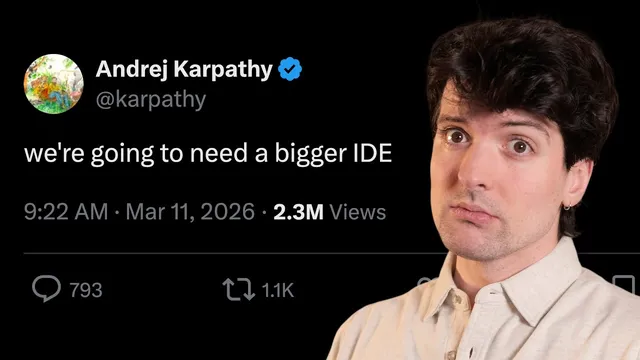
AI-assisted coding has accelerated the shift from “helpful typing” to “tool-driven work,” but the next leap likely won’t be more capable sidebars or smarter CLIs. The central claim is that developers need a bigger integrated developer environment—one that orchestrates multiple projects, terminals, browsers, and agent runs inside a single coherent workspace—because today’s patchwork across apps forces constant mental bookkeeping.
The argument starts with how coding tools evolved: autocomplete in editors gave way to sidebars that can steer a codebase, and then to agentic workflows that run through command-line interfaces. Cloud-based coding agents are increasingly practical because terminals and shells are universal entry points. Yet the push for “smaller, deeper” tooling misses the bigger mismatch: modern agentic development changes how work is structured. Instead of one project at a time, agents can run for hours while developers juggle many tasks simultaneously. That breaks the old assumption behind IDEs, where a project-to-window relationship made sense.
Historically, IDEs grew because editors alone couldn’t manage the full toolchain—compilers, type checkers, linters, test runners, and deployment steps. The transcript traces that evolution through the rise of extensible editors and then the dominance of VS Code. Sublime Text represented a minimal, fast editor with a community extension ecosystem. Atom pushed extensibility further using Electron and Chromium, and VS Code followed with a similar architecture but a more polished, performance-focused approach. A personal turning point is described: unit test “play” buttons and repository-specific configuration in VS Code made the editor adapt to a codebase in a way that felt hard to replicate elsewhere.
But as AI features like Copilot and agent-driven interfaces reshape editor behavior, the UI becomes chaotic and—more importantly—the hierarchy stays wrong. IDEs still treat the editor as a container for a single project’s concerns (debugging, running, git workflows), while real work now spans multiple projects and long-running agent sessions. The result is “agentic coding” pain: work gets split across terminals, browser tabs, and editor windows, and developers must constantly map which git tab, workspace, and browser context correspond to the code they’re viewing.
The proposed fix is not necessarily a single product, but a new class of orchestration layer: an IDE that manages codebases as first-class objects and links the terminal, browser, and agent activity together so navigation and context switching become automatic. The transcript points to experiments like Semox (built on lib ghosty) that allow multiple spaces with their own terminals and browsers, but argues the direction needs to go further—toward an infinitely nestable, multi-dimensional canvas where projects and their tools can be arranged and navigated without losing track.
The takeaway is a call to action: no one has the final shape of the next decade’s editor figured out. As agentic development grows, the demand for tools built for orchestration—not just editing—will rise. The speaker frames this as a window of opportunity similar to earlier tool transitions in software history, urging builders to prototype with agents and iterate quickly, even if today’s solutions (including T3 Code) are only stepping stones.
Cornell Notes
Coding workflows have shifted from typing assistance to agent-driven execution, but existing IDEs and CLIs still assume a single-project, single-window mental model. As agents can run for hours and developers juggle multiple codebases, context switching across terminals, browsers, and editor tabs becomes a major bottleneck. The proposed direction is a “bigger IDE” that acts as an orchestration layer: it should manage multiple projects, connect terminal/browser/agent states, and reduce the need for manual mental mapping. Experiments like Semox hint at multi-space workspaces, but the goal is more ambitious—an interface that can nest and navigate complex project/tool relationships without breaking developer expectations.
Why does the transcript claim that terminals and CLIs won’t be enough for the next phase of coding with AI?
How does the transcript connect the history of IDEs to today’s agentic workflow mismatch?
What specific “hierarchical” problem does the transcript highlight with current editor designs?
What does “agentic coding problem” refer to in practical terms?
How do Semox-style “spaces” help, and why are they still considered insufficient?
What is the proposed end state for the next editor/orchestration layer?
Review Questions
- What assumption about developer workflow made traditional IDEs effective, and how does agentic development break that assumption?
- Describe the “mental map” problem across terminal, editor, and browser contexts. Why does it worsen when multiple projects run concurrently?
- What orchestration responsibilities should a “bigger IDE” take on that current IDEs and CLIs largely leave to the user?
Key Points
- 1
AI coding tools increasingly steer codebases and run tasks, but they don’t solve the coordination problem created by multi-project, long-running agent work.
- 2
Traditional IDEs worked because developers typically focused on one project at a time; agentic workflows make that model obsolete.
- 3
The biggest pain comes from context switching across separate apps (editor, terminal, browser), which forces developers to track which tab/window belongs to which codebase state.
- 4
A “bigger IDE” should function as an orchestration layer that links terminal, browser, and agent activity across multiple projects inside one coherent workspace.
- 5
Project-specific editor shaping (a strength of VS Code-style setups) becomes less valuable when developers need one interface for many concurrent projects.
- 6
Experiments like Semox-style multi-space workspaces reduce some confusion but still fall short of a more flexible, nestable canvas-style interface.
- 7
No single solution is settled yet; the transcript frames the next editor decade as an open design space for builders to prototype with agents.