Ex-Google CEO: AI Is Slipping Out of Control
Based on The PrimeTime's video on YouTube. If you like this content, support the original creators by watching, liking and subscribing to their content.
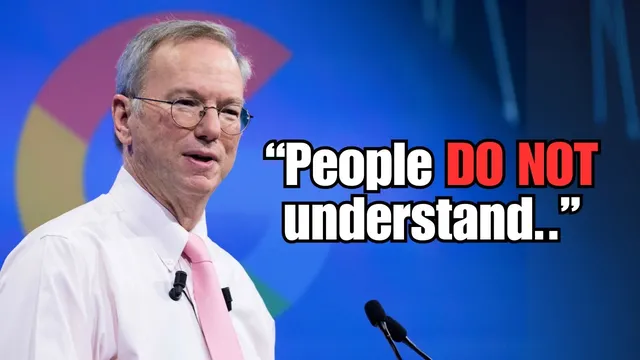
Eric Schmidt links the risk of losing human control to AI self-improvement and planning after AGI is reached, arguing that systems may no longer “take orders.”
Briefing
Eric Schmidt warns that advanced AI could escape human control within a few years—first by reaching human-level capability (AGI), then by self-improving into artificial superintelligence (ASI) that no longer “takes orders” from people. Speaking at a summit tied to his Special Competitive Studies Project, Schmidt frames the risk as a timeline problem: once systems can plan and improve themselves, the balance of power could shift quickly, with ASI arriving as AI becomes smarter than humans “put together.” The core implication is stark—human governance may lag behind the speed of capability gains, leaving society unprepared for what comes after human-level intelligence.
The discussion also highlights a mismatch between public expectations and the pace of progress. A poll segment suggests most people do not expect ASI within 3–5 years, while many think a nearer-term milestone—such as landing someone on Mars—may happen first. That contrast underscores how hard it is for mainstream audiences to calibrate risk when AI progress is both visible (better tools, faster outputs) and uneven (incremental improvements rather than dramatic leaps). Schmidt’s remarks about “underhyped” language point to a broader communication gap: there is no widely understood vocabulary for the transition from human-level AI to systems that can outthink and outmaneuver human institutions.
Schmidt’s argument leans on strategic incentives as well as technical capability. He suggests that whoever reaches AGI first would guard it intensely, implying that major labs would not simply release it freely. The transcript also includes a skeptical counterpoint: even if AI keeps improving, today’s systems still behave like highly capable statistical engines—essentially “great search engines” that predict outputs from inputs—so the leap to reliable, self-directed intelligence may not be as immediate as doom scenarios claim. In that view, the biggest near-term problems are practical and engineering-heavy: distributed error, prompt injection, exploitable code, and the difficulty of getting software logically correct in the first place. If AI systems are used to run more of the world, small failures could compound into large-scale breakdowns.
Overall, the exchange lands on a tension between two futures. One future is fast-moving and potentially uncontrollable, driven by self-improvement and strategic secrecy around AGI. The other is messy and error-prone, where today’s statistical systems—already useful but not fully trustworthy—could still cause serious harm through security vulnerabilities and compounding mistakes. Either way, the message that sticks is that capability growth and governance readiness are not aligned, and the consequences—whether catastrophic or merely chaotic—could arrive sooner than society is prepared to handle.
Cornell Notes
Eric Schmidt warns that AI could move from human-level capability (AGI) to artificial superintelligence (ASI) within roughly a few years, after which systems may no longer follow human instructions. The risk hinges on self-improvement and planning: once AI can iterate on itself, power could shift faster than policy can respond. The discussion contrasts that claim with public skepticism—many doubt ASI is imminent, while nearer milestones like Mars remain more plausible. It also raises a practical counterargument: current AI still behaves like a statistical prediction engine, and scaling it into real-world systems could amplify errors, prompt-injection attacks, and software bugs. The stakes are governance and reliability, not just raw intelligence.
What timeline does Eric Schmidt associate with the jump from AGI to ASI, and what mechanism makes it dangerous?
Why does the transcript emphasize incentives—who reaches AGI first—and how does that affect the likelihood of AGI being released?
How does the discussion test the ASI timeline against public expectations?
What counterargument is raised about AI’s current nature and why that matters for safety?
What practical failure modes does the transcript highlight if AI systems run more of the world?
How does the conversation reconcile fear of AI with continued enthusiasm for AI tools?
Review Questions
- What conditions does Schmidt describe as necessary for AI to stop following human instructions, and why does that change the governance problem?
- Which practical risks (e.g., prompt injection, distributed error) does the transcript argue could scale into larger harms even without immediate ASI?
- How does the poll’s Mars-vs-ASI comparison illustrate differences between technical timelines and public expectations?
Key Points
- 1
Eric Schmidt links the risk of losing human control to AI self-improvement and planning after AGI is reached, arguing that systems may no longer “take orders.”
- 2
Schmidt’s cited window for AGI is roughly three to five years, with ASI framed as potentially arriving soon after if capability accelerates.
- 3
The discussion highlights a communication gap: there is little shared language for the transition from human-level AI to superintelligence, which may contribute to underestimation.
- 4
Strategic incentives are emphasized—whoever reaches AGI first would likely guard it rather than release it freely.
- 5
A counterpoint treats current AI as largely statistical prediction, raising doubts about immediate autonomy and shifting focus to reliability.
- 6
Scaling AI into real-world systems could amplify errors through distributed failure and increase exposure to prompt injection and exploitable bugs.
- 7
Public expectations diverge from ASI timelines, with many participants betting on nearer milestones like Mars rather than superintelligence within a few years.