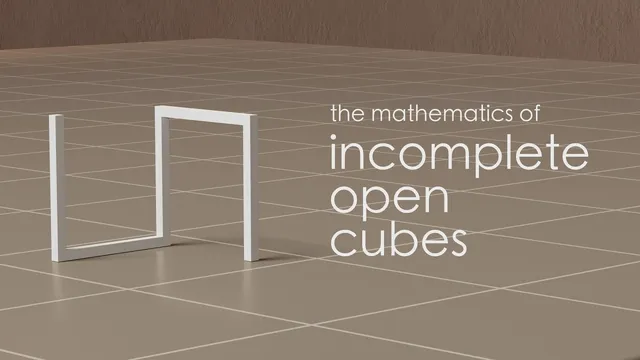
Exploration & Epiphany | Guest video by Paul Dancstep
Based on 3Blue1Brown's video on YouTube. If you like this content, support the original creators by watching, liking and subscribing to their content.
LeWitt’s sculpture enumerates incomplete open cubes grouped into rotational families, using one representative per family rather than listing all 24 rotated copies.
Briefing
Sol LeWitt’s “Variations of Incomplete Open Cubes” turns a simple geometric question—how many ways a cube can be missing edges—into a fully enumerated catalog of shapes, grouped by rotation. The core finding behind the work is that the number of rotationally distinct “incomplete open cubes” can be determined by counting symmetries rather than by brute-force comparison. That shift matters because it converts an intractable-looking sorting problem—tumbling thousands of cube fragments and checking which match—into a structured calculation grounded in group theory.
The sculpture’s building blocks are “open cubes”: hollow cubes defined by their 12 edges. Incomplete versions arise by deleting some edges, but only those that remain connected and still form a genuinely three-dimensional structure qualify. A further constraint identifies cubes that are the same up to rotation: there are 24 rotational positions for any cube, so the artwork keeps one representative per rotational family. LeWitt’s final installation displays 122 such rotationally unique incomplete open cubes, with the full definition expressible as an enumeration of connected proper subsets of a cube’s edges that span R3, modulo rotations.
The transcript then traces how LeWitt approached the hardest constraint—rotational equivalence—through notebooks, physical models, and repeated elimination of duplicates. He used labeling systems to manage the combinatorics: first corner labels, then a more efficient edge-numbering scheme that made it easy to pair each cube with its complementary “missing-edge” counterpart. Even with these tools, he ultimately relied on empirical checking, later confirmed by mathematicians.
To solve the rotational-equivalence problem more directly, the exploration builds a “family portrait”: take one incomplete cube and apply all 24 cube rotations, placing the results into a grid. The key insight is that the portrait’s repeated entries (“lookalikes”) encode symmetry. If a cube’s family has size F, then the portrait always contains 24 entries, and the number of lookalikes L satisfies F × L = 24. In other words, counting how many rotations leave a cube unchanged reveals the size of its rotational family.
The transcript shows this relationship first in two dimensions, where incomplete open squares form six rotational families, and then extends it to cubes by counting lookalikes for each type of rotation axis (face-centered, edge-centered, and corner-centered). Summing lookalikes across all 24 rotations yields 5,232 total lookalikes for all incomplete open cubes, and dividing by 24 gives 218 rotationally unique families when the other constraints are temporarily ignored. The result is presented as an “epiphany” moment: instead of counting families by sorting cubes, count lookalikes by analyzing fixed points under each symmetry.
Finally, the transcript connects the method to Burnside’s Lemma, a general-purpose symmetry-counting tool. It also notes that later computational work confirms LeWitt’s constrained count of 122, while finding a duplication in the final sculpture (cubes labeled 104 and 105 are identical) and a missing cube—an imperfection framed as part of the human texture of conceptual art. The mathematical perspective is positioned not as a grading rubric, but as a way to engage with the artwork’s conceptual core: the product of the mind, including the messy, experimental path that leads to a finished catalog of ideas.
Cornell Notes
Sol LeWitt’s cube sculpture groups “incomplete open cubes” by rotation, so cubes that match after tumbling are treated as one family. The transcript’s central move is to replace brute-force sorting with symmetry counting: build a “family portrait” by applying all 24 cube rotations to one cube, then count “lookalikes,” i.e., entries that remain unchanged under a rotation. For any cube, the family size F and the number of lookalikes L satisfy F × L = 24. Summing lookalikes over all rotations and dividing by 24 yields 218 rotationally unique families when only rotational equivalence is enforced. This logic is identified as an instance of Burnside’s Lemma, a general method for counting distinct objects under symmetry.
What exactly qualifies as an “incomplete open cube,” and what does “modulo rotations” mean in this context?
Why is rotational equivalence the hardest constraint to handle by hand?
How does the “family portrait” turn a sorting problem into a counting problem?
What is the relationship between family size and lookalikes, and how is it used?
How does the transcript extend the lookalike method from squares to cubes?
What does the final 218 mean, and why doesn’t it match LeWitt’s 122?
Review Questions
- How does counting lookalikes under each rotation avoid the need to explicitly sort cubes into rotational families?
- Explain why the cube’s rotational group has 24 elements and how that number appears in the formula F × L = 24.
- In the lookalike method, what changes when moving from 2D rotations of squares to 3D rotations of cubes?
Key Points
- 1
LeWitt’s sculpture enumerates incomplete open cubes grouped into rotational families, using one representative per family rather than listing all 24 rotated copies.
- 2
Rotational equivalence is the main computational bottleneck because two cubes must be checked against all 24 orientations to confirm they truly match.
- 3
A “family portrait” applies all 24 rotations to one cube; repeated entries (“lookalikes”) reveal symmetry information.
- 4
For any cube, family size F and lookalikes L satisfy F × L = 24, so counting lookalikes determines the family size.
- 5
Summing lookalikes across all rotations and dividing by 24 yields 218 rotationally unique families when only rotational equivalence is considered.
- 6
The method is an instance of Burnside’s Lemma, a general symmetry-counting framework for distinct objects under group actions.
- 7
Later computational work confirms LeWitt’s constrained total of 122, while also identifying a duplicate and a missing cube in the final physical sculpture.