Exploring Arecibo in VR 180
Based on PBS Space Time's video on YouTube. If you like this content, support the original creators by watching, liking and subscribing to their content.
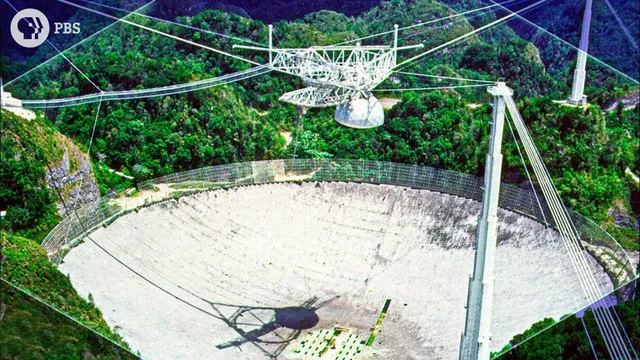
Arecibo’s 305-meter dish can’t be steered like smaller telescopes, so it targets the sky using a spherical reflector plus a movable receiver system.
Briefing
Arecibo Observatory—an enormous, non-steerable radio telescope in Puerto Rico—is built to “look” across the sky by using a spherical reflecting surface plus a movable receiver system, letting it map the universe and reach outward for signals from other civilizations. The VR 180 walkthrough emphasizes how the facility’s scale and engineering solve a basic problem: a dish over 300 meters wide can’t be aimed like smaller telescopes, so Arecibo instead uses clever optics and mechanics to position sensitive receivers with extreme precision.
At the heart of Arecibo is a 305-meter-diameter spherical reflector made from nearly 40,000 precisely aligned aluminum panels. Because the surface is spherical rather than parabolic, it reflects incoming radio waves from different sky directions in a symmetric way—then the telescope’s “Gregorian dome” corrects the blurred focus. Two reflectors inside the dome refine the signal and route it into a sophisticated receiver suite, effectively turning a fixed dish into a system capable of targeting different regions of the sky.
The walkthrough also highlights Arecibo’s dual role as both a listening instrument and an active transmitter. In addition to decoding faint signals, it functions like a form of planetary radar: short pulses can bounce off objects such as planets and asteroids, with reach described as far as Jupiter. The facility has also been used to send messages into space, including a famous transmission in 1974. A new signal is currently being planned, underscoring Arecibo’s continued relevance to the search for extraterrestrial intelligence.
Mechanically, the telescope’s receiver hardware sits on a massive, suspended structure. Visitors in the VR experience stand on catwalks and platforms roughly 450 feet above the dish, with the receiver positioned by an azimuth arm that can maneuver on two axes. The system is designed to place the receiver within about one millimeter of the optimal location for the astronomical target—an accuracy requirement that makes the engineering feel as precise as it is vast.
The program ties the observatory’s technical design to its scientific legacy. Arecibo helped discover the first planet beyond our solar system and has been central to exoplanet research and the broader search for life elsewhere. It was originally conceived in the 1950s as a military facility during the Cold War, aimed at understanding the ionosphere, but it ultimately became a landmark scientific tool. That origin story feeds into a larger framing: Arecibo is portrayed as a powerful symbol of technological civilization—our “ear” and, if chosen, our “voice”—with the potential to answer whether humanity is alone.
Overall, the core takeaway is that Arecibo’s distinctive spherical optics, massive receiver platform, and radar/transmission capabilities combine to make it both a uniquely sensitive instrument and a lasting conduit for messages between Earth and the cosmos.
Cornell Notes
Arecibo Observatory’s fixed, 305-meter spherical dish can still “point” to different parts of the sky by using a movable receiver system and a Gregorian dome with two reflectors that correct focus. Nearly 40,000 aluminum panels form the spherical surface, while the azimuth arm positions the receiver with about one millimeter precision. Beyond listening for extraterrestrial signals, Arecibo also transmits and performs radar—bouncing pulses off planets and asteroids and reaching as far as Jupiter. The facility’s legacy includes helping discover the first confirmed planet beyond our solar system and playing a central role in exoplanet research and the search for extraterrestrial intelligence. Its Cold War military origins evolved into a science-driven instrument that can potentially answer whether life exists elsewhere.
Why can’t Arecibo simply be steered like a typical telescope, and how does it compensate?
What does the spherical dish design change compared with a parabolic dish?
How does Arecibo act as more than a “listening” telescope?
What engineering details show just how extreme Arecibo’s scale is?
What scientific milestones and research areas are tied to Arecibo’s capabilities?
Review Questions
- How does Arecibo’s spherical reflector and Gregorian dome enable sky targeting without a steerable dish?
- What are the differences between Arecibo’s radar-style pulse bouncing and its role in transmitting messages to other stars?
- Why does receiver positioning accuracy (around one millimeter) matter for Arecibo’s observations?
Key Points
- 1
Arecibo’s 305-meter dish can’t be steered like smaller telescopes, so it targets the sky using a spherical reflector plus a movable receiver system.
- 2
Nearly 40,000 aluminum panels form the spherical surface, creating a geometry that reflects signals symmetrically from different sky directions.
- 3
The Gregorian dome’s two reflectors correct the spherical dish’s blurred focus and route the signal into advanced receivers.
- 4
Arecibo functions both as a sensitive receiver for extraterrestrial signals and as a transmitter/radar system that can bounce pulses off planets and asteroids.
- 5
The observatory has transmitted messages to space, including a 1974 broadcast, and plans for another new signal are underway.
- 6
Arecibo helped discover the first planet beyond our solar system and remains central to exoplanet research and the search for extraterrestrial intelligence.
- 7
Originally conceived as a Cold War military facility focused on the ionosphere, Arecibo became a landmark science instrument with global significance.