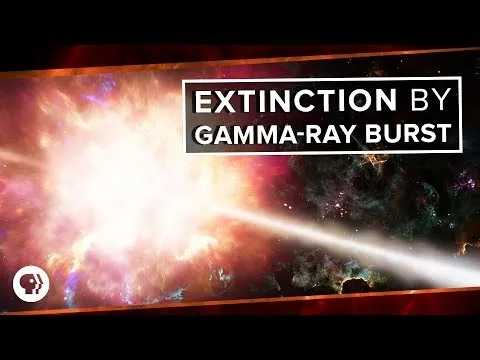
Extinction by Gamma-Ray Burst
Based on PBS Space Time's video on YouTube. If you like this content, support the original creators by watching, liking and subscribing to their content.
Nitrogen-oxide chemistry is the main long-term GRB hazard: nitric oxide destroys ozone and nitrogen dioxide absorbs sunlight.
Briefing
Gamma-ray bursts pose a credible, hard-to-prevent extinction threat because their long-term atmospheric chemistry can strip Earth’s ozone and trigger climate cooling—effects that can last years and devastate UV-sensitive ecosystems. The most concrete case comes from the Ordovician–Silurian (OS) mass extinction about 440 million years ago, where fossil evidence lines up with a burst-driven spike in ultraviolet exposure.
The mechanism starts with how a gamma-ray burst (GRB) interacts with the atmosphere. Even if most gamma rays and X-rays are blocked by air, the radiation still breaks apart nitrogen and oxygen molecules high in the sky. Those fragments recombine into nitrogen oxides—especially nitric oxide and nitrogen dioxide—that then attack ozone and absorb incoming sunlight. Nitric oxide catalyzes ozone destruction, thinning the protective layer that shields life from solar UV. Nitrogen dioxide further reduces the energy reaching the surface, and both compounds can persist for a few years. The result is a two-pronged biological hit: a surge in damaging UV at sea level and a pathway to global cooling. Estimates cited for a GRB within roughly 10,000 light years suggest ozone depletion could drive up ultraviolet by as much as 30%, enough to harm sensitive organisms such as phytoplankton, the base of the marine food chain and a major oxygen producer. Nitric acid rain is another downstream effect.
Why link the OS extinction to a GRB rather than only climate? The fossil record shows a pattern that correlates extinction risk with expected UV exposure: species living near the ocean surface or in shallow water were more likely to die out, or to die out earlier, than deeper-dwelling organisms. That depth-related gradient fits a GRB scenario because deeper water offers more shielding from UV. The OS extinction also coincides with the onset of an ice age. Scientists agree the climate shift drove many of the extinctions, but a relatively sudden glaciation needs a trigger. A GRB could supply that trigger by rapidly increasing nitrogen dioxide and thus altering sunlight absorption, with extinction beginning before the full ice-age machinery took hold—consistent with a “UV shock first, climate consequences after” timeline.
Even if the OS event’s cause remains debated, the broader hazard is treated as recurring. Based on observed GRB rates in other galaxies and the Milky Way’s stellar population, Earth is estimated to pass through the danger zone—within about 10,000 light years of a GRB—roughly once every billion years, with an expected range of one to three such events. The catch is that there’s no reliable way to know a GRB will aim at Earth until it happens. The nearest candidate mentioned sits about 8,000 light years away: WR 104, a Wolf–Rayet star in a binary system whose spiral nebula suggests the system’s axis may point toward Earth. If the star’s rotational axis aligns with our line of sight when it produces a GRB, Earth could be in the firing line. However, follow-up observations with Keck telescopes indicate the orbital axis may not be directly aimed at us, and since the jet direction depends on the star’s rotational axis, the alignment could still be unfavorable.
The transcript also contrasts GRBs with supernovae. Supernovae are more common and can be damaging, but producing GRB-like atmospheric effects would require a much closer event—within about 20 to 30 light years—distance constraints that are not currently met by any known stars likely to explode soon. The practical takeaway is grim but time-scaled: a GRB is expected within the next half to one billion years, and when it arrives, there’s no place in the solar system to hide—though future atmospheric repair, such as ozone rebuilding and chemical cleanup, is floated as a possible mitigation path.
Cornell Notes
Gamma-ray bursts can drive mass extinction by changing Earth’s upper atmosphere for years. Even when most gamma rays are blocked, they trigger nitrogen-oxide chemistry that destroys ozone and increases UV at the surface, while nitrogen dioxide also absorbs sunlight and can contribute to global cooling. The Ordovician–Silurian extinction (~440 million years ago) is highlighted as a possible GRB-linked event because extinction severity tracks expected UV exposure: shallow-water species died more than deep-water species, and the timing matches the start of an ice age. The hazard is not just theoretical—estimates suggest Earth enters the GRB danger zone (within ~10,000 light years) about once per billion years, but there’s no way to know the burst will be aimed at us until it happens. A nearby candidate, WR 104 (~8,000 light years away), is discussed as a potential but uncertain threat due to jet-orientation uncertainties.
How can a GRB harm Earth if the atmosphere blocks most gamma rays and X-rays?
What specific fossil-record pattern supports a GRB link to the Ordovician–Silurian extinction?
How does the timing of the OS extinction connect to climate change in the GRB scenario?
How often does Earth enter the GRB danger zone, and why can’t it be predicted in advance?
What makes WR 104 a notable nearby GRB candidate, and what uncertainty remains?
Why are supernovae treated as a secondary threat compared with GRBs for Earth’s current risk?
Review Questions
- What atmospheric chemical pathway turns GRB radiation into ozone depletion and increased UV at the surface?
- How does the shallow-water vs deep-water extinction pattern strengthen (or weaken) the GRB hypothesis for the Ordovician–Silurian event?
- What observational evidence and remaining uncertainties are used to assess WR 104 as a potential GRB threat?
Key Points
- 1
Nitrogen-oxide chemistry is the main long-term GRB hazard: nitric oxide destroys ozone and nitrogen dioxide absorbs sunlight.
- 2
Nitrogen oxides can remain in the atmosphere for years, allowing sustained UV increases and potential global cooling.
- 3
The Ordovician–Silurian extinction shows a depth-related pattern consistent with UV-driven mortality, with shallow-water species more affected than deep-water species.
- 4
The OS extinction’s timing aligns with the start of an ice age, fitting a GRB scenario where UV shock precedes climate change.
- 5
Estimated GRB rates imply Earth enters the ~10,000 light-year danger zone about once per billion years, but jet orientation prevents advance warning.
- 6
WR 104 (~8,000 light years away) is a leading candidate due to its Wolf–Rayet nature and face-on spiral nebula, though Keck data complicate the alignment needed for a jet toward Earth.
- 7
Supernovae can also be catastrophic, but GRB-like atmospheric effects would require a much closer event (roughly 20–30 light years), which is not currently indicated by nearby stars.