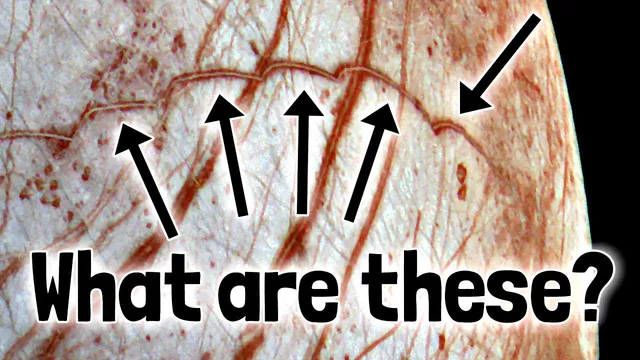
Extraterrestrial Cycloids - Why Are They on Europa?
Based on minutephysics's video on YouTube. If you like this content, support the original creators by watching, liking and subscribing to their content.
Europa’s surface contains repeating cycloid-like arcs (ridges and some troughs), with arc segments roughly 100 km long.
Briefing
Europa’s surface on Jupiter’s moon is riddled with repeating arc-shaped ridges and troughs—each arc segment spans about 100 km—and the leading explanation ties that pattern to how Jupiter’s tides flex the moon’s thick ice shell. Instead of plate tectonics, the current best model says cracks form when tidal stretching creates enough stress to break the ice, then the cracks curve because the direction of that stretching keeps rotating during Europa’s orbit. The result is a cycloid-like path that can restart and repeat, producing the striking, regularly arcing geometry seen in Galileo-era images.
Europa is widely believed to have a frozen water layer several miles thick floating over a global ocean of liquid water. That ocean–ice setup makes the surface mechanically active: the ice can fracture, and stresses can propagate through it. On Earth, similar-looking cycloid-esque curves appear around the Pacific Ring of Fire through plate subduction and collision, but Europa’s arcs don’t show the clear “one piece of surface pushed under another” signatures that would be expected from a comparable tectonic mechanism. The overlapping, abundant cycloid curves also make a simple subduction-style origin unlikely.
The alternative explanation starts with Europa’s tides. Jupiter’s gravity raises tides on Europa, but not in the same way as Earth’s—Europa always keeps the same face toward Jupiter, so the tidal forcing comes mainly from orbital eccentricity. Europa’s slightly elliptical orbit changes Jupiter’s gravitational pull as the moon moves closer and farther, producing a periodic squeezing and stretching of the ice shell. Over the scale of the entire moon, that deformation means any given point on the surface experiences alternating compression and tension at different times.
Crucially, the direction of the compression and stretching doesn’t stay fixed. During each orbit, the tension/compression axis rotates like a clock hand: it rotates clockwise in the southern hemisphere and counterclockwise in the northern hemisphere, completing a full rotation per orbit. When tidal tension becomes large enough to initiate a crack, the crack propagates perpendicular to the instantaneous tension direction. But because the tension direction is steadily turning, the crack’s growth path bends away from its starting direction. As the orbit continues, the system eventually swings from tension back to compression, halting crack growth. Later, when tension returns, the crack resumes—now with the tension direction having rotated again—so the next segment turns sharply and continues the arc.
A refinement called “tailcracking” may help generate the sharp corners between segments, but the core mechanism is the same: rotating tidal stress steers crack propagation, and the cycle repeats each orbit to build the repeating cycloid-like arcs.
Future observations aim to test this picture. Hubble has detected possible plumes erupting from Europa’s surface, which—if confirmed—could sample the ocean beneath. The James Webb Space Telescope will use thermal imaging and spectroscopy to study those plumes and to probe Europa’s geologic activity, tides, and tectonics, helping determine how the moon’s surface features formed and whether conditions could support life.
Cornell Notes
Europa’s surface shows repeating cycloid-like arcs—about 100 km per segment—made of ridges and some troughs. The leading theory links them to Jupiter-driven tides acting on a thick, frozen ice shell over a liquid ocean. Europa’s slightly elliptical orbit causes periodic squeezing and stretching, and the key twist is that the direction of tension/compression rotates during each orbit (clockwise in the south, counterclockwise in the north). Cracks grow perpendicular to the instantaneous tension direction, so as that direction rotates, the crack curves; when tension flips to compression, growth stops, then resumes later with a new direction, producing repeated arc segments. “Tailcracking” may sharpen the corners between segments.
Why don’t Europa’s cycloid arcs look like Earth-style plate tectonics?
What makes Europa’s tides different from Earth’s?
How does the rotating direction of stress create curved cracks?
Why do cracks stop and then restart, producing repeated segments?
What role might “tailcracking” play in the arc geometry?
How could plume observations help test the tidal-cracking idea?
Review Questions
- How does Europa’s orbital eccentricity change the tidal forcing compared with Earth’s rotation-driven tides?
- Describe the sequence of tension → crack growth → compression → crack stop → tension return that produces repeated arc segments.
- Why does the crack propagate perpendicular to the tension direction, and how does the rotating stress axis determine the crack’s curvature?
Key Points
- 1
Europa’s surface contains repeating cycloid-like arcs (ridges and some troughs), with arc segments roughly 100 km long.
- 2
A thick ice shell over a liquid ocean makes Europa mechanically fracture-prone, but the arcs don’t match clean plate subduction signatures.
- 3
Europa’s tides arise mainly from orbital eccentricity, causing periodic squeezing and stretching rather than Earth-like rotation under a tidal bulge.
- 4
The direction of tidal compression and tension rotates during each orbit—clockwise in the south and counterclockwise in the north—like a clock hand.
- 5
Cracks grow perpendicular to the instantaneous tension direction; because that direction rotates, cracks curve instead of remaining straight.
- 6
When the orbit shifts from tension to compression, crack growth stops; when tension returns, cracks restart with a rotated direction, creating repeated arc segments.
- 7
Tailcracking may help generate sharp corners between segments, refining the cycloid-like geometry.