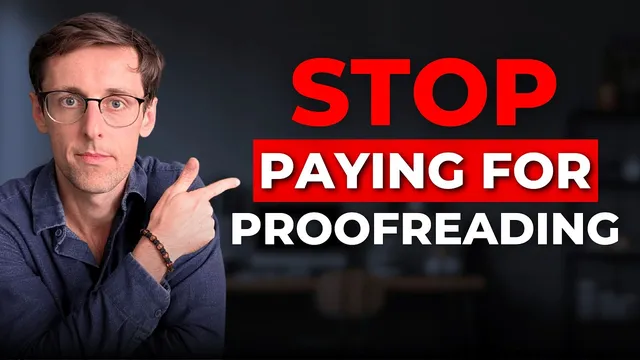
Fast and free hacks to proofread your research paper for a Q1 journal
Based on Academic English Now's video on YouTube. If you like this content, support the original creators by watching, liking and subscribing to their content.
Treat proofreading as a skill to learn, not a service to outsource, so future manuscripts don’t repeat the same struggles.
Briefing
Proofreading doesn’t have to mean paying thousands of dollars—or staying dependent on outside editors. The core message is that researchers can learn to proofread their own manuscripts effectively, then use AI tools to catch routine errors, reducing both cost and turnaround time while building a transferable academic skill.
The financial case is laid out plainly: if proofreading services cost around $1,000 per paper, publishing three papers a year for a decade can total roughly $30,000. Beyond the price tag, the bigger drawback is educational. Paying for editing may improve a single submission, but it doesn’t necessarily teach the author how to write and revise at a high standard themselves—so the same struggle repeats for every new paper.
Human proofreading starts with practical tactics that make mistakes easier to see. A key recommendation is to take a break after writing—pausing for a few days so the brain returns with fresh attention. Printing the manuscript is also emphasized because errors stand out more clearly on paper than on a screen. From there, authors should actively list mistakes and look for patterns, turning recurring problems into a personal checklist.
Effective self-proofreading is framed as a structured workflow rather than a single pass. One approach is to run focused sessions targeting specific categories: for example, checking coherence and flow in one pass, then verifying whether tables and figures present accurate numbers and correct structure in another. Another tool is an “issues log” that records common writing problems so future proofreading sessions can systematically hunt for them. Time constraints are handled through prioritization using an 80/20 mindset: major issues like coherence and overall flow can determine whether a paper is received well, while smaller mechanics—such as missing third-person “-s”—rarely drive rejection on their own.
The transcript also highlights quick tactics that speed up revision: using Word’s Find and Replace to correct repeated errors, reading text backwards to catch stubborn mistakes, and reading aloud to surface issues that silent reading misses. A built-in spell checker is treated as non-negotiable, and peer review is recommended in a targeted way—sharing only two pages with colleagues so they can spot problems quickly and the author can apply those lessons to the rest of the manuscript.
Machine proofreading is presented as a complement, not a replacement. The recommended tool is Paper (downloadable via a link in the description), with a low monthly cost for the paid version. The workflow described is simple: paste or open the manuscript in Microsoft Word and let Paper scan for suggested changes. But suggestions aren’t automatically accepted. The transcript stresses judgment—some edits are minor and useful (articles, missing “s,” small spelling issues), while others are unnecessary, ambiguous, or even potentially meaning-altering.
In the end, AI is positioned as a time-saver for grammar and surface-level issues, while deeper editing—especially for flow, structure, and substantive clarity—still requires human expertise. The takeaway is a hybrid strategy: build self-proofreading skill for long-term independence, then use AI to reduce hours spent on routine mistakes before submission to Q1 journals.
Cornell Notes
Self-proofreading can replace expensive, outsourced editing by turning revision into a repeatable skill. The transcript recommends taking a multi-day break, printing the manuscript, and using an issues log to track recurring mistakes. Proofreading works best in focused passes (e.g., coherence/flow first, then figures/tables, then language), with prioritization guided by an 80/20 rule—major flow problems matter more than small grammar slips. AI proofreading via Paper can quickly catch many routine errors, but its suggestions must be reviewed because some are unnecessary, debatable, or contextually wrong. The combination aims to save money and time while improving long-term writing quality.
Why does the transcript argue that paying for proofreading can be counterproductive beyond cost?
What concrete steps make self-proofreading more effective?
How should an author prioritize what to fix first when time is limited?
What are the “fast” proofreading tactics mentioned for catching hard-to-see errors?
How does Paper (the AI tool) fit into the workflow, and what limits are emphasized?
Review Questions
- Which proofreading steps in the transcript are designed to improve error detection (e.g., break, printing, reading aloud), and how would you apply them to your own revision schedule?
- How would you build an “issues log” and use it to prioritize fixes across multiple manuscripts?
- What types of Paper suggestions would you accept automatically versus review carefully for context and necessity?
Key Points
- 1
Treat proofreading as a skill to learn, not a service to outsource, so future manuscripts don’t repeat the same struggles.
- 2
Take a multi-day break before proofreading to return with a fresher, more mistake-sensitive mindset.
- 3
Print the manuscript and use an issues log to track recurring errors and systematically hunt for them later.
- 4
Proofread in focused passes (flow/coherence, figures/tables accuracy, then language) rather than one undifferentiated read-through.
- 5
Prioritize high-impact problems first using an 80/20 rule—coherence and structure typically matter more than minor grammar slips.
- 6
Use Word tools like Find and Replace, plus tactics like reading backwards and reading aloud, to catch stubborn mistakes.
- 7
Use Paper to speed up detection of routine grammar and small errors, but review suggestions critically because some are unnecessary, debatable, or contextually wrong.