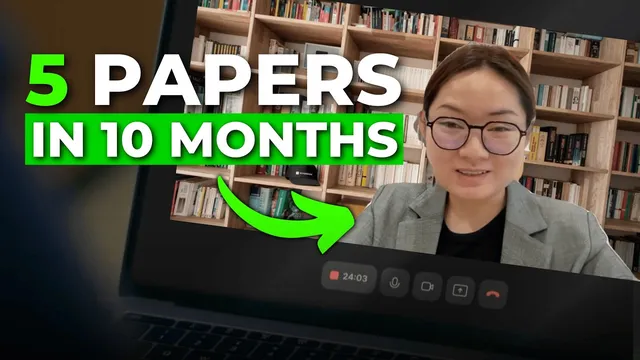
Fast and proven process to 5 research papers in 10 months (in Q1 journals)
Based on Academic English Now's video on YouTube. If you like this content, support the original creators by watching, liking and subscribing to their content.
A long cycle of journal switching and desk rejections left the researcher uncertain about what to improve and demotivated near the PhD deadline.
Briefing
A PhD researcher credits a structured academic writing and publication support platform with turning a long, demoralizing publication struggle into rapid output—two published papers, three additional submissions in progress, and a new lecturer role within roughly a year after joining. The turnaround matters because it targets the bottlenecks that often derail late-stage PhD students: journal selection, reviewer-response strategy, and the ability to revise manuscripts in a way that satisfies editors rather than just improving text.
Before the platform, the researcher described a familiar cycle of uncertainty and setbacks. English was not their mother tongue, so even when they felt confident about their thesis and papers, they worried whether native-level clarity and structure were strong enough. Publication also became a time sink: one paper reportedly spent more than six months bouncing between journals, frequently ending in desk rejections without clear reasons. That lack of actionable feedback—paired with the pressure of an approaching PhD deadline—left them demotivated and anxious about whether their work would ever clear the publication hurdle.
After joining around July 2024, the researcher said the biggest change came from professional, highly specific feedback that went beyond vague critique. Instead of receiving only general comments like “the introduction lacks flow,” the platform’s coaches and reviewers pointed to concrete revision targets: where linking citations should appear between paragraphs, when significance or definitions of key concepts should be introduced earlier, and how to fix issues such as redundancy or incorrect sentences. The researcher emphasized that this specificity didn’t just correct a single manuscript; it taught patterns they could reuse in future writing, helping them avoid repeating the same mistakes.
Community support also played a role. The researcher described the platform as a place to post ongoing struggles and questions at any time, with peers offering help from different perspectives. While PhD peers in the same department were supportive, the platform’s broader mix of backgrounds made feedback feel less “field-bound” and more useful for clarity. They also valued the fact that coaches and community members were not necessarily experts in the researcher’s exact subfield. That mattered because, as their supervisors had suggested, if someone outside the specialty can understand the argument and what the paper is trying to tell, the manuscript is likely communicating effectively.
By the end of the PhD, the researcher reported publishing two papers and submitting three more, alongside completing the doctorate and moving into a lecturer position in China. Their advice to other researchers is practical: try the platform early, reduce anxiety by choosing the right support for writing and publication improvement, and adopt a mindset that outsourcing revision expertise doesn’t signal weakness. They framed the service as both feedback and training—learning how to revise through multiple rounds and how to refine writing skills that can carry forward across an academic career.
Cornell Notes
A late-stage PhD researcher described a shift from months of journal rejections and unclear desk-rejection outcomes to rapid progress after joining an academic writing and publication support platform around July 2024. The key difference was feedback that was professional and specific—down to where citations should be added, how to improve paragraph-to-paragraph flow, and when to move definitions and significance earlier in an introduction. The researcher also valued the platform’s community: peers and coaches offered perspectives outside their exact subfield, which they said helped confirm whether the argument was understandable. Within roughly a year, they completed the PhD, published two papers, submitted three more, and became a lecturer in China. The takeaway is that targeted revision guidance plus a supportive community can reduce the trial-and-error cycle of publishing.
What problems made publishing feel especially difficult before the turnaround?
What kind of feedback changed the revision process most?
Why did the researcher value feedback from people outside their specific research field?
How did community support differ from support during the PhD?
What mindset and strategy did the researcher recommend to other PhD students or researchers?
Review Questions
- What specific types of revision guidance (e.g., citations, paragraph flow, placement of definitions) did the researcher say made reviewer feedback easier to act on?
- Why did feedback from non-subfield experts serve as a proxy for whether the paper’s argument was understandable?
- How did the researcher’s description of desk rejections and journal switching shape their confidence before joining the platform?
Key Points
- 1
A long cycle of journal switching and desk rejections left the researcher uncertain about what to improve and demotivated near the PhD deadline.
- 2
Joining the support platform around July 2024 coincided with a rapid shift: two papers published and three more submitted in progress, alongside completing the PhD.
- 3
The most impactful feedback was specific and actionable, including guidance on sentence correctness, redundancy, and how to restructure introductions for clearer flow.
- 4
Reviewer-style comments became easier to implement when coaches translated vague critiques into concrete changes, such as where to add linking citations and when to introduce significance and key definitions.
- 5
The platform’s community support provided ongoing help and multiple perspectives, which the researcher found more varied than support from same-department peers.
- 6
Non-subfield feedback was valued as a test of clarity: if outsiders can understand the argument, the manuscript is communicating effectively.
- 7
The researcher’s advice centers on using appropriate expertise for revision, reducing anxiety by choosing the right support, and treating feedback as training for long-term writing improvement.