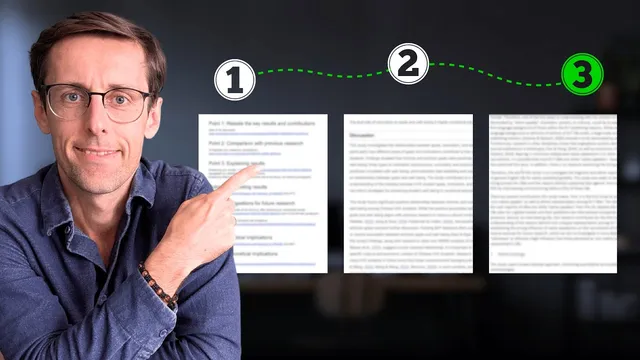
Fastest way to publish 3 papers in Q1 journals in a year (they don’t want you to know)
Based on Academic English Now's video on YouTube. If you like this content, support the original creators by watching, liking and subscribing to their content.
Allocate writing time at the year and semester level so Q1 output fits teaching and admin duties rather than competing with them.
Briefing
Publishing three or more Q1-journal papers every year while working less hinges on two linked systems: a calendar-based writing plan that removes “chance” from research output, and a repeatable pipeline for generating high-impact ideas and turning them into papers efficiently. The core problem identified is not lack of ability, but a daily pattern where writing time gets repeatedly displaced by email, data work, literature reading, and interruptions—leaving researchers to write in scattered bursts, then lose momentum when they finally sit down to draft.
The proposed fix starts with a year-level plan that explicitly allocates writing time alongside teaching, administration, and other duties. Instead of relying on hope that writing time will appear, researchers are urged to map goals across semesters and months using an Excel sheet and a structured planner. The year plan should translate broad targets (three or more papers) into intermediate milestones and concrete actions—research, data collection, and writing—so the workload is visible and schedulable rather than reactive.
That long-term allocation then needs a daily operating system. Each day ends with intentional planning for the next day: selecting specific tasks, scheduling them on a calendar, and committing to follow-through. Progress is reviewed at day’s end, with adjustments made for tomorrow. The emphasis is on preventing “days turning into weeks and months” without meaningful writing progress, because even a strong annual plan fails if daily execution drifts.
Planning alone, however, won’t guarantee top-journal acceptance. The transcript argues that many researchers waste months on resubmissions because their projects don’t deliver sufficient contribution or novelty for elite venues. To avoid that, a systematic approach to high-impact idea generation is presented, beginning with research gaps: missing evidence on a topic or geography, lack of consensus, limitations in prior studies, and unresolved practical or research problems. These gaps should be tracked as they’re found—using a simple Word table—so they can be converted into new study concepts.
Because gaps are “obvious” to everyone, the next step is to look beyond the discipline. A malaria example is used: Tu Youyou’s breakthrough came not from following existing malaria compound testing, but from studying ancient Chinese medical texts. A reference to wormwood—linked to intermittent fevers—led to artemisinin, later saving millions and earning a Nobel Prize. The transcript also highlights using professional experience to spot angles others miss, illustrated through an English-teaching course book meeting where the author noticed a lack of diversity and questioned whether that pattern held across course books—an insight they claim had not been studied in the literature.
Finally, the writing process is reframed as something that can be engineered. Instead of treating each paper as a blank-slate creation, researchers are encouraged to build detailed templates for each section (introduction, literature review, discussion, conclusion). Because most papers in a narrow specialty follow predictable structures and reuse similar phrasing and content, templates let future papers be assembled faster with less rewriting. The transcript recommends blocking time to create these blueprints (e.g., one to two hours) and reusing them across many papers over years, turning writing from a painful, paragraph-by-paragraph struggle into a more repeatable workflow. It closes by pointing to ethical AI use as a further acceleration path.
Cornell Notes
The transcript’s central claim is that consistent Q1 output comes from systems, not motivation: a year-long writing schedule plus a daily planning routine that protects writing time from constant interruptions. It also argues that top-journal acceptance depends on high-impact ideas, so researchers should systematically harvest research gaps, then push novelty by looking outside their discipline and using professional experience to spot overlooked questions. To make writing efficient, it recommends creating detailed templates for each paper section, since introductions, literature reviews, and discussions often follow repeatable structures and language in a focused niche. Together, these steps aim to reduce wasted months, resubmissions, and the “blank document” paralysis that slows progress.
Why do researchers end up spending 6–12 months on one paper even when they work hard?
What does a “proven plan” look like for publishing three or more Q1 papers in a year?
How should researchers generate high-impact research ideas instead of relying on obvious gaps?
What examples are used to show “outside the discipline” and “professional experience” can create breakthroughs?
Why does the transcript recommend paper-writing templates instead of starting from scratch each time?
Review Questions
- What specific daily behaviors does the transcript recommend to prevent writing time from being displaced by email and other tasks?
- List the four categories of research gaps mentioned, and explain how tracking them can feed into new study ideas.
- How does the transcript justify using templates for paper sections, and what practical benefit does that create over multiple papers?
Key Points
- 1
Allocate writing time at the year and semester level so Q1 output fits teaching and admin duties rather than competing with them.
- 2
Use a daily planning loop: schedule next-day tasks in advance, follow the calendar, and review progress at day’s end.
- 3
Generate ideas by systematically harvesting research gaps, then convert those gaps into concrete study concepts.
- 4
Differentiate by looking outside the discipline and by using professional experience to spot questions others overlook.
- 5
Create detailed templates for each paper section to reduce blank-document paralysis and cut repetitive rewriting.
- 6
Treat template-building as an upfront investment that compounds over many papers across years.