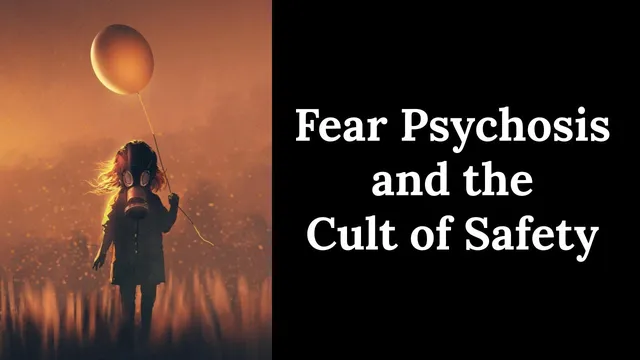
Fear Psychosis and the Cult of Safety - Why are People so Afraid?
Based on Academy of Ideas's video on YouTube. If you like this content, support the original creators by watching, liking and subscribing to their content.
Fear is portrayed as culturally produced and reinforced, so anxiety can rise even when objective dangers are lower than in earlier eras.
Briefing
Modern life is marked by a “fear psychosis” in which people live longer and face fewer existential threats than earlier generations, yet feel more endangered than ever. The central claim is that fear has become culturally normal—reinforced by narratives, institutions, and policy—so threats multiply in public imagination even when real-world danger does not. Sociologist Barry Glassner is cited to frame the problem: abundant money and power can help organizations perpetuate fear, turning anxiety into a profitable and politically useful resource.
A key mechanism is how fear becomes internalized as “common sense.” Frank Furedi’s work is used to argue that the fear perspective sensitizes people to focus on potential hazards while distracting attention from likely positive outcomes of engaging with uncertainty. That lens doesn’t just make people cautious; it expands what counts as a hazard. Since the 1980s, commentators have noted an explosion of risks, and the meaning of “risk” has shifted toward a largely negative connotation. Where earlier eras often treated risk-taking as compatible with noble aims—adventure, self-realization, freedom, truth—today risk-takers are frequently labeled foolish or selfish.
Worst-case thinking drives this shift. People anticipate the most catastrophic scenario and then behave as if it is probable. The transcript links this mindset to policy ambitions for a “zero-risk” society, a goal described as irrational because it would require abolishing uncertainty itself. From there, the precautionary principle enters as an organizing logic: when uncertainty exists, the safest option is to protect oneself and others and side with caution. In practice, that logic appears as an “inverted quarantine,” where healthy people isolate from perceived dangers rather than containing actual illness—an approach framed as a response to the belief that the human condition is inherently unsafe.
The “cult of safety” is described as quasi-religious, with safety rules and restrictions treated as self-justifying even when evidence is weak or absent. Safety theater becomes a recurring theme: procedures can function mainly to reassure the public that someone is managing threats, regardless of whether those threats are real. Instead of reducing fear, the constant presence of safety rules signals that the environment is unsafe and implies people cannot responsibly assess risks themselves. By trading freedom for restrictions, people lose control over their lives, which heightens insecurity.
A further driver is the authority of “The Science,” contrasted with actual science. Real science depends on evidence, experimentation, and openness to revision; “The Science” is portrayed as a trust-in-authority framework that discourages skepticism and treats dissent as moral or political wrongdoing. The transcript argues that education, policy messaging, and advertising socialize people from a young age to treat fear as responsible and to assume vulnerability as a defining human trait.
The closing direction is not denial of danger but a call to reframe humanity: humans are resilient and adaptable, and uncertainty can create opportunity as well as risk. The transcript suggests that awareness of fear’s cultural machinery—and a more optimistic view of what it means to be human—can open space for either precaution or courageous risk-taking, depending on how people perceive their own condition.
Cornell Notes
The transcript argues that modern societies have developed a “cult of safety” and a “fear psychosis” that makes people feel endangered even as life expectancy rises and many threats decline. Fear becomes internalized as common sense: people focus on potential hazards, expand the list of risks, and evaluate experiences through worst-case thinking. Policy and culture then reinforce this through the precautionary principle and “inverted quarantine,” where healthy people isolate from perceived dangers. Safety rules and “The Science” are portrayed as quasi-religious and self-justifying, often functioning as “safety theater” rather than evidence-based protection. The proposed remedy is awareness of how fear is socially produced and a more optimistic view of human resilience and adaptability.
Why does the transcript claim fear has grown even when objective threats are lower than in the past?
What does “fear perspective” mean, and how does it change how people interpret uncertainty?
How do worst-case thinking and the “zero-risk” ideal connect to policy?
What is the precautionary principle, and why does the transcript call its modern form an “inverted quarantine”?
What role does “The Science” play in sustaining the cult of safety?
What alternative does the transcript suggest to fear-driven safety culture?
Review Questions
- How does internalizing fear as “common sense” change what people count as a risk, according to the transcript?
- What distinguishes “The Science” from science in the transcript’s framework, and why does that distinction matter for public policy?
- Why does the transcript argue that safety rules can increase insecurity rather than reduce it?
Key Points
- 1
Fear is portrayed as culturally produced and reinforced, so anxiety can rise even when objective dangers are lower than in earlier eras.
- 2
The “fear perspective” sensitizes people to potential threats and shifts attention away from likely positive outcomes of engaging with uncertainty.
- 3
Worst-case thinking and the pursuit of “zero risk” encourage behavior and policy that treat uncertainty as intolerable.
- 4
The precautionary principle is linked to “inverted quarantine,” where healthy people isolate from perceived dangers rather than containing actual illness.
- 5
Safety theater can make rules feel necessary even without evidence, while constant restrictions signal that the environment is inherently unsafe.
- 6
The transcript argues that trading freedom for safety rules can heighten insecurity by undermining people’s sense of control.
- 7
A more optimistic view of human resilience is offered as a way to loosen fear’s grip and make room for either precaution or courageous risk-taking.