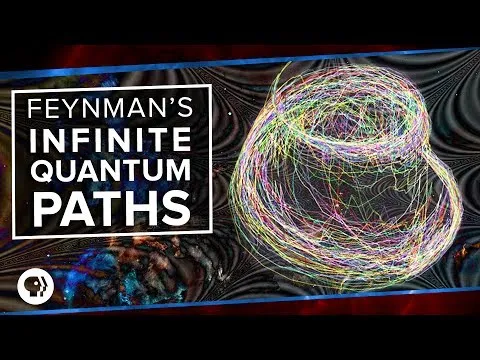
Feynman's Infinite Quantum Paths
Based on PBS Space Time's video on YouTube. If you like this content, support the original creators by watching, liking and subscribing to their content.
Feynman’s path integral computes transition probabilities by summing complex probability amplitudes over all conceivable histories between A and B.
Briefing
Quantum mechanics’ “infinite paths” idea becomes mathematically usable once Feynman turns one classical rule—least action—into a quantum weighting scheme. The result, the Path Integral Formulation, assigns a complex probability amplitude to every conceivable way a particle can travel from point A to point B, then adds those amplitudes together to get the measurable probability. The payoff is more than a new way to compute: it reproduces Schrödinger’s equation and provides a natural bridge to quantum field theory, where particles are excitations of fields rather than isolated objects.
The starting point is the double-slit experiment. With initial and final positions known, the question becomes which slit a particle actually uses. The interference pattern on the screen demands that each particle behaves as if it takes both routes at once—not as two separate events with ordinary probabilities, but as a single combined amplitude. In Feynman’s formulation, time is sliced into tiny intervals, and at each step the particle is allowed to take any straight-line segment in space. This generates an astronomically large set of “ridiculous” trajectories—loops, extreme detours, and other paths that would be impossible to track directly. Yet the quantum action principle supplies the missing physics: each path’s contribution carries a phase determined by the action, so paths that don’t match the classical behavior cancel out through destructive interference.
Classically, least action works because objects follow the path that minimizes the action, a quantity tied to how kinetic and potential energy trade off along the route and how long the journey lasts. In relativity, the relevant version is proportional to proper time, the time measured along the trajectory, which treats space and time symmetrically. Feynman keeps the same action quantity but uses it to weight amplitudes rather than to select a single path. When all amplitudes are summed, only the paths near the classical least-action route survive with significant net contribution, explaining why everyday physics looks deterministic even though the quantum description is not.
The deeper leap comes when the same machinery is extended beyond single-particle paths. In quantum field theory, “what happens between A and B” includes not just countless particle trajectories but countless field histories and events. A photon can temporarily become a virtual electron–positron pair and then annihilate back; an electron can emit and reabsorb a photon that itself can spawn particle–antiparticle pairs, and so on. Feynman’s path integrals can sum over these histories because they describe oscillating fields, where particles are excitations—vibrations—of underlying field components. That makes the framework naturally compatible with the structure of quantum field theory.
Taking infinite intermediate events seriously introduces a new problem: infinities that don’t cancel neatly. Feynman diagrams help organize and tame these divergences, and the transcript hints at further tools—such as interpreting antimatter as matter traveling backward in time—used to make the calculations workable. The episode then pivots to audience questions, contrasting the quantum electromagnetic field with the historical luminiferous æther, discussing why the universe contains far more matter than antimatter due to CP violation, and clarifying that quantum field theory and string theory are not the same—QFT is field vibrations in 4D spacetime, while string theory replaces particles with vibrational modes of strings in higher-dimensional spaces.
Cornell Notes
Feynman’s path integral formulation turns the classical principle of least action into a quantum rule for combining contributions from every conceivable history between two points. By slicing time into small intervals and summing complex probability amplitudes for all paths, destructive interference cancels the “crazy” trajectories, leaving the classical least-action behavior as the dominant outcome. This framework reproduces Schrödinger’s equation and is naturally suited to quantum field theory, where particles are excitations of fields and intermediate events include processes like virtual particle creation. The same “infinite possibilities” that make the method powerful also produce divergences, which are handled using tools such as Feynman diagrams and related interpretive techniques. The approach also sets up later discussion of antimatter and deeper symmetry issues like CP violation.
How does the double-slit experiment motivate the path integral idea?
What is the “one piece of real physics” Feynman adds to the infinite-path sum?
Why do probability amplitudes behave differently from ordinary probabilities?
How does the path integral extend from particles to quantum field theory?
Why do infinities become a problem in the field version of the path integral?
What’s the key difference between the quantum electromagnetic field and the luminiferous æther?
Review Questions
- In the path integral formulation, what role does the action play in determining which paths contribute most to the final probability?
- Why does summing complex probability amplitudes lead to interference patterns that ordinary probability rules can’t reproduce?
- How does moving from particle paths to field histories change what “infinite possibilities” means, and why does that create divergence problems?
Key Points
- 1
Feynman’s path integral computes transition probabilities by summing complex probability amplitudes over all conceivable histories between A and B.
- 2
The action principle supplies the quantum weighting: each path’s contribution carries a phase determined by the action, enabling destructive interference.
- 3
Classical least-action behavior emerges because most quantum paths cancel out, leaving paths near the least-action route to dominate.
- 4
The formulation reproduces Schrödinger’s equation and is mathematically powerful enough to support quantum field theory.
- 5
In quantum field theory, particles are excitations of fields, so the sum includes not only paths but also intermediate interaction events like virtual pair creation.
- 6
Summing over infinite possibilities can produce divergences in the field case, requiring organizational and regularization tools such as Feynman diagrams.
- 7
Audience Q&A emphasizes that the quantum electromagnetic field has no preferred reference frame, unlike the historical luminiferous æther; it also highlights CP violation as a reason matter outnumbers antimatter.