Feynman's Lost Lecture (ft. 3Blue1Brown)
Based on minutephysics's video on YouTube. If you like this content, support the original creators by watching, liking and subscribing to their content.
The ellipse construction is driven by a constant focal sum: every point on the curve has the same sum of distances to two foci.
Briefing
A lost Feynman lecture on planetary motion turns a familiar result—elliptical orbits—into a geometric inevitability. The core claim is that combining the inverse-square law of gravity with Kepler’s second law forces the planet’s velocity to behave in a way that, when translated back into position space, can only produce an ellipse. The payoff is less about heavy calculus and more about a chain of constructions: an ellipse appears from a rotated-line geometry trick, and the same tangency logic reappears when the lecture converts velocity information into orbital shape.
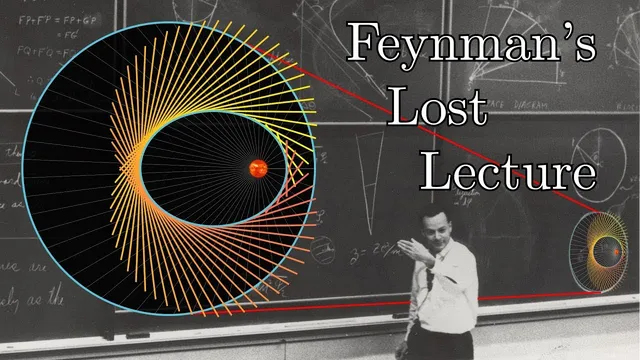
The argument begins with a precise definition of an ellipse using two foci: every point on the curve has a constant sum of distances to the foci. From there, it introduces a “mildly pleasing curiosity” that becomes central later. Start with a circle and pick an eccentric point inside it (not the center). Draw many chords from that eccentric point to points on the circle, then rotate each chord by 90 degrees about its midpoint. The rotated lines form tangents to a particular ellipse whose focal sum equals the circle’s radius. The proof hinges on similar triangles: along each rotated line (a perpendicular bisector of the original chord), the sum of distances from the two candidate foci stays constant at the intersection with the circle’s radius and increases elsewhere—meaning the line touches the ellipse at exactly one point. In short, rotating chords about their midpoints manufactures an ellipse because it manufactures its tangents.
With the geometry tool in hand, the lecture pivots to physics. Kepler’s second law says the area swept out per unit time is constant, a consequence of angular momentum conservation when the force always points toward the sun. For a small time step, the swept area is approximately ½·R·v_perp·Δt, and angular momentum conservation keeps R·v_perp fixed, so the area rate depends only on Δt. Crucially, this does not assume an ellipse; it only requires central (sunward) forces.
Next comes the inverse-square law. The sun’s gravitational force scales like 1/R^2, so the acceleration scales the same way. Over the time it takes the planet to traverse a small equal-angle slice, the lecture shows that the change in velocity is proportional to (Δt)/(R^2). But Kepler’s second law implies Δt itself scales like R^2 for equal angular slices, so the factors cancel: the velocity change across each slice has the same magnitude no matter where the planet is in its orbit. Because the force direction rotates by a constant angle from slice to slice, these equal-length velocity-change vectors line up as the sides of a regular polygon. As the slices get finer, that polygon approaches a circle.
The final step translates “velocity-space circle” into “position-space ellipse.” The lecture tracks how the planet’s velocity direction at a given orbital angle corresponds to tangency directions determined by points on the velocity circle. A clever 90-degree rotation—applied to the entire setup and then to each velocity direction—reorients those tangency constraints so they match the earlier ellipse construction: the rotated tangency lines correspond to the ellipse’s tangents, and the tangency points line up with the planet’s orbital positions. The result is a geometric QED: the orbit must be an ellipse, with the inverse-square law and Kepler’s second law jointly enforcing the necessary tangency structure.
Cornell Notes
The lecture reconstructs why central gravity with an inverse-square force produces elliptical orbits without relying on heavy calculus. It first proves a geometric fact: rotating many chords of a circle by 90 degrees about their midpoints creates tangents to an ellipse defined by two foci, with a constant “focal sum.” Then it uses Kepler’s second law (constant swept area, from angular momentum conservation under sunward forces) to relate equal angular slices of the orbit to time intervals scaling like R^2. Combining that with the inverse-square law shows that the planet’s velocity changes by equal-sized steps from slice to slice, forming a circle in velocity space. A final 90-degree rotation maps those velocity-space tangency directions back into position space, forcing the orbit to be an ellipse.
How does the lecture define an ellipse in a way that later connects to orbit shape?
Why do rotated chords of a circle produce tangents to an ellipse?
What does Kepler’s second law contribute to the argument, and what assumptions does it avoid?
How do the inverse-square law and Kepler’s second law combine to make velocity changes equal in size?
Why does the velocity-space path become a circle, and how does that force an ellipse in position space?
Review Questions
- In the chord-rotation construction, what geometric relationship guarantees that the perpendicular bisector is tangent to the ellipse at one point?
- How does the lecture use equal-angle slicing to show that traversal time scales like R^2?
- What exact cancellation occurs when combining Δv ∝ Δt/R^2 with Kepler’s second law, and why does it matter for the regular polygon argument?
Key Points
- 1
The ellipse construction is driven by a constant focal sum: every point on the curve has the same sum of distances to two foci.
- 2
Rotating chords by 90 degrees about their midpoints turns perpendicular bisectors into tangents to a specific ellipse whose focal sum equals the circle’s radius.
- 3
Kepler’s second law follows from angular momentum conservation for any central force, without assuming an elliptical orbit or the inverse-square law.
- 4
Equal angular slices of the orbit have traversal times that scale like R^2, linking geometry of motion to distance from the sun.
- 5
The inverse-square law makes acceleration scale like 1/R^2, so the velocity change across a slice scales like Δt/R^2.
- 6
Because Δt scales like R^2 for equal-angle slices, the velocity-change magnitude becomes constant, producing a regular polygon that approaches a circle in velocity space.
- 7
A 90-degree rotation maps tangency directions from velocity space back to position space, matching the earlier ellipse-tangent construction and forcing elliptical orbits.