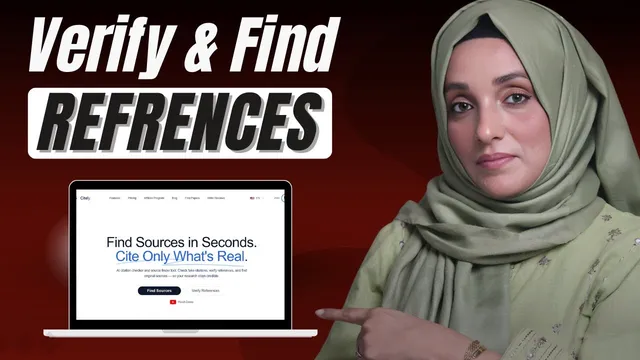
Find Sources & Verify Citations with this AI Tool
Based on Dr Rizwana Mustafa's video on YouTube. If you like this content, support the original creators by watching, liking and subscribing to their content.
sitely.ai is positioned as a citation verification tool, not a writing generator, aimed at preventing fabricated or nonexistent references.
Briefing
AI writing tools can produce citations that look convincing while failing basic authenticity checks—missing sources, fabricated-looking details, or references that don’t exist. A new verification-focused workflow aims to fix that gap by checking whether claims and bibliographic entries actually map to real papers in major academic indexes.
The tool, sitely.ai, is positioned not as a writing assistant but as a citation auditor. After signing in with a Gmail account, users get two core features: “Find Sources” and “Verify References.” The “Find Sources” function takes text the user has already written—up to 300 characters per submission—and returns a list of real papers that support the specific argument in that excerpt. For example, a paragraph about “AI powered marketing and artificial intelligence into marketing strategies” yields matching literature, and the user can open individual sources to copy citations in a chosen format for a research bibliography. A second example on “generative artificial intelligence and marketing” similarly produces targeted paper suggestions, with the interface allowing users to review how the topic is treated in each candidate work.
The second feature addresses a more common failure mode: AI-generated reference lists that may contain incorrect titles, wrong authors, or nonexistent DOIs. Users paste a set of references they want to cross-check; each reference verification costs one credit, so the workflow encourages prioritizing the entries most likely to be wrong. The tool then performs cross-referencing against integrated academic databases—described as including Crossref, arXiv, OpenAlex, PubMed, and Semantic Scholar—along with pattern checks such as DOI matching and similarity scoring.
Results are presented as a credibility breakdown: some papers are “verified” with evidence that the title is available, author information is roughly 75% correct, and dates align with what the reference claims. Others show mismatches—such as low title similarity (e.g., 39.5%), author discrepancies, and a date that may still partially match—indicating the citation is likely incorrect. In cases where a paper can’t be found at all, the tool flags the reference as “not found” and recommends the closest alternative match based on topical and bibliographic similarity. The practical outcome is a triage system: verified entries can be kept, mismatched ones can be corrected, and missing ones can be replaced with better sourced substitutes.
The takeaway is straightforward: instead of trusting AI-generated citations at face value, researchers can validate claims against real indexed literature and use similarity-based matching to repair broken references—reducing the risk of citing nonexistent work and improving the reliability of academic writing.
Cornell Notes
sitely.ai is presented as a citation-verification tool for researchers who already have text and reference lists, especially when those materials were generated with AI. It offers two main functions: “Find Sources,” which matches up to 300 characters of a user’s paragraph to supporting papers in major academic databases, and “Verify References,” which cross-checks pasted citations for existence and bibliographic accuracy. Verification uses credit-based checks and returns similarity and match indicators such as title availability, author similarity (about 75% in one example), and date alignment. When a reference is missing or mismatched, the tool can suggest a closest alternative paper, helping users replace unreliable citations with real, indexed sources.
What problem does sitely.ai target in AI-assisted academic writing?
How does “Find Sources” work, and what does it produce?
What does “Verify References” check, and how is it priced?
What kinds of verification outcomes does the tool report?
How does the tool handle references that can’t be found or don’t match?
Review Questions
- When would a researcher choose “Find Sources” versus “Verify References”?
- What signals (e.g., DOI/title/author/date similarity) does sitely.ai use to decide whether a citation is verified or mismatched?
- How does the credit-per-reference model influence how a user should plan a citation audit?
Key Points
- 1
sitely.ai is positioned as a citation verification tool, not a writing generator, aimed at preventing fabricated or nonexistent references.
- 2
“Find Sources” matches up to 300 characters of a user’s paragraph to supporting papers and lets users copy citations in a chosen format.
- 3
“Verify References” cross-checks pasted citations for existence and bibliographic accuracy using integrated academic databases such as Crossref, arXiv, OpenAlex, PubMed, and Semantic Scholar.
- 4
Verification is credit-based: each reference check costs one credit, so users should prioritize the citations most likely to be wrong.
- 5
Results include verified matches, mismatches (e.g., low title similarity and author differences), and not-found references.
- 6
When a reference fails verification, the tool can recommend the closest alternative paper to replace unreliable citations.