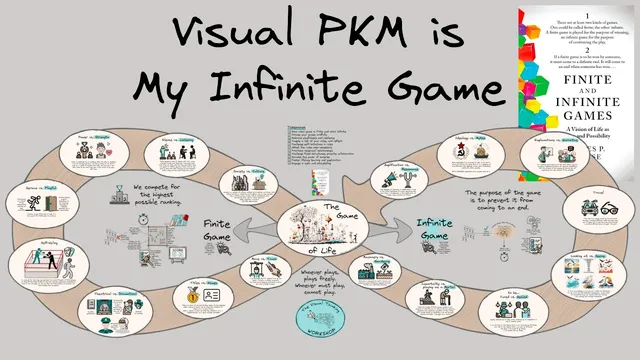
Finite and Infinite Games - Book on a Page
Based on Zsolt's Visual Personal Knowledge Management's video on YouTube. If you like this content, support the original creators by watching, liking and subscribing to their content.
Identify whether the situation is operating as a finite game (winning/ranking within fixed boundaries) or an infinite game (continuing with shifting horizons).
Briefing
James Carse’s “Finite and Infinite Games” draws a sharp line between games meant to end and games meant to continue—and the distinction matters because it changes how people should choose tactics, relationships, and even how they interpret life. Finite games aim at winning or ranking highest inside fixed boundaries: they run within a defined time and space, involve specified players, use predetermined rules, and end when someone achieves the goal. Infinite games, by contrast, are played to keep going. They don’t rely on fixed boundaries; they operate with shifting “horizons,” open membership, and rules that evolve during play to prevent the game from closing.
The transcript turns that core framework into a practical lens for everyday decisions. In finite games, tactics often revolve around controlling outcomes and managing surprise as a threat—because surprise can end the game abruptly, leaving the loser “standing there surprised” at the final move. Infinite games treat surprise differently: it becomes the fuel for continuation, like walking through an open door and staying ready for what emerges beyond it. Carse’s language system reinforces the contrast: finite play is associated with “touch”—a push toward a foreseen place—while infinite play is associated with “move,” a purposeful motion that stays aligned with an open future.
A recurring theme is how roles shape behavior. Finite games tend to lock people into seriousness tied to titles—academic results, job positions, sports achievements—where attention shifts from an open future to a completed past. Infinite games emphasize freedom and playfulness: players can step off the field at any time, and they remember that freedom even while acting within roles. That role-based flexibility shows up in how communication works too. Finite speech is portrayed as deliberate and predetermined, with the listener expected to follow a planned process; infinite speech is more open-ended, where the listener’s silence creates space for the speaker to share something personal.
The transcript also expands the finite/infinite divide into broader social and creative categories. “Society” is framed as boundary-bound and norm-driven, preserving established power structures, while “culture” is described as more creative and tradition-aware, even threatening to the status quo. “Machinery” represents control and waste, whereas “gardening” represents respecting nature’s vitality and diversity. Even mortality is reinterpreted: finite-game winners gain a kind of symbolic immortality through titles, while infinite players accept death as inevitable and continue “as mortals,” with losing treated like death at the end of each finite game.
To make the ideas actionable, the transcript closes with a set of steps: identify which game is being played; use surprise strategically in finite contexts while embracing it to keep infinite games alive; join and leave games mindfully; compile and revisit personal roles; adapt rules and boundaries as needed; prioritize reciprocal relationships and listening; challenge fixed structures in favor of collaboration; and keep learning through ongoing exploration. Myths and storytelling are positioned as tools for reframing conflict and moving society forward, with poets using narrative to generate possibilities rather than lock in predetermined outcomes. The overall message is that choosing the right “game logic” can reshape how people pursue goals, handle uncertainty, and sustain meaning over time.
Cornell Notes
Carse’s framework distinguishes finite games—played to win within fixed boundaries—from infinite games—played to continue by keeping horizons open. Finite games rely on predetermined rules, specified players, and a clear end state; surprise often signals the final move that ends play. Infinite games allow open membership, evolving rules, and a shifting horizon, treating surprise as the reason play can keep going. The transcript extends the model into communication (deliberate vs open-ended speech), identity (titles vs flexible roles), and social life (society’s boundaries vs culture’s creativity). The practical takeaway is to recognize which “game logic” applies, then adjust tactics, relationships, and personal learning accordingly.
What makes a game “finite,” and why does that shape strategy?
How does an “infinite game” avoid ending, and what role does surprise play?
Why do titles and roles matter differently in finite vs infinite play?
How does communication differ across the two game types?
What do “society vs culture” and “machinery vs garden” add to the framework?
What practical actions follow from the finite/infinite distinction?
Review Questions
- How would you classify a real-life situation you’re currently in—what boundary features (time, space, rules, players, endpoint) make it finite or infinite?
- Give one example of how “surprise” would function as an advantage in a finite game but as a continuation mechanism in an infinite game.
- Which personal behavior changes would you make if you treated your relationships or work as an infinite game rather than a finite one?
Key Points
- 1
Identify whether the situation is operating as a finite game (winning/ranking within fixed boundaries) or an infinite game (continuing with shifting horizons).
- 2
Use surprise differently: treat it as a winning lever in finite games, and treat it as the fuel that keeps infinite games alive.
- 3
Remember that roles and titles tend to lock attention onto a completed past in finite play, while infinite play keeps freedom and the open future in view.
- 4
Adjust communication style: finite speech follows predetermined purpose, while infinite speech benefits from listener silence that enables personal, emergent meaning.
- 5
Scale the framework outward by watching for boundary-driven “society” dynamics versus creativity-driven “culture,” and for control-oriented “machinery” versus life-respecting “gardening.”
- 6
Practice mindful participation: compile your roles, revisit your limitations and rules, and adapt them when they become unnecessary rather than fixed.
- 7
Sustain an infinite-game mindset through lifelong learning, reciprocal relationships, and myths/storytelling that keep possibilities open.