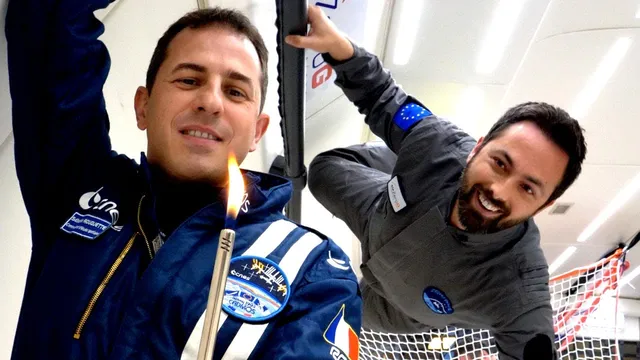
Fire in ZERO-G!!
Based on Veritasium's video on YouTube. If you like this content, support the original creators by watching, liking and subscribing to their content.
Parabolic weightlessness happens when the aircraft’s acceleration matches free fall (~9.8 m/s²), minimizing contact forces between people and the plane.
Briefing
A series of carefully flown parabolic maneuvers in a “Zero-G plane” delivers brief weightlessness by matching the aircraft’s acceleration to free fall—then uses the same setup to test how gravity-dependent physics changes everyday phenomena like flames and a rotating slinky. The core takeaway is that “weightless” doesn’t mean “no forces,” but rather that the net contact force between a person (or object) and the aircraft drops to near zero when both accelerate downward at about 9.8 m/s². That distinction matters because it reshapes intuition: objects can keep moving, combustion can look dramatically different, and even a stretched, rotating slinky can fail to contract in ways that feel counterintuitive under normal gravity.
The flight begins with a hyper-G climb that presses passengers into the floor at roughly 1.8 times body weight. Because the plane’s acceleration points upward and perpendicular to the floor, standing becomes difficult and blood shifts toward the feet, triggering dizziness for some. The climb also creates motion-sickness risk: the vestibular system becomes hypersensitive to head movement, which is why the experience is sometimes nicknamed the “vomit comet.” Passengers are advised to keep their heads still and look straight ahead.
Once the aircraft reaches a steep angle—around 50 degrees—the engines are throttled back and the plane follows a parabolic trajectory. Weightlessness starts when the plane and everything inside it continue accelerating toward Earth at the same rate as a freely falling object in vacuum. During the “zero-g” segment, the plane still moves upward while accelerating downward, so the net effect is that contact forces largely vanish. After about 22 seconds, pilots pull out of the dive, returning passengers to hyper-G as the aircraft accelerates upward again. In total, the group completes thirteen zero-g parabolas, plus additional segments simulating Mars and Moon gravity.
That gravity shift becomes a platform for experiments. A small barbecue lighter’s flame is compared across 1g, hyper-g, zero-g, and reduced-gravity conditions. Under normal gravity, buoyancy helps hot combustion products rise, pulling in oxygen and producing a distinctive flame shape. In hyper-g, the buoyancy effect strengthens, stretching the flame longer. In zero-g, buoyancy largely disappears, so combustion becomes less efficient: the candle flame produces more smoke and rises less, while the flame’s shape becomes distorted by fuel flow rather than gravity-driven convection. The discussion ties this to how hard it is to maintain combustion in space, where oxygen access to fuel is limited by the lack of buoyant mixing.
A slinky experiment adds another intuition challenge. In normal gravity, a slinky’s weight contributes to stretching and contraction. In zero-g, the experimenter swings a slinky around the head to stretch it, then releases it and watches the end behavior. The slinky remains fairly stretched and keeps rotating at about the same frequency, because the tension required to maintain circular motion provides the centripetal force—so weight never enters the equation. The result underscores that rotation and tension can sustain a stretched shape even when “weight” is absent.
The experience ends with a reflection on why zero-g research matters: it doesn’t just change comfort—it changes what physics looks like, forcing new models beyond everyday gravity-based intuition. The trip is credited to NovaSpace, with invitations and collaborations involving Bruce (e-penser) and Diana (Physics Girl).
Cornell Notes
Parabolic flights create weightlessness by tuning the aircraft’s acceleration to match free fall at about 9.8 m/s², reducing contact forces between passengers and the plane. The maneuver starts with a hyper-G climb (about 1.8× body weight) that can cause dizziness and motion sickness, then transitions into a ~22-second zero-g segment when engines are throttled and the plane follows a parabola. Experiments show gravity’s role in buoyancy-driven combustion: flames stretch in hyper-g, while zero-g reduces buoyant mixing, leading to poorer combustion and more smoke. A slinky stretched by rotation can remain stretched after release in zero-g because tension supplies the centripetal force, not weight. These results highlight why zero-g research is needed to test intuition and physics assumptions.
How does a parabolic flight actually produce “weightlessness” rather than just a dive?
Why do passengers feel heavier during the setup phase, and why does it cause dizziness?
What changes in flame shape and combustion quality across 1g, hyper-g, and zero-g?
Why does a rotating slinky stay stretched in zero-g after release?
What does the “Mars gravity” and “Moon gravity” portion add to the experiments?
Review Questions
- What acceleration condition must the aircraft meet for passengers to experience near-zero contact forces?
- How do buoyancy and oxygen access explain the differences between flame behavior in hyper-g versus zero-g?
- Why does rotation allow a slinky to remain stretched in zero-g even though weight is absent?
Key Points
- 1
Parabolic weightlessness happens when the aircraft’s acceleration matches free fall (~9.8 m/s²), minimizing contact forces between people and the plane.
- 2
The lead-in hyper-G climb can feel like about 1.8× body weight and can cause dizziness and motion sickness due to vestibular sensitivity.
- 3
During the zero-g segment, the plane follows a parabolic trajectory: it continues moving upward while accelerating downward, so passengers feel lighter.
- 4
Flame shape depends strongly on gravity-driven buoyancy: hyper-g lengthens flames, while zero-g reduces buoyant mixing and worsens combustion efficiency.
- 5
In zero-g, flame geometry is influenced more by fuel flow than by hot-air rise, often producing more smoke.
- 6
A slinky can remain stretched in zero-g if rotation supplies tension for centripetal force; weight is not required to maintain the stretched state.