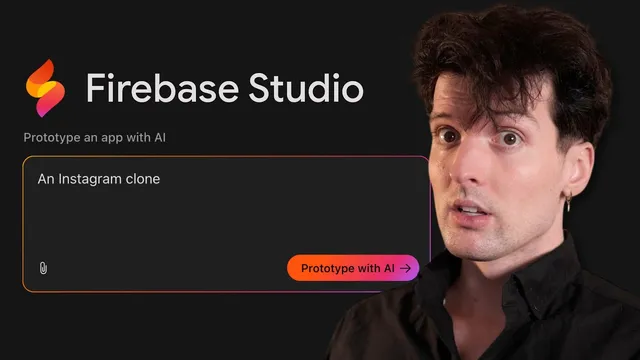
Firebase made an IDE?
Based on Theo - t3․gg's video on YouTube. If you like this content, support the original creators by watching, liking and subscribing to their content.
Firebase Studio is designed as an all-in-one, cloud-based agentic environment for building and deploying AI apps, aiming to reduce multi-service setup work.
Briefing
Google’s Firebase is rolling out Firebase Studio, a cloud-based “agentic” app builder meant to unify prototyping, coding workspaces, testing, deployment, and running AI apps in one place. The pitch is that Firebase Studio can behave like an “AWS for AI” by removing the usual glue-work required to stand up back-end infrastructure—especially the tedious, multi-service setup that slows down teams building production features.
Skepticism quickly turns into a mixed reaction. On the surface, Firebase Studio looks like a serious product: it generates a functional Next.js app from a prototype click, uses an in-browser editor built on open-source VS Code tooling, and offers instant previews via shareable URLs. The interface also leans into modern developer workflows—switching between prototyping and editing modes, generating UI components, and running error checks and autofixes as code is produced. Gemini is positioned as a speed advantage, and the UI responds quickly enough that TypeScript compilation and validation become the bottleneck rather than raw generation.
But the core promise—full-stack completeness—collapses under basic requirements. As soon as the workflow demands real backend behavior (authentication, persistence, and working routes), the generated apps repeatedly fail. The transcript highlights missing or broken backend implementations (features left as “to-do implement,” forms that don’t submit anywhere, and flows that don’t create or persist data). Even when the UI looks polished, the “server side” pieces often aren’t wired up correctly, leaving the app unable to create events, handle sign-in properly, or store results.
The frustration is amplified by comparisons to other AI builder tools mentioned during the testing: Bolt, Vzero, and Lovable. Those tools also struggle with backend correctness and integration friction, but the speaker’s takeaway is that Firebase Studio is uniquely positioned to do better because Firebase already provides the backend building blocks. Instead, it often behaves like a thin wrapper around integrations rather than a reliable end-to-end builder.
The transcript ends with a blunt assessment: none of the tested tools can reliably build a “real app” in the sense of working authentication and data persistence. Firebase Studio, however, is described as the best positioned to become major—because it looks right, feels coherent, and is designed for a full-stack future—yet it’s not ready to recommend until it can consistently deliver the missing backend functionality. The call to action is clear: Firebase should focus on full-stack execution and integration depth, not just impressive UI generation.
Cornell Notes
Firebase Studio is Google’s preview of a cloud-based, agentic environment for building AI apps end-to-end, aiming to reduce the multi-service setup that typically slows teams down. It generates a working Next.js app quickly, provides an in-browser editor based on VS Code tooling, and supports instant previews via shareable URLs. In practice, the workflow repeatedly breaks when backend requirements appear—authentication, persistence, and working routes often fail or are left incomplete. The result is a product with strong UX and generation speed that still can’t reliably deliver production-grade full-stack behavior. That gap matters because AI app builders live or die on backend correctness, not just landing pages and UI prototypes.
What is Firebase Studio trying to replace or simplify for developers building AI apps?
What parts of Firebase Studio feel most “real” or developer-ready during the prototype-to-code flow?
Where does Firebase Studio fail the full-stack test, and why is that decisive?
How does the transcript use comparisons to other AI builders to frame the problem?
What specific friction repeats across tools in the transcript?
What is the final verdict and what would need to change?
Review Questions
- Which Firebase Studio features in the transcript suggest it could be a strong developer workflow, and which features fail when backend requirements are introduced?
- What does the transcript imply is the minimum bar for an AI app builder to be considered “production-ready”?
- How do the comparisons to Bolt, Vzero, and Lovable support (or weaken) the critique of Firebase Studio?
Key Points
- 1
Firebase Studio is designed as an all-in-one, cloud-based agentic environment for building and deploying AI apps, aiming to reduce multi-service setup work.
- 2
The prototype-to-code experience is fast and polished, including Next.js generation, an in-browser VS Code-based editor, and instant shareable previews.
- 3
Backend correctness is the breaking point: authentication, persistence, and working routes frequently fail or remain incomplete.
- 4
AI builder tools broadly struggle with full-stack integration, but Firebase Studio is judged more critically because Firebase should make backend completion easier.
- 5
Gemini API key prompts and other repeated setup friction reduce usability during iterative development.
- 6
The transcript’s conclusion is that Firebase Studio has high potential but isn’t ready to recommend until it can consistently deliver end-to-end functionality.