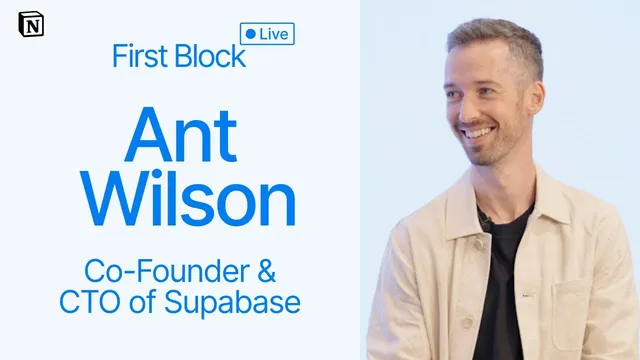
First Block: Interview with Ant Wilson, Co-Founder and CTO of Supabase
Based on Notion's video on YouTube. If you like this content, support the original creators by watching, liking and subscribing to their content.
Supabase’s culture requires every new hire to begin in frontline support, monitoring community channels and fixing usability issues immediately.
Briefing
Supabase’s growth story hinges on a simple operational rule: treat customer problems as the top priority, even when building a complex developer platform. Ant Wilson, co-founder and CTO, frames early momentum and long-term credibility as outcomes of relentless frontline support—fixing “I don’t know how to use this” issues immediately, regardless of fundraising timelines or internal roadmaps. That customer-first posture is formalized in the company’s culture: every new hire, from executives to interns, starts as frontline support and monitors community channels like X and Reddit to resolve real friction.
That approach connects directly to how Supabase positions itself and markets to developers. The company began as an open-source alternative to Firebase, but early messaging failed to clarify what it was for. A rebrand sharpened the tagline into a clear “open-source Firebase alternative,” and the impact was immediate: more visitors understood the product quickly, the project gained traction on Hacker News, and GitHub stars surged. Wilson’s takeaway is blunt—product quality matters, but messaging determines whether developers can tell in seconds if it fits their needs.
Supabase’s original technical wedge also came from personal experience. Wilson’s co-founder had hit scaling limits with Firebase and wanted a transactional, SQL-based Postgres foundation. Supabase built the missing pieces developers associated with Firebase—authentication, file storage, and real-time streams—so the “why” felt obvious to developers because the founders were solving their own pain.
Marketing strategy follows the same logic of meeting developers where they already are, at the moment they start new projects. Instead of generic promotion, Supabase leans into meme marketing and developer entertainment—using a successful YouTube channel that discusses broader developer topics before tying back to product launches. Wilson also treats timing as a core variable: either be “sniper-targeted” at the exact moment a developer begins a build, or stay “ubiquitous” through consistent presence. Supabase chooses the latter via community-native content rather than shouting database features.
Community feedback shapes the roadmap, but with guardrails. Wilson says roughly 80% of the roadmap is community-driven, yet Supabase draws a line at adjacent products that don’t align with its identity as a database company. Front-end hosting is declined because competitors like Vercel already excel, while database-adjacent features—such as GraphQL—are embraced when they strengthen the data layer story.
Scaling up adds another set of priorities: security, stability, and performance. Wilson argues these are the understated features that build enterprise trust, even if they rarely trend on social media. As Supabase grows to around 150 people across 37 countries, the company maintains speed through explicit culture documentation, written communication, and asynchronous work norms. Global coverage also becomes a product advantage—low latency for customers worldwide—because the team and infrastructure were designed for distributed reality from the start.
Finally, Wilson’s founder advice boils down to relationship-building before the company exists and to rebuilding with honest customer feedback rather than comforting internal assumptions. If Supabase were restarted today, the first “block” would be discarding preconceptions and actively seeking the specific things that are broken or unclear—because that’s where the next iteration of the product, and the next round of trust, begins.
Cornell Notes
Ant Wilson describes Supabase’s rise as the result of a disciplined customer-first system: everyone starts as frontline support, watching community channels and fixing usability issues immediately. Clear positioning mattered as much as product quality—changing the tagline to “open-source Firebase alternative” improved comprehension and drove early traction on Hacker News and GitHub. The product wedge came from solving the founders’ own Firebase scaling limits using Postgres, then adding Firebase-like capabilities such as authentication, storage, and real-time streams. Supabase scales with explicit culture, heavy written/asynchronous communication, and global coverage that supports low latency. For roadmap and growth, community input is central, but the company stays focused on the database layer and treats security, stability, and performance as enterprise foundations.
Why does Supabase treat customer support as a company-wide responsibility, not a department function?
How did a rebrand change Supabase’s early traction despite keeping the same product?
What technical and product choices formed Supabase’s “wedge” into the market?
What marketing approach does Supabase use to stay top-of-mind with developers?
How does Supabase decide which community requests to accept—especially when they push beyond the database layer?
What enables Supabase to ship quickly and maintain culture across 37 countries?
Review Questions
- What specific mechanism ensures that customer issues get handled quickly at Supabase, and how does that affect product adoption?
- How did Supabase’s messaging change alter developer comprehension, and what metrics or signals followed?
- When community requests conflict with Supabase’s identity, what decision rule does Wilson describe for staying focused on the database layer?
Key Points
- 1
Supabase’s culture requires every new hire to begin in frontline support, monitoring community channels and fixing usability issues immediately.
- 2
Clear positioning as an “open-source Firebase alternative” improved developer understanding within seconds and drove early traction on Hacker News and GitHub.
- 3
The company’s product wedge came from solving the founders’ own Firebase scaling limits by building Firebase-like capabilities on top of Postgres.
- 4
Developer-focused marketing relies on timing and community-native content; meme marketing and developer entertainment help keep Supabase top-of-mind.
- 5
Roadmaps are largely community-driven, but Supabase draws boundaries to protect its database-layer focus and avoid competing with specialists like Vercel in front-end hosting.
- 6
Enterprise trust is built through sustained attention to security, stability, and performance rather than flashy claims.
- 7
A globally distributed team maintains speed and alignment through explicit written culture, asynchronous communication norms, and time-zone coverage that supports continuous support.