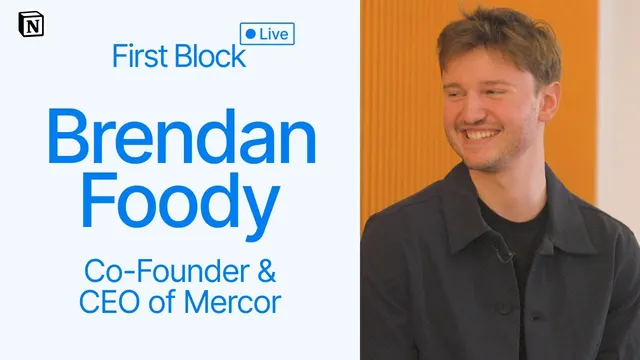
First Block: Interview with Brendan Foody, Co-Founder and CEO of Mercor
Based on Notion's video on YouTube. If you like this content, support the original creators by watching, liking and subscribing to their content.
Mercor’s recruiting automation targets three outcomes: more candidates on the platform, better candidate-job matching, and faster hiring cycles.
Briefing
Mercor’s co-founder and CEO Brendan Foody frames the company’s mission as an efficiency upgrade to hiring: automate repetitive recruiting steps while improving candidate availability, matching quality, and time-to-hire. The core idea is that “vibes-based” decisions can be reduced by grounding selection in performance data—predicting (1) whether a candidate will be interested in a role and (2) whether that candidate will perform well once hired. The result is a recruiting system designed to be more transparent and less biased, while still leaving room for human judgment at the final stage.
Foody ties Mercor’s approach to a long-running obsession with talent allocation, a problem he calls both universal—everyone spends their time through work—and surprisingly under-addressed by most companies. His path to recruiting software began with early hustles that taught him about incentives, competition, and scaling: selling donuts for profit in middle school, then undercutting a competitor’s higher-cost donuts, and later doing AWS consulting for classmates who were eligible for startup credits but weren’t applying. Those experiences evolved into building recruiting workflows with friends, hiring engineers internationally, and partnering with a code club at IIT Kharagpur to source talent. As ChatGPT gained traction, Foody says the manual resume reviews and interview processes his teams were using felt antiquated—and ripe for automation.
The company’s scale, as shared in the conversation, is striking. Mercor reportedly grew from a one-to-100 million revenue run rate in 11 months, reached well over half a million users, and has conducted hundreds of thousands of interviews across roles spanning software engineering, medicine, law, finance, and HR. Mercor also works with six of the Magnificent Seven and all of the top five AI labs, according to Foody. He credits this momentum to building the right product while the market shifted from crowdsourcing low- and medium-skilled work toward sourcing and vetting exceptional people to collaborate directly with AI researchers.
On hiring and leadership, Foody emphasizes a high bar early: keep standards as high as possible for the first 10 hires because those early decisions shape the next hundred. As the company grows past the “friend group” phase, culture must be operationalized through processes and values. Three values anchor Mercor’s culture: a can-do attitude that optimizes toward larger outcomes, high standards (especially in hiring), and intensity—working “like no one else.” He also describes a leadership scaling principle: build a network of people the CEO deeply trusts to quarterback initiatives to completion, and cultivate decision-makers who hold strong opinions loosely, updating quickly when evidence contradicts them.
Fundraising is treated less as a trophy and more as an input to building. Foody recounts bootstrapping to a million-dollar revenue run rate before dropping out of college, then raising a seed round with General Catalyst, followed by Series A and Series B. He highlights that investors moved quickly after seeing customer conversations and inflection metrics. Even with rapid growth, he warns that startups oscillate between extreme highs and lows, and recommends long-term perspective anchored in metrics and a north-star metric that compounds over a decade.
Finally, Foody’s product philosophy is practical: automate repetitive steps, improve matching by combining interest and performance prediction, reduce bias by focusing on interview transcripts rather than multimodal “fit,” and use humans for final judgment once the funnel is diversified. If Mercor were rebuilt today, he says the first block would still be the team—because execution depends on trusted people.
Cornell Notes
Brendan Foody describes Mercor as a recruiting platform built to automate repetitive hiring tasks while improving three outcomes: more candidates, better matching, and faster hiring. Matching blends two predictions: whether a candidate will be interested in a role and whether they will perform well once hired, using performance data from interview outcomes and resumes. Foody argues that much hiring is “vibes-based,” so Mercor reduces bias by grounding decisions in performance evidence and by having an AI interviewer evaluate interview transcripts rather than multimodal signals. He also stresses leadership and culture: keep a high bar for the first 10 hires, scale culture through values and processes, and build a trusted leadership bench. The company’s rapid growth is framed as arriving at the right time as the market shifted from crowdsourcing to vetting top talent for AI work.
How does Mercor’s matching system try to avoid “vibes-based” hiring?
What does Foody say is the right way to think about hiring early in a startup?
What cultural values does Mercor try to preserve as it grows beyond a small team?
How does Foody describe scaling leadership inside the company?
Why does Foody believe timing mattered for Mercor’s fundraising and growth?
What is Foody’s long-term approach to handling startup volatility?
Review Questions
- What are the two predictions that drive Mercor’s matching, and how does each one use different data?
- Why does Foody insist the first 10 hires should keep the highest bar possible, and how does that affect later scaling?
- How does Foody balance reducing bias with the need for human judgment in final hiring decisions?
Key Points
- 1
Mercor’s recruiting automation targets three outcomes: more candidates on the platform, better candidate-job matching, and faster hiring cycles.
- 2
Matching is built from two models: predicting candidate interest in a role and predicting candidate performance after hire using performance data.
- 3
Foody argues that bias reduction comes from grounding decisions in evidence and evaluating interview transcripts rather than multimodal “fit” signals, while still allowing humans to make final calls.
- 4
Early hiring should prioritize quality: keep standards as high as possible for the first 10 hires because those people shape the company’s next major scale decisions.
- 5
Mercor’s culture is anchored by can-do ambition, high standards, and intensity, and it must be translated into processes once the team stops functioning like a small friend group.
- 6
Scaling leadership depends on building a bench of trusted people who can quarterback initiatives end-to-end, supported by context, training, and culture.
- 7
Fundraising is treated as an input to product building rather than a standalone goal, with investor momentum tied to customer conversations and measurable inflection.