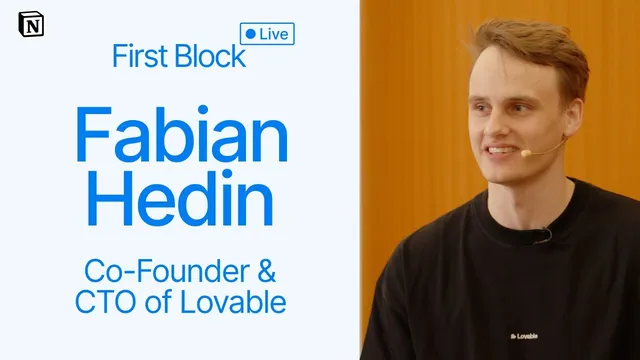
First Block: Interview with Fabian Hedin, Co-Founder and CTO of Lovable
Based on Notion's video on YouTube. If you like this content, support the original creators by watching, liking and subscribing to their content.
Fabian Hedin frames Lovable’s core mission as enabling non-technical founders to build software from scratch, not just improving developer workflows.
Briefing
Lovable’s co-founder and CTO Fabian Hedin credits the company’s rapid rise—from $1M to $100M in revenue in eight months—to a simple but difficult shift: using AI to help non-technical people build real software from “0 to 1,” not merely to assist developers inside existing workflows. Hedin says the hardest problem wasn’t generating code snippets; it was making software creation practical for people who don’t want to learn years of technical skills, including the choices that determine whether an app can actually survive in production.
His path to that idea started early. Minecraft pulled him into running a server and building a website around it, which led him to learn HTML, CSS, and JavaScript. In high school, he moved from games to business applications and began building SaaS products. After a real estate SaaS venture right after graduation, he studied at the Royal Institute of Technology in Stockholm, where he met Anton and joined a YC startup called Depict for 10 months—his longest employment to date—before leaving to build again.
The turning point came in summer 2023 when Anton asked him to take a walk and introduced a new CLI for creating software, built around GPT-3 and GPT-4-era models. Hedin says he could already see the direction: AI would enable a new kind of software creation, but the team had to find an approach that worked for non-technical users. Early doubts centered on whether foundational models were good enough for the use case. The company launched in November (about eight months before the interview), and Hedin describes that moment as when the concept became real beyond his own conviction.
Lovable’s name reflects its product philosophy. The company started as “GPT Engineer,” but the brand “Lovable” was already in use, tied to the idea of moving from low-fidelity design to a “minimum lovable product”—building the real thing rather than discarding an MVP and starting over. Hedin also points to a key early mistake: launching too late. The team sat on a waitlist longer than it should have, missing the chance to establish a lead while the category was still forming.
As the company scaled, Hedin emphasized staying close to product without becoming a meeting-heavy executive. He tries to say no to meetings and keeps those he joins short, while still working day-to-day on both high- and low-level product and engineering decisions. The company’s structure aims to stay flat—around 40 engineers at the time of the conversation—so ideas can float and the best ones win.
On process, he argues that traditional planning artifacts like PRDs and heavy roadmap cycles may be less necessary when prototypes can be built quickly. Still, the bigger shift is technical: AI can generate initial software, but production readiness depends on how well the system handles complexity over time—databases, migrations, and ongoing maintenance. Hedin says Lovable is designed to encode good technical choices up front so users don’t have to manually pick tools like Supabase.
Finally, he frames the company’s broader mission as accelerating startup creation for the “99%” who don’t code much. He also highlights a partnership angle: combining Lovable with Notion, where users already store context, could reduce the context bottleneck that limits many AI tools. His advice to founders is to focus on what foundational models can do today rather than overbuilding for a future version of AI—and, if rebuilding Lovable from scratch, to start by using Lovable itself.
Cornell Notes
Fabian Hedin says Lovable’s breakthrough is enabling non-technical people to build software “0 to 1” using AI, with production-ready outcomes rather than just developer assistance. The company’s launch in November—after early doubts about whether foundational models could support the workflow—turned a personal conviction into real traction. Hedin credits early momentum to broad product scope, faster general launch timing, and a flat engineering culture that keeps decisions close to product. He also stresses that “production-ready” means handling long-term complexity: databases, migrations, and ongoing maintenance, plus making good technical choices automatically. The Notion partnership is positioned as a way to turn Notion’s stored context into software creation inputs, reducing a major constraint for AI builders.
What does “0 to 1 as fully non-technical” mean in Lovable’s approach, and why is it harder than developer-focused AI tools?
Why did the team initially doubt whether foundational models were sufficient, and what changed by launch?
How does Lovable’s naming connect to its product philosophy?
What early execution mistake does Hedin point to, and what lesson does it carry for founders?
What does “production-ready” mean when AI generates software, especially as codebases grow?
How does Lovable aim to reduce technical-choice burden for users?
Review Questions
- How does Lovable’s target user group change the definition of success compared with developer-assist AI tools?
- Which parts of software complexity does Hedin identify as the main barrier to “production-ready” AI-generated apps?
- What operational habits does Hedin use to stay hands-on as the company scales, and how do those habits support a flat engineering culture?
Key Points
- 1
Fabian Hedin frames Lovable’s core mission as enabling non-technical founders to build software from scratch, not just improving developer workflows.
- 2
The company’s November launch is described as the moment the idea moved from internal conviction to measurable traction.
- 3
Lovable’s name reflects a “minimum lovable product” concept: using AI to build the real software rather than discarding an MVP and starting over.
- 4
Hedin cites a key early mistake—waiting too long for a general launch—arguing that speed mattered more than a prolonged waitlist.
- 5
Scaling required staying close to product while reducing meeting load; Hedin tries to say no to meetings and keeps them short.
- 6
Lovable’s definition of production readiness centers on long-term maintainability: databases, migrations, and the ability to keep improving after the first version.
- 7
The Notion partnership is positioned as a way to turn stored context into software creation inputs, addressing a major bottleneck for many AI tools.