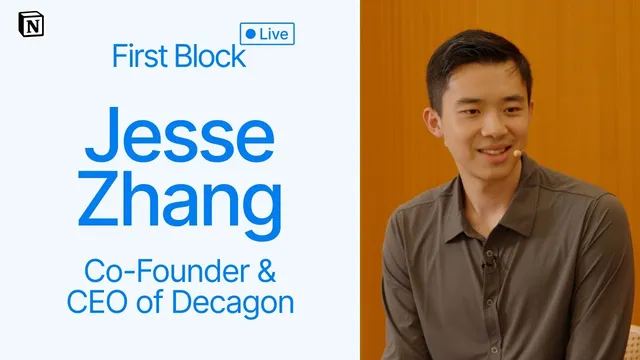
First Block: Interview with Jesse Zhang, Co-Founder and CEO of Decagon
Based on Notion's video on YouTube. If you like this content, support the original creators by watching, liking and subscribing to their content.
Decagon positions AOPs as natural-language, SOP-like instructions that make agent behavior transparent and easier to update than brittle conversation trees.
Briefing
Decagon’s core bet is that customer service automation can move from brittle, hand-built chatbot trees to reliable, business-ready AI by using “agent operating procedures” (AOPs)—natural-language instructions that teams can read, update, and test like standard operating procedures. The approach targets a recurring enterprise pain point: even when models can generate text, traditional automation systems often break under real-world edge cases and become expensive to maintain. By letting teams specify workflows in plain language, Decagon aims to make AI behavior transparent and iteratable, so deployments can improve quickly without requiring constant technical re-engineering.
That design philosophy is tied to how Decagon avoids the fate many AI pilots face: stalling before production or failing to prove ROI. Jesse Zhang frames the company’s path as customer-first rather than narrative-driven. Early on, the prevailing industry assumption was that incumbents would eventually copy the idea and undercut new entrants; Decagon’s counter was to focus on customers from the ground up and treat the market as still unsolved—because strong customers willing to partner signal there’s real work left to do. In hindsight, the company’s production success is attributed to two practical advantages in customer support: impact can be measured with clear operational metrics like deflection rates and customer satisfaction, and AI can be “derisked” with a structural fallback to human escalation. That combination makes it easier to build a business case and reduces the pressure to get every interaction perfect before going live.
Decagon’s product performance is also linked to model capability and iteration speed. Zhang points to “Jedi models” as well-suited for conversational and transactional problem-solving, while AOPs enable faster iteration across complex workflows and edge cases—an advantage that shows up in reported outcomes such as 70–80% deflection and roughly 3x customer satisfaction improvements at customers including Duolingo, URA, ClassPass, and Notion.
The company’s growth story reflects a broader operating style shaped by earlier startup lessons. Zhang’s first company, Loki, went through YC and struggled for about two years to find a useful direction before landing on video capture for games, which led to acquisition by Niantic in 2021. The key takeaway was not just talking to customers, but getting better at it—turning ideation into a systematic, customer-validated process.
On enterprise trust and scaling, Zhang credits short-term execution early: rapidly deploying to large customers, building a team that could ship, and letting the product “mold” around real usage. As the customer base solidified, the company shifted toward longer-term infrastructure work. Hiring strategy followed a similar logic—early generalists from trusted networks, then more specialization as the company grows. Today the team is nearing 200 people, up from roughly a dozen about a year and a half earlier.
For founders, Zhang’s advice is to avoid overindexing on generic scaling playbooks and instead focus on personal strengths, timing, and product fit. Rebuilding Decagon from scratch would mainly mean hiring key roles—especially marketing—earlier, since waiting until demand is obvious can cost months of recruiting and ramp time. Overall, Decagon’s story ties together measurable ROI, maintainable agent design, and disciplined execution as the path from pilot to production.
Cornell Notes
Decagon builds AI customer service agents that can handle conversations, look up data, reason through steps, and guide users through workflows. Its central mechanism is “agent operating procedures” (AOPs): natural-language instructions that make agent behavior transparent, easier to update, and faster to iterate than brittle, tree-based automation. Zhang links production success to two enterprise realities—customer service metrics like deflection and satisfaction are easy to quantify, and human escalation provides a structural fallback that reduces risk. The company also credits speed in early execution: deploying quickly to large customers and letting real usage shape the product. Over time, Decagon has shifted from short-term shipping to longer-term infrastructure and more specialized hiring.
Why does Decagon treat AOPs as more than just a prompt-writing trick?
What makes customer support a uniquely workable use case for AI agents compared with other domains?
How does Zhang connect Decagon’s success to avoiding the “AI pilots fail” pattern?
What role do models and iteration speed play in the reported performance gains?
How did the Loki experience shape the approach to ideation and customer discovery at Decagon?
What hiring philosophy supports Decagon’s scaling from early stage to enterprise deployment?
Review Questions
- How do AOPs change the maintenance and update process compared with tree-based chatbot systems?
- Which two factors make ROI easier to prove in customer service, and how do they reduce deployment risk?
- What does Zhang say founders should do differently when choosing ideas and building go-to-market plans?
Key Points
- 1
Decagon positions AOPs as natural-language, SOP-like instructions that make agent behavior transparent and easier to update than brittle conversation trees.
- 2
Customer support deployments are derisked through measurable metrics (deflection rate and customer satisfaction) and a structural fallback to human escalation.
- 3
Decagon’s path to production success is linked to customer-first direction rather than industry narratives about incumbents copying the idea.
- 4
Reported outcomes at customers are attributed to both model suitability for conversational/transactional tasks and faster iteration enabled by AOPs.
- 5
Zhang’s earlier startup experience (Loki) reinforced the need for a more systematic, intentional ideation phase and better customer conversations.
- 6
Enterprise trust and scaling early on were driven by short-term execution: rapid deployment to large customers and building the product around real usage.
- 7
Hiring strategy evolves from early generalists hired through trusted networks to later specialization as the company grows.