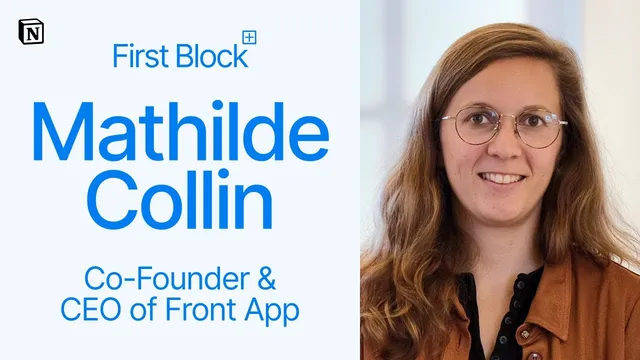
First Block: Interview with Mathilde Collin, Co-Founder & CEO of Front
Based on Notion's video on YouTube. If you like this content, support the original creators by watching, liking and subscribing to their content.
Front’s “front office” concept treats communication as a team workflow where users just want responses, not ticket bureaucracy.
Briefing
Front’s co-founder and CEO Mathilde Collin traces the company’s rise to a simple, repeatable idea: build a “front office” for communication that makes teams feel good while delivering fast, high-signal feedback—then run the organization with radical transparency so employees stay engaged even when results wobble.
Collin’s origin story starts with constraints and alignment. After graduating in 2012, she wanted to start a company but lacked money. An angel investor in France funded Front pre-product and introduced her to her co-founder, who had also been looking for a new venture. They spent an early dinner stress-testing the hardest questions—firing each other, equity splits, and exit scenarios—before taking the leap. The product’s initial focus was email, but the team deliberately avoided building an email-only tool. That choice made it easier to add other channels later, because the underlying concept was always a shared “front office” experience: people want to send messages and get responses, not manage ticket numbers or workflow bureaucracy.
Her motivation for choosing email—and then expanding beyond it—was personal. She experienced how toxic work environments can make people “sad as a human being,” and she wanted to create a workplace where people are happy, regardless of the specific work. Email was the tool everyone already used, yet it wasn’t designed for teams. Front aimed to improve the daily experience of people spending hours in the app by turning communication into a team workflow that still feels lightweight to the user.
Collin also credits service and customer-facing rigor as a growth engine. Support teams aren’t just a cost center; they can become valuable product input and even a sales differentiator when companies publish support metrics and treat service as part of the customer journey. She links this to a broader mindset popularized by Danny Meyer’s “Setting the Table”: engagement comes from learning from customers and building loops back into product and sales, not from deflecting tickets.
Early customer acquisition leaned heavily on content. With a landing page and a beta sign-up, Collin drove early interest by writing about communication and contrasting synchronous vs. asynchronous work as Slack surged. She notes a stark early conversion gap—thousands signed up, only a few used the product—then explains why: the earliest version was email-like but missing attachments, which made adoption awkward. Still, it enabled rapid feedback and iteration.
Scaling culture and engagement became the next major challenge. Collin describes a period in 2017 when her co-founder was diagnosed with cancer and she later developed severe anxiety that forced her to stop working. Recovery came through a mix of hypnosis, therapy, time off, exercise, better eating, meditation, and strict boundaries like removing work apps from her phone. In hindsight, the experience deepened empathy and led to lasting changes.
For engagement, she ties motivation to purpose: employees stay engaged when they know who they serve. Front operationalizes that connection through onboarding support inquiries, recurring all-hands with customer stories and workflow demos, and heavy use of transparency tools so employees can see what customers like and dislike. All-hands are designed around transparency that removes the “should we hide this?” dilemma—calendars, board decks, and goal tracking are shared—so even missed quarters are discussed directly, with a plan and confidence check. The goal isn’t hype; it’s meaning.
Her leadership practices extend to one-on-ones and hiring. Monthly “happiness one-on-ones” ask employees what they’re most and least happy about and what would improve their professional lives, helping leaders catch issues early and avoid surprise resignations. Hiring guidance emphasizes extreme selectivity—would this person be someone you’d want to hire 10 times?—and treating early hires as potential co-founders. She also warns against hiring to solve problems the company hasn’t already solved internally, especially in areas like marketing where channels must be discovered.
Across product, growth, culture, and leadership, Collin’s throughline is consistent: transparency and customer connection aren’t soft values—they’re operational systems that keep teams aligned, learning, and resilient when performance isn’t perfect.
Cornell Notes
Mathilde Collin credits Front’s growth to a “front office” approach to team communication: build a shared inbox/workflow experience that feels simple to users while enabling fast feedback for the team. She links product strategy to culture by treating support as both a customer experience and a product input, then scaling engagement through radical transparency—public calendars, board decks, and goal tracking—so missed targets are discussed with a plan rather than hidden. Collin also describes personal mental-health challenges in 2017 and how recovery led to lasting boundaries and empathy, which then informed how she runs engagement systems. Her management toolkit includes customer-connected onboarding, recurring all-hands, and monthly “happiness one-on-ones” that focus on how people feel, not just work status.
Why did Front’s founders start with email but avoid designing the product as “email-specific”?
How did content drive early customer acquisition, and what did the early conversion gap teach?
What does Collin mean by support being a sales tactic, not just a cost center?
How does Front keep employees connected to customers as the company scales?
What’s the logic behind “radical transparency,” and how does it handle bad quarters?
Why are monthly “happiness one-on-ones” treated as more valuable than status-focused meetings?
Review Questions
- What product design choice helped Front expand beyond email without rebuilding the core experience?
- How does Collin connect transparency to engagement during both strong and weak performance periods?
- What hiring principles does Collin use to avoid common early-stage mistakes, especially for marketing and sales?
Key Points
- 1
Front’s “front office” concept treats communication as a team workflow where users just want responses, not ticket bureaucracy.
- 2
The company avoided building an email-only product early, making it easier to add new communication channels later.
- 3
Early acquisition relied heavily on content and beta sign-ups, with rapid iteration driven by tight feedback loops despite low initial usage.
- 4
Customer support is positioned as a growth lever: publishing support metrics and delivering strong service can increase trust and sales.
- 5
Collin links employee engagement to purpose—employees stay motivated when they know who they serve and can see customer feedback directly.
- 6
Radical transparency is implemented through processes that force disclosure (board decks, goal tracking), including missed quarters paired with a credible plan.
- 7
Leadership systems like monthly “happiness one-on-ones” and selective hiring practices are used to prevent surprises and keep culture aligned as the company scales.