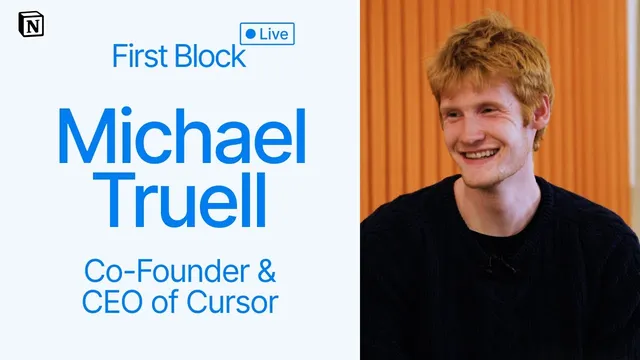
First Block: Interview with Michael Truell, Co-Founder and CEO of Cursor
Based on Notion's video on YouTube. If you like this content, support the original creators by watching, liking and subscribing to their content.
Cursor positions itself as an AI-native coding environment for professional developers, aiming to speed work without abandoning code comprehension.
Briefing
Cursor’s rise traces back to a simple but consequential bet: AI will become the “pane of glass” where professional developers build software, so the best product strategy is to redesign the coding environment around that future rather than bolt AI onto existing workflows. Michael Truell describes Cursor as the best way for professional developers to build software with AI—positioned like Google Docs is for writing and Figma is for design—where models help developers move faster while still keeping them grounded in the codebase they’re working on.
The origin story starts with a false start that nearly derailed the team’s direction. After forming with three close friends from MIT and drawing inspiration from early GitHub Copilot, the group first chased mechanical engineering—training 3D autocomplete models for CAD workflows. That effort ran into “bad founder-market fit” (they weren’t mechanical engineers) and hard data constraints: CAD/3D ML had far less usable training data than code, and transfer from existing pretrained models was weak. With momentum stalling and passion fading, the team pivoted back to what they knew deeply—programming.
The pivot sharpened into a broader thesis about how software development will change as models improve. Truell argues that active software building will shift from editing millions of lines of logic toward specifying what the software should do and how it should look. Cursor’s editor-first approach followed from that reality: if software development flows through AI models, then the interface where developers work must change too. That’s why the company initially built a minimally useful editor from scratch—complete with its own terminal, remote SSH, LSP integrations, and early Copilot-style integration—before later deciding to base the roadmap on VS Code to avoid spending too many engineering cycles reinventing core editor “wheel” components.
On the AI side, Cursor avoids framing itself as a “vibe coding” tool where developers lose the thread. Instead, it treats large language models as powerful helpers and an “advanced interpreter/compiler” for turning higher-level intent into concrete code, using rich context from the codebase and the organization. The end goal is a higher level of abstraction where developers can look less at boilerplate, but Truell stresses that professional work still requires reading and understanding code—especially in large teams—so control and traceability remain central.
Growth accelerated only after a long runway. There was roughly a year in “the wilderness” refining ideas that didn’t become Cursor, then a period of dialing in the product after launch. Truell credits acceleration to both product maturity and a key lever under the hood: custom models built on top of major foundation models, which improved Cursor’s performance enough to unlock broader adoption.
Inside the company, the team’s focus strategy evolved alongside hiring. Early on, they hired slowly and avoided distractions like networking and speaking, driven by fear of pulling attention away from product quality. Later, that caution was recognized as a bottleneck. As the company scaled to around a hundred people, Notion became the internal wiki and onboarding backbone, and the team leaned into structured focus weeks—paired with hiring for “micro pessimism” and “macro optimism”—to cut through the noise of fast-moving AI and constant customer feedback. The throughline is skepticism toward startup orthodoxy, a willingness to pivot when passion and data don’t align, and a belief that the co-founding team matters more than conventional playbooks.
Cornell Notes
Cursor’s co-founder Michael Truell links the product’s success to a thesis: AI will become the core interface for professional software development, so the editor itself must be redesigned around model-driven workflows. After a year-long false start in mechanical engineering and CAD-focused 3D ML—hampered by weak founder-market fit and limited data—the team pivoted to programming, where their background and available code data made progress more feasible. Cursor initially built an editor from scratch to control the experience, then shifted to VS Code foundations to avoid long-term reinvention. Growth came after product dialing and custom model work on top of major foundation models, not immediately after launch. Internally, Notion scaled onboarding and context, while hiring and focus-week practices helped the team stay productive amid rapid AI change.
Why did the team abandon mechanical engineering and CAD-focused AI work?
What core product idea drove Cursor to build an editor rather than just an AI coding extension?
How did Cursor’s early engineering approach change over time?
How does Cursor aim to balance speed from AI with developer control?
What drove Cursor’s adoption after an initially slow period?
What internal practices helped the team stay focused while scaling?
Review Questions
- What specific constraints (data and fit) made the CAD/3D ML approach difficult to scale, and how did those constraints influence the pivot back to programming?
- Why does building an editor from scratch create both control and long-term cost, and what tradeoff led to basing Cursor on VS Code?
- How does Cursor’s approach to AI differ from “vibe coding,” and what does Truell say still requires human attention in professional development?
Key Points
- 1
Cursor positions itself as an AI-native coding environment for professional developers, aiming to speed work without abandoning code comprehension.
- 2
A CAD/mechanical engineering detour failed due to weak founder-market fit, limited domain data, and poor transfer from existing pretrained models.
- 3
Cursor’s editor-first strategy follows from the belief that software development will increasingly flow through AI models, requiring new UI and workflows.
- 4
The team initially built an editor from scratch to control the experience, then switched to VS Code foundations to avoid long-term reinvention overhead.
- 5
Cursor’s AI balance emphasizes delegation and context-aware assistance rather than “vibe coding,” keeping developers anchored to large codebases.
- 6
Adoption accelerated after product dialing and improvements from custom models built on top of major foundation models.
- 7
Notion scaled internal onboarding and company context, while hiring and focus-week practices helped the team manage noise in a fast-changing AI landscape.