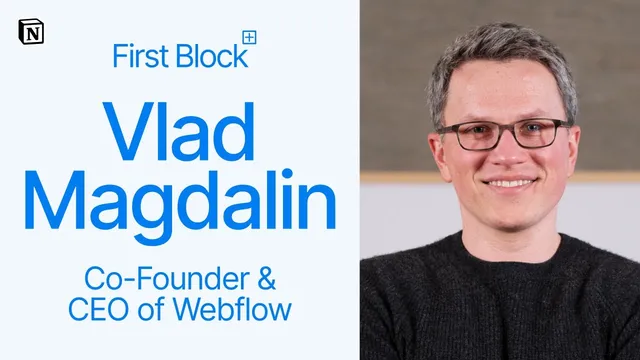
First Block: Interview with Vlad Magdalin, Co-Founder and CEO of Webflow
Based on Notion's video on YouTube. If you like this content, support the original creators by watching, liking and subscribing to their content.
Webflow’s core vision depended on browser technology finally supporting the interactive visual editing experience the founders wanted.
Briefing
Webflow’s rise wasn’t driven by a straight line from idea to product—it took a decade of false starts, shifting technology constraints, and near-collapse funding decisions before the company found a sustainable niche. Vlad Magdalin credits the breakthrough to timing: browser capabilities finally made a visual, code-free web builder feasible, and the final attempt in 2012/2013 aligned the right product with the right moment. The payoff came later than the early hype suggested, but it arrived through a community of designers and small businesses who treated Webflow as a livelihood rather than a hobby.
Magdalin traces the company’s origin to a personal “translation layer” insight from his early web design work. Designers were producing screen-based layouts while developers translated those into code and CMS systems—an inefficient split that left value on the table. Seeing invoices that billed far more than the labor cost, he concluded that creatives needed something closer to 3D animation software for the web: a tool where the creative intent could be expressed directly, without losing power in the handoff to engineering.
The Webflow co-founding story centers on trust and complementary skills. One co-founder is Magdalin’s brother, and the other is Bryant, an early engineering hire from a prior venture at Intuit. The team’s division of labor mapped to the product’s needs: strong HTML/CSS and front-end abstraction from Magdalin, deep backend and infrastructure expertise from Bryant, and product design/customer focus from the designer co-founder. Their early work rhythm—months of designing and coding together in a small setting—was paired with constant debate, which Magdalin frames as both friction and fuel.
Family and immigration shaped the founder mindset. Arriving in the U.S. as a refugee at age nine, Magdalin says the experience removed the “chip on the shoulder” drive and replaced it with a belief that life was mostly upside. Poverty and the need to work built a work ethic that later made repeated attempts feel inevitable, even after setbacks like Y Combinator rejection.
The long road to Webflow’s current success included three major attempts before the final one. Each time, momentum was interrupted by life events, competitors, or technology that wasn’t ready—particularly the lack of browser support for the kind of visual front end Webflow would eventually deliver. When Webflow launched paid plans in 2013, conversion was far lower than expected: tens of thousands signed up for a demo/playground, but only about 50 converted to paid plans. Instead of treating that as failure, Magdalin describes it as a “blessing in disguise”—those who did pay became deeply engaged, using Webflow for 8–10 hours a day and feeding product feedback that helped shape the company.
Financial discipline also mattered. After a seed round that initially raised far less than targeted, Magdalin says fundraising became exhausting and unproductive, leading to a decision to stop chasing investors and focus on building. The company later reached cashflow break-even in 2015, which reduced pressure to pursue traditional venture metrics. Hiring and leadership evolved around mission alignment and leaders who “sweat the details,” with an early front-end engineer hire (Dan) credited with inventing core interaction and animation systems that accelerated growth.
As Webflow looks forward, Magdalin frames the company’s mission as part of a broader “empowerment economy,” where software creation becomes as normal as literacy. He expects no-code, low-code, and AI to expand the share of people who can build and automate real solutions—shifting software from a tool for specialists to a daily capability for everyone.
Cornell Notes
Vlad Magdalin says Webflow’s success came after a decade of attempts, with the final launch only becoming viable when browser technology caught up to the vision of a visual web builder. The early product attracted huge waitlist interest, but paid conversion was tiny—about 50 paying customers—until those users proved Webflow was transformative enough to become their livelihood. That community feedback helped Webflow find its niche in a “middle zone” between developers and non-technical businesses, and it shaped a product strategy that doubled down on professional creators. Financial survival also played a role: after exhausting fundraising, the company focused on building until reaching cashflow break-even in 2015, reducing dependence on venture timelines. The long-term goal is an “empowerment economy,” expanding software creation beyond specialists.
Why did Webflow take so long to become real, and what changed by the final attempt?
What was the “translation layer” insight that seeded the idea for Webflow?
How did Webflow’s early paid conversion results reshape the company’s understanding of product-market fit?
How did family and immigration influence Magdalin’s approach to repeated startup attempts?
What role did cashflow break-even play in Webflow’s funding strategy?
What hiring principle stayed consistent as Webflow scaled?
Review Questions
- What specific mismatch between waitlist interest and paid conversion forced Webflow to reinterpret its early demand signals?
- Which technology constraint delayed the visual front-end vision, and how did the final timing change the outcome?
- How did reaching cashflow break-even alter Webflow’s approach to fundraising and hiring pace?
Key Points
- 1
Webflow’s core vision depended on browser technology finally supporting the interactive visual editing experience the founders wanted.
- 2
A “translation layer” insight from agency work—design intent getting lost in handoffs to code and CMS—helped define the product’s purpose.
- 3
Trust and complementary skills among the co-founders (design/customer focus, front-end abstraction, backend/infrastructure depth) shaped early execution.
- 4
Early product-market fit emerged from a small group of power users who used Webflow as a livelihood, not from mass conversion of waitlist signups.
- 5
Repeated startup attempts were interrupted by timing, competitors, life events, and readiness of the underlying technology—until the final attempt aligned the pieces.
- 6
Financial survival mattered: stopping fundraising after exhausting seed efforts and reaching cashflow break-even reduced dependence on venture metrics.
- 7
Webflow’s hiring and leadership emphasis centered on mission alignment and leaders who deeply understand the craft of the product.