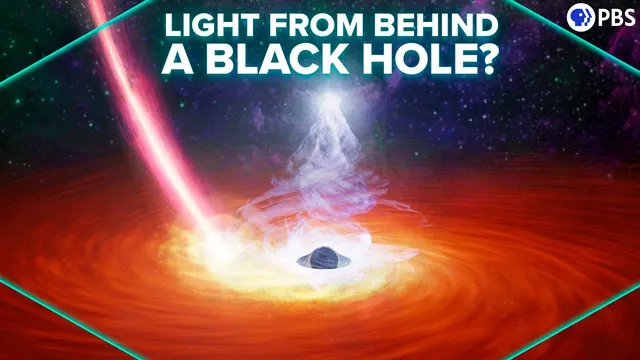
First Detection of Light from Behind a Black Hole
Based on PBS Space Time's video on YouTube. If you like this content, support the original creators by watching, liking and subscribing to their content.
A Nature study reported the first clear detection of light arriving from behind a black hole by using flare timing and spectral echoes.
Briefing
A Nature study reported the first clear detection of light arriving from behind a black hole—an observational breakthrough that turns a long-standing “can’t see past the event horizon” problem into a measurable signal. The result hinges on tracking how X-rays and an iron emission line echo after a flare near a nearby supermassive black hole, using timing differences across the line’s blue and red wings to infer the geometry and motion of gas in the system.
The work centers on I Zwicky 1, a Seyfert galaxy about 100 million light-years away, where a black hole is surrounded by an accretion disk and additional structures that shape the radiation. Close to the hole, an X-ray corona—an intense region of high-energy electrons produced after extreme ultraviolet and X-ray radiation strip atoms of nearly all electrons—boosts disk photons up into X-ray energies. Meanwhile, fast winds of matter flow outward; at these depths only heavy elements such as iron can retain electrons, making the iron K-alpha line a key tracer.
The flare sequence is crucial. When the X-ray corona brightened, the light spread in multiple directions: some photons traveled directly toward Earth, others reflected off the accretion disk, and some reflected off the disk on the far side of the black hole. A portion of that far-side light was then captured by the black hole’s gravity and swung back toward the observer, effectively producing a gravitationally lensed “behind-the-hole” pathway. The timing of the flare’s distinct phases revealed these separate routes.
Even more telling was how the iron K-alpha line responded. Because the gas producing the line is moving at high speeds, the line is broadened and split into a blue-shifted side (gas moving toward the observer) and a red-shifted side (gas moving away). The study found that the blue wing varied before the red wing. In reverberation mapping terms, that ordering points to an outflow component rather than simple inflow: the near-side and far-side light-travel delays, combined with the Doppler shifts from gas motion, determine which part of the line reacts first.
The broader physical picture emerging from these timing signatures is an expanding, iron-laced vortex or wind that narrowly escapes being swallowed. The analysis also includes additional constraints—such as estimating the black hole’s mass (about 30 million solar masses) and testing aspects of general relativity—showing that the “behind-the-black-hole” detection is not just a novelty, but a tool for probing strong gravity and the kinematics of matter near event horizons.
The transcript frames this as a payoff of decades-old techniques, especially reverberation mapping, which reconstructs the structure around black holes by watching how spectra change after flares. With next-generation observatories like the Vera Rubin Observatory expected to expand monitoring capabilities, the approach could scale from individual targets to large samples, making it easier to map how gas falls in, gets lifted by radiation, and then streams outward in the most extreme environments in the universe.
Cornell Notes
The study reports the first convincing detection of light that took a path from behind a black hole, inferred from how X-ray and iron-line emission echoed after a flare. In I Zwicky 1, an X-ray corona brightened, and photons followed multiple routes: direct travel to Earth, reflection off the accretion disk, and a gravitationally lensed path that effectively samples the far side. Reverberation mapping of the iron K-alpha line showed the blue wing varying before the red wing, a timing pattern consistent with outflow rather than pure inflow. The result also supports broader modeling of the system, including black hole mass estimates and tests of general relativity, turning strong-gravity geometry into measurable spectral timing.
How does reverberation mapping turn spectral flickering into a map of the region near a black hole?
Why do the blue and red wings of the iron K-alpha line matter for diagnosing gas motion?
What physical structures in I Zwicky 1 enable the “behind-the-black-hole” signal to be detected?
How does gravitational lensing create evidence for light coming from behind the black hole?
What motion scenarios can produce similar broad emission lines, and how does reverberation mapping break the degeneracy?
Why is the iron K-alpha line especially useful in the innermost regions near a supermassive black hole?
Review Questions
- What specific timing relationship between the blue and red wings of the iron K-alpha line would you expect for inflow versus outflow, and why?
- Describe the three photon paths after the X-ray corona flare and explain how their different travel times make “behind-the-black-hole” light detectable.
- How does combining Doppler information (line profile) with reverberation delays (time variability) allow constraints on the structure near a black hole?
Key Points
- 1
A Nature study reported the first clear detection of light arriving from behind a black hole by using flare timing and spectral echoes.
- 2
The analysis focuses on I Zwicky 1, a Seyfert galaxy roughly 100 million light-years away, where a supermassive black hole powers an accretion disk and an X-ray corona.
- 3
The X-ray corona flare sends photons along multiple routes, including a gravitationally lensed path that effectively samples the far side of the system.
- 4
Reverberation mapping of the iron K-alpha line showed the blue wing varying before the red wing, supporting an outflow component rather than pure inflow.
- 5
The iron K-alpha line works as a tracer because intense radiation strips most elements of electrons, leaving heavy elements like iron as the main emitters in the innermost region.
- 6
The study also used the data to estimate the black hole mass (about 30 million solar masses) and to test aspects of general relativity.
- 7
The approach scales from detailed physics of individual systems toward larger monitoring efforts as next-generation observatories come online.